51 honest answers · updated 2026
Everything you wanted to ask about a Morocco trip.
Plain answers on visas, payment, safety, vehicles, tipping, best seasons and how WhatsApp support works during your trip.
Bespoke & private journeys
How does Morocco Honeymoons design a bespoke itinerary — and how many revisions do I get?
After your initial enquiry we spend time understanding your travel style, pace, accommodation preferences and any non-negotiables before drafting a first proposal. That proposal arrives as a detailed day-by-day document with route logic, property rationale and a fully itemised cost — not a generic template. We revise without limit until the plan feels precisely right; most couples reach a final version after two or three exchanges. A 30% deposit confirms your booking; cancellation and refunds follow Serenity Morocco Tours' booking terms (https://www.serenitymoroccotours.com/booking-terms).
Do you ever combine our vehicle, guide or camp with other guests?
Never. Every element of a Morocco Honeymoons journey — airport transfers, touring vehicles, guides, desert camps and private riads — is reserved exclusively for your party. You will not share a minibus, a camp dining tent or a guided medina walk with strangers. This extends to camel treks and balloon flights booked through us: we reserve the allocation for your group alone wherever the operator permits it.
What is the difference between a riad, a palace hotel and a luxury desert camp — and how do you choose which suits us?
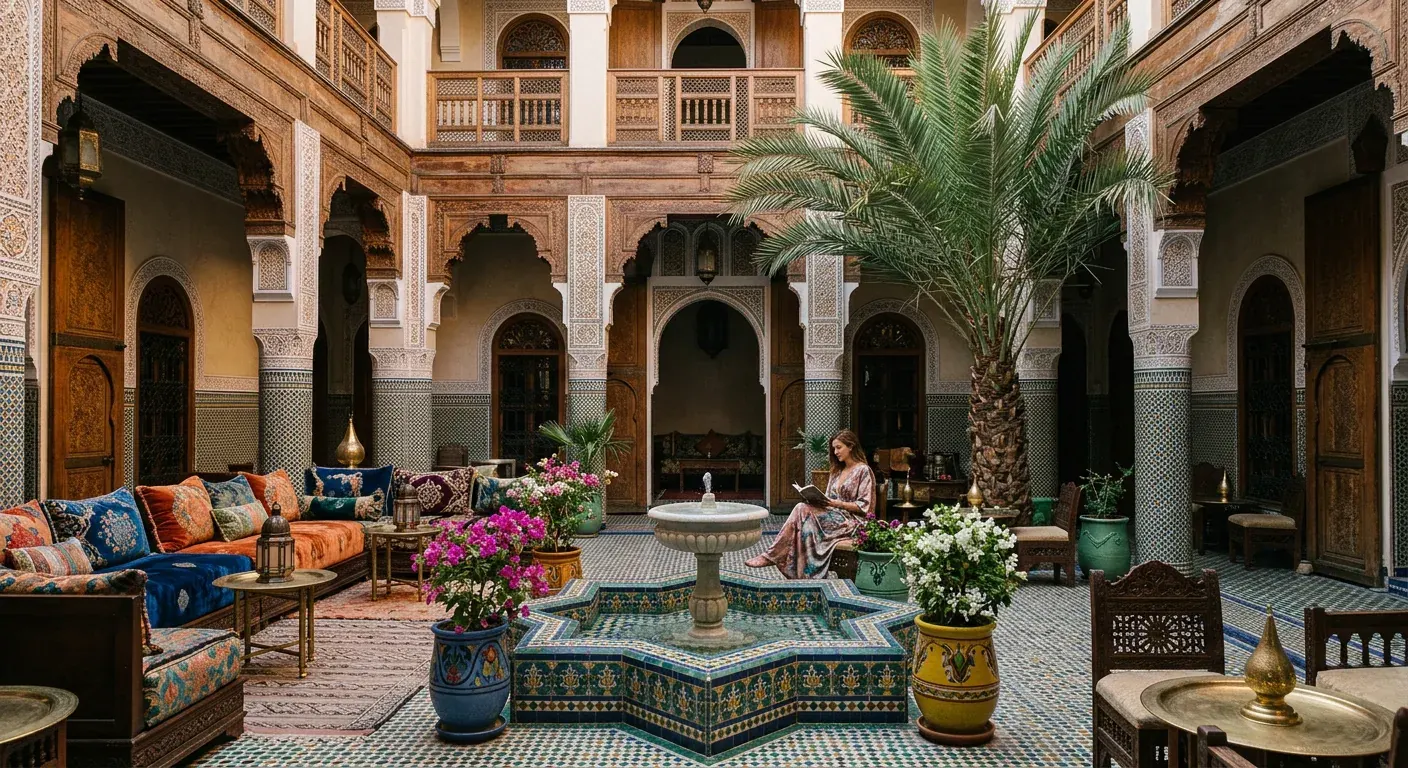
A riad is a privately owned townhouse, typically eight to twenty rooms, built around a courtyard garden; the best combine intimate scale with museum-quality craftsmanship and highly personal service. A palace or grand hotel (think La Mamounia or Amanjena) offers full resort amenities — spa, multiple restaurants, a large pool — alongside Moroccan grandeur; suited to guests who want both immersion and resort comfort in one address. A luxury desert camp provides ensuite canvas pavilions with proper beds, en-suite bathrooms, solar lighting and starlit dining — distinct from a bivouac or shared camp. We match accommodation to how you actually want to spend your time each day: active early risers, late-rising romantics and wellness-focused couples often arrive at different answers.
How do you accommodate dietary requirements and accessibility needs on a private trip?
We document every dietary requirement at enquiry — coeliac, vegan, severe allergy, religious restriction — and brief every kitchen and camp ahead of arrival, in writing. Private tours mean menus can be adapted without compromise; we do not depend on a fixed group menu. For accessibility, we assess each property and route against your specific needs: step-free riad access, adapted bathroom fittings and low-gradient walking routes are all available with advance planning. Please share all requirements early so we can guarantee, rather than merely attempt, the right arrangements.
What honeymoon touches can be arranged, and how should I frame the request?
We can arrange a thoughtful range of private details: a rose-petal turndown and candles on arrival, a private rooftop dinner under the stars, a champagne breakfast in your riad courtyard, a hammam session reserved exclusively for two, a dawn camel ride before the public camps wake, and a silver tray of Moroccan pastries and fresh mint tea waiting after a long driving day. These are arranged in advance and confirmed with each property; they are not improvised. Please simply note your preferences — and any details you would like to surprise a partner with — when you make your enquiry, and we will handle the rest discreetly.
How is payment structured for a bespoke booking, and what happens if I need to cancel?
A 30% deposit confirms your booking; cancellation and refunds follow Serenity Morocco Tours' booking terms (https://www.serenitymoroccotours.com/booking-terms). Every payment is issued with a formal invoice and a written service agreement detailing every included item. We strongly recommend travel insurance that covers cancellation for any reason — we include a shortlist of providers with your confirmation documents.
Booking & payment
How do I book a Morocco trip with Morocco Honeymoons?
Send a few lines through our contact form or WhatsApp — your dates, group size and what you love. We confirm by email within 24 hours, with a written itinerary, route options and an itemised quote. A 30% deposit confirms your booking; cancellation and refunds follow Serenity Morocco Tours' booking terms (https://www.serenitymoroccotours.com/booking-terms).
What payment methods do you accept?
A 30% deposit confirms your booking; cancellation and refunds follow Serenity Morocco Tours' booking terms (https://www.serenitymoroccotours.com/booking-terms). Payment methods are set out in those terms, and every payment is invoiced.
Is my deposit refundable?
A 30% deposit confirms your booking; cancellation and refunds follow Serenity Morocco Tours' booking terms (https://www.serenitymoroccotours.com/booking-terms).
Do you offer payment plans?
A 30% deposit confirms your booking; cancellation and refunds follow Serenity Morocco Tours' booking terms (https://www.serenitymoroccotours.com/booking-terms).
Can I book less than a week in advance?
Often yes. Airport transfers and day tours can often be arranged at short notice. Multi-day private itineraries need at least 72 hours so we can arrange drivers, riads and guides. During high season (March–May, September–November) more lead time is better.
Will I receive a written contract?
Always. After your deposit clears you receive a PDF service agreement listing every included service and price. Nothing is left to verbal agreement; cancellation and refunds follow Serenity Morocco Tours' booking terms.
Visas & entry
Do I need a visa to visit Morocco?
Most travellers — EU, UK, US, Canada, Australia, New Zealand, Japan and GCC nationals — receive a 90-day visa-free entry stamp on arrival at any international airport or land border. Your passport must be valid for at least six months beyond your entry date. Check the official Moroccan Ministry of Foreign Affairs list around 60 days before travel, as the list does change.
Which nationalities need a visa in advance?
Passport holders from many African, South Asian and some Latin American countries require a visa before arriving. Applications go through the nearest Moroccan consulate and typically take 10–15 business days. We can provide a formal operator invitation letter to support your application — just ask when enquiring.
Is there a departure tax or airport fee?
No separate departure tax is levied on tourists. All airport fees are bundled into your airline ticket. Some riads include the city tourist tax (taxe de séjour, roughly €1–4 per room per night) in their rate; others charge it at checkout — we flag this in your itinerary.
Can I cross from Morocco into Spain (Ceuta / Melilla)?
Yes. Both Ceuta and Melilla are Spanish enclaves with open land borders. EU/Schengen nationals cross freely; other nationalities follow normal Schengen rules. Ferries run from Tangier and Nador to mainland Spain as well. We can arrange overland transfers to any border point.
Money & costs
What currency does Morocco use?
The Moroccan Dirham (MAD, written as دره). Notes come in 20, 50, 100 and 200 MAD; coins in 1, 2, 5 and 10 MAD. Dirhams are not internationally traded, so you exchange on arrival. Approximate guidance: 1 USD ≈ 10 MAD, 1 EUR ≈ 10.8 MAD, 1 GBP ≈ 12.7 MAD (rates fluctuate — check a live source before travel).
Where is the best place to exchange money?
Bank branches and official exchange booths (marked 'Bureau de Change') at the airport or city centre offer reliable rates with no commission. Avoid touts at medina gates — their rates look favourable but often include sleight-of-hand counting. ATMs on the Visa/Mastercard network (Banque Populaire, Attijariwafa, CIH) dispense dirhams at competitive interbank rates; notify your bank before travelling.
How much should I budget per day?
Budget travellers get by on $50–70/day (cheap riads, street food, local buses). Mid-range comfort — a decent riad, sit-down restaurants, private transfers — runs $150–250/day. Luxury is whatever you wish: a five-star riad and tasting menus can reach $500+/day. Our private tours sit comfortably in the mid-range to luxury band, with accommodation to match your preference.
Are tips expected in Morocco?
Tips are appreciated but never compulsory. Common norms: drivers $10–15 per day, half-day guides $20, full-day guides $30–40, riad staff $2–5 per night, porters $1–2 per bag, restaurant servers 10–15% if service isn't included. We never bundle tips into our pricing so you stay in control.
Is haggling normal in the souks?
In the medina souks, yes — opening prices are rarely final. A polite counter-offer of 40–50% of the first quote and a friendly negotiation is culturally expected and enjoyed. Fixed-price shops exist (look for a price tag). Groceries, pharmacies, cafés and supermarkets charge set prices. Never feel pressured — walking away is always an option.
Safety & health
Is Morocco safe for tourists?
Yes. Morocco is one of the most stable and tourist-friendly countries in North Africa, with a well-established tourism industry and a significant police presence in tourist areas. As with any destination, apply standard urban common sense: keep valuables out of sight, use authorised guides inside medinas, and take licensed taxis. The UK, US and EU governments all rate Morocco as a 'normal precautions' destination for most regions.
Is Morocco safe for solo female travellers?
Yes, with awareness of local norms. Before your trip we brief your driver, choose female-friendly riads with secure entrances, and give you a WhatsApp line for support during your trip. Wearing a light scarf over the shoulders in medinas and covering knees reduces unwanted attention. Hammam visits, cooking classes and souks shopping can be arranged as female-only outings on request.
Do I need vaccinations before visiting Morocco?
No vaccinations are legally required for entry from most countries. We recommend checking with your GP or a travel clinic 4–6 weeks before departure. Commonly advised boosters include Hepatitis A, Typhoid and Tetanus. Rabies pre-exposure is worth considering for long rural stays. Malaria risk in Morocco is negligible and prophylaxis is not typically recommended.
Can I drink the tap water?
Tap water in major cities meets WHO standards and locals drink it, but travellers' digestive systems often react to the different mineral content. We recommend bottled or filtered water for the first week, especially in rural areas and Sahara camps. Our vehicles always carry sealed water bottles.
What travel insurance do I need?
We strongly recommend comprehensive travel insurance covering: medical treatment and emergency evacuation, trip cancellation/curtailment, baggage loss, and personal liability. For desert treks, mountain hikes or helicopter experiences, confirm your policy covers 'adventure activities'. We send a list of recommended providers (with remote-area cover) in your quote. Insurance is mandatory for our trekking and desert itineraries.
Is Morocco LGBTQ+ friendly?
Same-sex relations are technically illegal under Moroccan law, though enforcement against discreet tourists is exceptionally rare. Public displays of affection — by any couple — are uncommon and best avoided. We operate non-discriminatory bookings for all travellers and can suggest accommodation with known inclusive policies. We encourage you to research the current situation from specialist travel resources before deciding.
Getting around
What kind of vehicles do you use?
Modern sedans (Mercedes E-class or equivalent) for city and airport transfers, 4×4 Land Cruisers and Prados for mountain and desert routes, and Mercedes Vito / Hyundai H1 minivans for groups up to 8. All vehicles are under 4 years old, air-conditioned, carry bottled water and have USB charging ports. For larger groups we can coordinate a convoy or minibus.
Will my driver speak English?
Yes. Every driver in our network speaks fluent English. French and Spanish are also widely available — just request at booking. For in-city guides we can also arrange German, Italian, Portuguese, Arabic and Tamazight (Berber) speakers.
How does intercity travel work?
Private chauffeured transfer is the most comfortable option — we handle all inter-city legs. Morocco also has an excellent train network (ONCF) linking Casablanca, Rabat, Fès and Marrakech, with modern double-deckers. CTM and Supratours operate luxury coaches to most cities. Domestic flights (RAM, Air Arabia Maroc) connect Marrakech, Casablanca, Agadir, Fès and Tangier.
Is driving a hire car in Morocco difficult?
Roads between major cities are generally good motorways. Mountain roads (Todra Gorge, Dades Valley, Tizi n'Tichka pass) are paved but narrow and winding; a 4×4 is recommended for off-piste routes. Traffic in medinas is chaotic and most historic centres ban cars entirely. All major international rental brands operate at airports. An International Driving Permit is recommended alongside your national licence.
How far is Marrakech from the Sahara?
Merzouga (Erg Chebbi dunes) is approximately 560 km from Marrakech via the High Atlas — about 8–9 hours by road, passing through Ouarzazate and the Draa Valley. Most travellers do it as a 2-night itinerary (Marrakech → Dades → Merzouga → Marrakech), or fly Marrakech–Errachidia (45 min) and drive the final 65 km. We recommend the overland route at least one way for the scenery.
Tours & customisation
Can I build a completely custom itinerary?
Absolutely — that is our core offering. Tell us your travel style (adventure, culture, food, wellness, photography), pace (relaxed vs packed), accommodation tier and must-sees. We design from scratch. There are no pre-set packages you must conform to; everything is bespoke.
What is the maximum group size you handle?
We regularly run private groups of 2–40 people. For 20+ guests we coordinate multiple drivers and vehicles, a dedicated group leader and a logistics manager in Marrakech. Corporate retreats, family reunions and wedding groups are all within our experience.
Do you offer day tours from Marrakech?
Yes. Popular full-day excursions from Marrakech include: Ourika Valley & Atlas villages, Ait Benhaddou Kasbah (UNESCO), Essaouira on the Atlantic coast, Ouarzazate film studios, and the High Atlas Tizi n'Tichka pass. Most depart at 8 am and return by 7–8 pm. Half-day city tours of Marrakech's medina are also available.
Can I join an existing group tour?
We specialise in private travel and do not sell shared group departures. If budget is the primary consideration, we're happy to recommend reputable group-tour operators for your route — we'd rather you have the right trip than the wrong one with us.
How does WhatsApp support during the trip work?
Once your booking is confirmed, you have a WhatsApp line to our team for the length of your trip. Lost passport, unexpected illness, flight delay, restaurant recommendation, weather change — message us and we arrange what is needed.
Can you arrange activities beyond transfers — cooking, hammam, camel ride?
Yes. We can book and escort you to: authentic hammam & rhassoul clay treatments, Moroccan cooking classes in private riads, camel treks at sunrise in the Sahara, hot-air balloon flights over Marrakech, Atlas mountain trekking, quad biking in the Agafay desert, traditional carpet and pottery workshops, and private Gnawa or Andalusian music evenings.
When to go
What is the best time of year to visit Morocco?
Spring (March–May) and autumn (September–November) are peak quality seasons: warm days, cool evenings, green Atlas landscapes and manageable crowds. Summer (June–August) is very hot inland (Marrakech can hit 40 °C) but ideal on the coast (Essaouira, Agadir). Winter (December–February) brings snow to the High Atlas (great for skiing at Oukaimeden), comfortable desert temperatures and far fewer tourists. Ramadan is a rich cultural experience but restaurant hours change — worth knowing in advance.
When are peak and off-peak seasons?
High season is Easter week, July–August and the second half of October. Prices rise around 15–20% and popular riads sell out months ahead. Off-peak is January–February and mid-June: excellent value, uncrowded souks, shorter queues at sites. We book riads on your behalf year-round and flag capacity constraints early.
What is Ramadan like for tourists?
Ramadan (dates shift each year — check an Islamic calendar) is a fascinating cultural period: the medina comes alive after sunset with iftar feasting, music and families. Daytime restaurant and café options reduce but tourist-facing establishments generally remain open. Alcohol service may be limited outside hotels. Showing respect (no eating or drinking in public during the day) is appreciated and creates goodwill.
How hot does Marrakech get in summer?
July and August average daily highs of 37–40 °C in Marrakech, occasionally touching 43 °C during heatwaves. Early mornings (before 10 am) and evenings are perfectly pleasant. We schedule desert and mountain legs for spring/autumn and adjust city touring to early mornings during summer bookings. Coastal Essaouira sits at 22–26 °C year-round thanks to Atlantic trade winds — a popular escape.
Practicalities
What should I pack for Morocco?
Light, breathable layers work year-round — mornings and evenings cool quickly even in summer. Bring a light scarf or shawl (useful in mosques, hammams and medinas), comfortable walking shoes for cobblestoned medinas, sunscreen and sunglasses. For the Sahara: a warm layer for cold desert nights, a buff or scarf to wrap against sand, and a headlamp. We send a destination-specific packing list with your confirmed itinerary.
Is Wi-Fi and phone coverage reliable?
4G coverage from Maroc Telecom, Orange and Inwi is excellent in all cities and most highways. Coverage thins in deep Sahara dunes and some high Atlas valleys. Most riads and hotels offer free Wi-Fi. Buying a local SIM (available at the airport, requires passport) costs around $5–10 for 20–30 GB data and is the cheapest option for extended stays.
What plug sockets and voltage does Morocco use?
Morocco uses Type C and Type E round two-pin European plugs at 220V/50Hz. US travellers need a plug adapter and a voltage converter for 110V devices (check your charger label — most modern phone and laptop chargers are dual-voltage and only need the adapter). UK travellers need a Type G to Type C adapter.
Can I visit mosques as a non-Muslim tourist?
The vast majority of Moroccan mosques are closed to non-Muslims. The main exceptions are the Hassan II Mosque in Casablanca (guided tours run daily except Friday morning) and a handful of rural mosques that permit entry. Mausolea and zaouias are generally non-Muslim restricted. Admiring the exteriors, tiled courtyards and mihrabs from doorways or rooftops is entirely fine and often stunning.
What should I know about photography etiquette?
In public spaces, landscapes and architecture, photography is welcome. Photographing people — especially women, market vendors and artisans — requires asking permission first; a smile and 'Sma7 liya' (excuse me) goes a long way. Some individuals ask for a small tip, which is fair. Photographing official buildings, military installations and border posts is prohibited. The Jemaa el-Fna square performers sometimes expect a coin after you photograph them.
Is Morocco suitable for children and families?
Morocco is a wonderful family destination. Children are warmly welcomed everywhere — restaurants, riads and local families are genuinely delighted by them. Family-friendly highlights include camel rides, Sahara stargazing, cooking classes, Marrakech's Majorelle Gardens, and the beaches of Essaouira. We can arrange child safety seats, family-room riads, pace adjustments and age-appropriate activities. Let us know ages when enquiring.
Sustainability & community
How does Morocco Honeymoons support local communities?
We contract drivers, guides and camp staff directly — no marketplace middlemen, so they keep more of the income. We use Berber-owned mountain guesthouses, women-run cooking workshops, and a fixed 2% of every booking funds a year-round school programme in the Ourika valley.
Are the desert camps you book eco-friendly?
We favour desert camps that use solar power, refill stations (no single-use plastic), waterless dry toilets and locally sourced food.
How do you minimise the environmental impact of your tours?
We combine legs where possible to reduce empty vehicle miles, use accommodation with responsible water policies, avoid disturbing archaeological and natural sites, and brief every guest on 'leave no trace' principles before Sahara and Atlas departures. We are working toward B Corp certification and will publish a full sustainability report in 2026.
Still have a question?
We answer every message ourselves — no bots, no call centre. We confirm by email within 24 hours.
Write to us