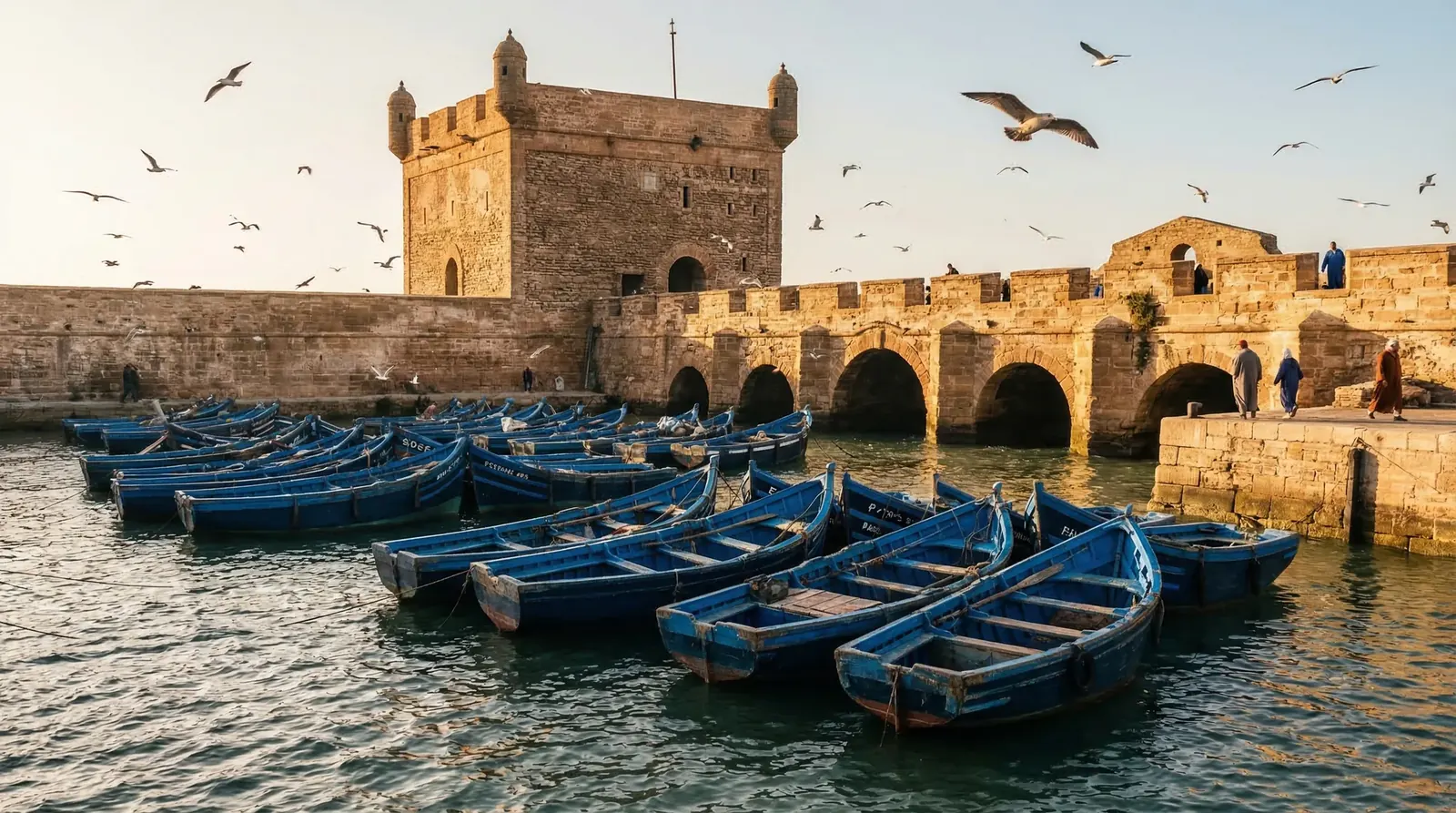
Essaouira was built to face the Atlantic. Its eighteenth-century ramparts fall sheer into the ocean; the wind — the Alizé — drifts almost constantly from the north, keeping the air fresh and the light luminous. After the glorious intensity of Marrakech, it feels like a long, slow breath out. The medina is smaller, calmer and washed in a paler palette: whitewash, blue woodwork, the soft grey of the Skala bastions — a town made for wandering hand in hand.
The ramparts and the Skala de la Ville
The sea ramparts — the Skala de la Ville — are Essaouira's signature, and the first place to drift to once your bags are settled. The platform runs the northern wall, cannon still facing the swell, with the long beach to the south and the rocky coast to the north. At sunset the light on the water turns extraordinary, and Gnaoua musicians sometimes gather here in the early evening with guembri and qraqeb. Walk the length to the harbour platform and loop back through the medina — an unhurried forty minutes that gives you the whole shape of the town.
The port and the morning catch
The working harbour sits just south of the ramparts. By morning, blue-hulled boats unload the night's haul — sea bass, bream, sole, cuttlefish, the occasional lobster — and the quayside grills will cook whatever you choose, simply and superbly. We can also arrange a private table at one of the town's finest kitchens, where the same catch arrives plated with rather more ceremony and a chilled glass to match.
A small boatyard beside the harbour still builds and mends traditional wooden vessels in a workshop open to the street. Twenty minutes watching the craftsmen is time well spent — one of the last living boat-building traditions on Morocco's Atlantic shore.
The beach: sea air, kites and long walks
The south beach runs for 20 km. The stretch beside the medina is the liveliest — horse and camel rides, kitesurfers launching from the shallows, football on the firm low-tide sand. Walk thirty minutes south and you have it almost to yourselves. Certified schools offer lessons and hire, and we can pair you with a private instructor on a quieter stretch. The experiences we weave into an Essaouira stay are always shaped to the wind forecast for your dates.
Gnaoua: the soul of Essaouira
Gnaoua music grows from the sub-Saharan communities who came to Morocco from the sixteenth century onward. Its voices — the three-stringed guembri, the metal qraqeb, layered call-and-response — build something hypnotic and intricately rhythmic. Essaouira is its spiritual heart, and each June the Gnaoua World Music Festival fills the medina with free outdoor stages and a great, joyful crowd.
Beyond the festival, Gnaoua groups play in Djemaa Moulay Hassan most evenings — sit with a tea and listen. For something more private, we can arrange an intimate session of musicians on your riad terrace, just for your party.
The medina: gentler souks
Essaouira's medina is smaller and far less pressing than Marrakech's. The artisan lanes specialise in thuya wood — a dense, fragrant burl unique to this coast, worked into boxes, frames and marquetry of exquisite precision. These are made in the workshops behind the stalls, not imported, and worth carrying home. The silversmiths of Rue Laalouj are excellent too; Essaouira's Jewish community long led the silver trade here, and the craft endures. Your guide can introduce the makers worth knowing.
Near the Bab Doukkala gate, a women's cooperative presses argan oil — culinary and cosmetic — with certified provenance from the surrounding biosphere. It is the place to buy, and a graceful private visit to arrange.
Where to stay
Stay within the medina, in a riad turned toward the ocean or folded around a courtyard. The finest restorations here keep thick walls, original tiled floors and an unforced grace. We hold a quiet shortlist with honest notes on what each suits — a couple seeking romance, a family, those who want the view above all — and can take a whole house for your party alone. Begin with our Essaouira destination page.
A word on the wind: the Alizé is real and steady. Ocean-facing rooms catch its sound and, now and then, a salt chill. If you sleep lightly or run cold, we will place you in a sheltered courtyard room. The wind is no flaw — it is the town's character — but worth arranging around.
Arriving, and when to come
A private chauffeured car from Marrakech takes two and a half hours via the A7 and the coast road, with a pause at the argan cooperative if you like. March to May and September to November are loveliest: mild days, fewer crowds and the wind at a gentle pitch. The June Gnaoua Festival draws large crowds, so we secure rooms months ahead for those attending. Summer is busy and breezy; winter is quiet and surprisingly mild on the coast compared with the interior — a serene time for a couple to escape.
Frequently asked
How far is Essaouira from Marrakech?
Essaouira lies 188 km west of Marrakech — around two and a half hours in a private chauffeured car on the A7 and then the coast road, with an argan cooperative stop along the way if you wish. Public buses run from Bab Doukkala in about three hours. Given the short distance, we always travel it privately, at a pace that lets the landscape become part of the day.
Is Essaouira good for kitesurfing and windsurfing?
Very much so — Essaouira's steady Atlantic trade winds (the Alizé) make it one of Africa's most reliable spots, with the long south beach at its best from March to October. Certified schools line the sand for lessons and hire. We can also arrange a private instructor and a quieter stretch of beach, so the experience feels yours rather than the crowd's.
What is Gnaoua music?
Gnaoua (or Gnawa) is a Moroccan musical and spiritual tradition born of the sub-Saharan communities brought to Morocco from the sixteenth century. It weaves the guembri (a three-stringed bass lute), metal qraqeb castanets and call-and-response chant into something hypnotic. Essaouira is its spiritual home, and each June the Gnaoua World Music Festival fills the town — we can also arrange a private evening of musicians on a riad terrace.
What are the best riads in Essaouira?
Essaouira's riad culture is intimate, the medina small and entirely walkable. We hold a quiet shortlist of restored houses where the Arabo-Andalusian architecture has been honoured rather than glossed over — some facing the ocean, some folded around a courtyard. Tell us your dates and your idea of the stay, and we will match the house, including exclusive-use buy-outs for couples.
Is Essaouira a relaxed place to spend a few days?
Wonderfully so. After Marrakech, Essaouira feels like exhaling: a compact, well-lit medina, an easy-going local population long used to visitors, and very little hustle. It is a gentle, romantic counterpoint to the cities — ideal for a slow weekend of sea air, harbour lunches and lamplit dinners.
What is argan oil and can you buy it in Essaouira?
Argan oil is pressed from the fruit of the argan tree (Argania spinosa), which grows almost only in the Souss-Massa region of southwest Morocco — used both in the kitchen, for its rich nutty depth, and in cosmetics. The land around Essaouira sits within the UNESCO argan biosphere. Buy from a women's cooperative for true provenance and fair pricing; we can arrange a private visit to one en route.
Essaouira calls
Fold a weekend on the Atlantic into your Morocco journey.
We weave Essaouira seamlessly into longer journeys — a private chauffeured transfer from Marrakech, a handpicked riad, a fine seafood lunch and a private Gnaoua evening. Two nights is our minimum; three lets you truly slow down.
Plan your Essaouira stay