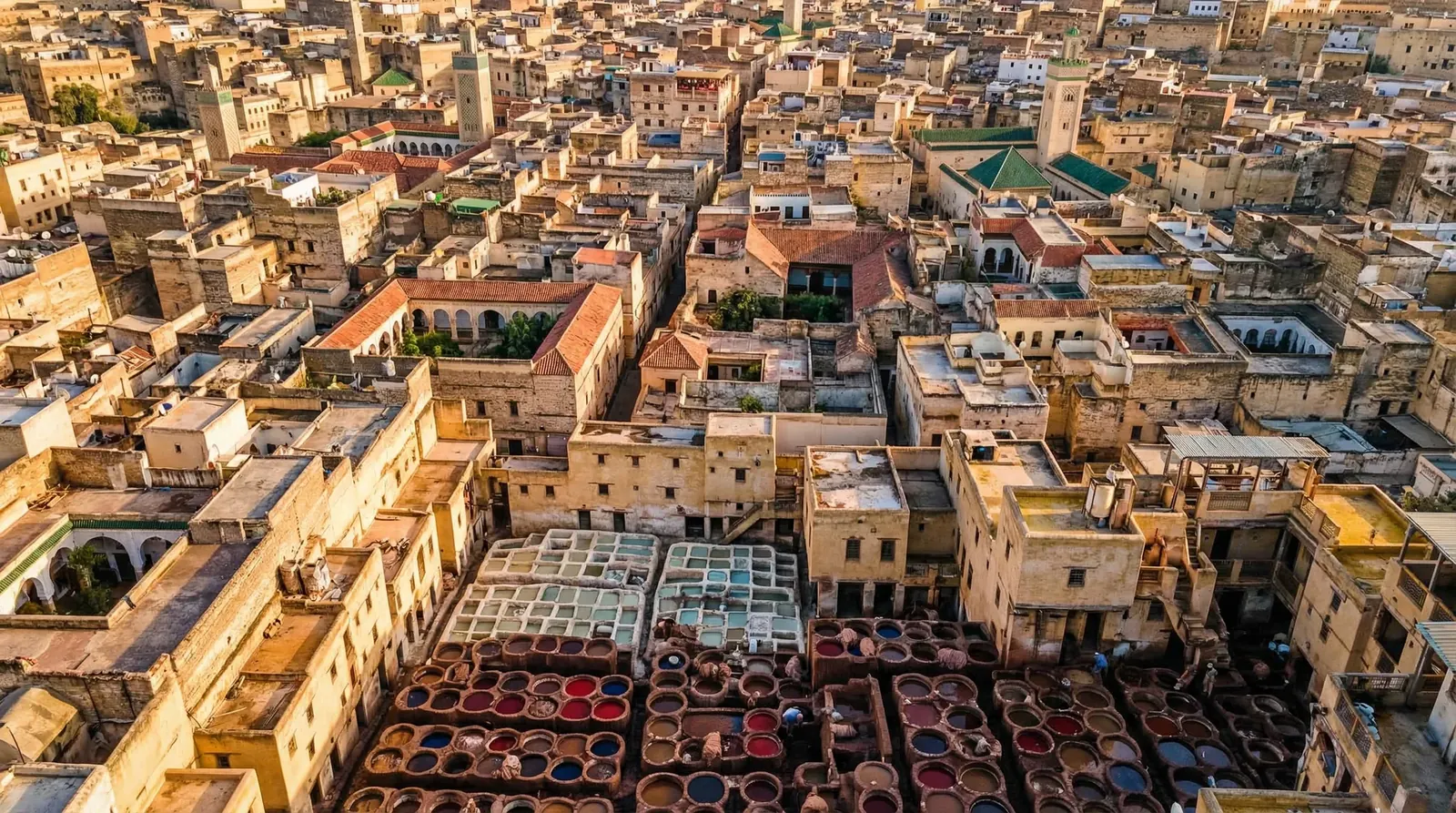
Fes el-Bali is a UNESCO World Heritage site and arguably the most intact medieval city anywhere on earth. Founded in 789 CE, it predates most European capitals. To walk it for the first time is to give yourself over to it — beautifully bewildered, endlessly delighted — and with a private guide beside you, that wonder comes without a moment of unease.
Why a private licensed guide changes everything
We say it warmly but plainly: on a first visit, travel with a licensed private guide. The medina runs to more than 9,000 lanes, many of them dead ends, and the signage is sparse by design — the city was built for those who already knew it. A licensed guide (badged by the Ministry of Tourism) offers what no map can: a graceful circuit through the highlights, entry to private ateliers and family courtyards, and the quiet authority that keeps the touts at bay. We weave one into every Fes itinerary.
The tanneries of Chouara
The Chouara tannery may be the most photographed scene in Morocco — a honeycomb of stone vats, dye and craft that has treated leather since the eleventh century. You take it in from the leather-shop terraces on the rim, a sprig of mint at your nose to soften the air. There is no obligation to buy, though the leather here is among the country's finest and fairly priced at source — and your guide can introduce the workshop worth your time.
Come before eleven for the richest light and the fullest vats; the afternoon sun flattens the colour and the work pauses. Your guide times it to perfection.
The Qarawiyyin — the world's oldest university
Founded in 859 CE by Fatima al-Fihri, the University of al-Qarawiyyin has a credible claim to being the oldest continuously operating university on earth — two centuries older than Oxford. The mosque is closed to non-Muslims, but the carved cedar doorways glimpsed from the lane, and the courtyard fountain seen through wrought-iron grilles, are among the most beautiful sights in the city. Pause here with your guide and let the geometry settle.
Beside it, the lovingly restored Nejjarine fountain and caravanserai hold a superb woodwork museum. A few minutes on its rooftop give you an aerial reading of the medina that no street-level photograph can capture.
The quiet Andalusian quarter
After a structured morning, let your guide bring you to the edge of the Andalusian quarter — the calmer, less-visited half of the medina across the river — and drift there a while. It has fewer visitors, gentler vendors, neighbourhood bakeries where locals leave unbaked dough on wooden boards for the communal oven, and the kind of lane views no app would ever route you through. A guide nearby means you wander freely, never anxiously.
When you wish to emerge, any local points you toward Bab Rcif or Bab Guissa in a moment. In Fes you may lose your bearings; you can never truly be lost.
Where to stay and what to taste
Stay within the medina, in a riad — the contrast between the narrow lane and the light-filled courtyard within is the defining Fes pleasure. We hold a shortlist of houses restored with patience rather than haste, several offered as exclusive-use buy-outs for couples. Begin with a Fes destination itinerary.
On the table, Fes is the culinary heart of Morocco. Pastilla — flaky pastry of pigeon or chicken with almonds and a dusting of sugar — is a Fassi creation; order it on a rooftop above the Bou Inania Medersa. We can also arrange a private dinner in a grand riad, or a cookery lesson with a Fassi cook. Your guide steers you to the kitchens that reward the detour and past the tourist tables on Rcif Square.
The best time to visit
March to May and September to November are ideal — mild days of 18 to 26°C, beautiful light and far fewer crowds than the European high summer. July and August can touch 40°C with little shade in the lanes. Winter (December to February) is cool and sometimes wet, yet quietly magical, with wood-smoke from the hammam chimneys and the medina at its most hushed.
If your dates are flexible and you are pairing Fes with Marrakech, we often place the warmer nights in the cooler higher-altitude south and bring you to Fes for the gentler shoulder of the journey.
Frequently asked
Do you need a guide to explore the Fes medina?
For a first visit, a private licensed guide is invaluable. The medina holds more than 9,000 lanes and few landmarks beyond the minarets. Ours navigate the tanneries, the Qarawiyyin quarter and the artisan streets in a graceful loop, opening doors to private workshops and family courtyards along the way — so the day becomes discovery rather than disorientation.
How is a private guide in Fes arranged?
We pair you with a private Fes guide for a full or half day, chosen for their knowledge and their access — the ateliers, riads and rooftop views the street-corner 'students' cannot offer. Those informal guides earn commissions from shops, not from you; ours are part of your itinerary, entirely on your side.
How much time do you need in the Fes medina?
A full day covers the essentials: the tanneries, the Bou Inania Medersa, the surrounds of the Qarawiyyin, the Nejjarine fountain and a wander through the dyers' and weavers' lanes. Two days lets you slow right down — a private cookery lesson, the quiet Andalusian quarter across the river, and the unhurried hours when the medina is loveliest.
Can you see the tanneries comfortably?
The famous Chouara tannery is viewed from the leather-shop terraces on the rim, where you are offered a sprig of mint to soften the scent. There is no obligation to buy, though the leather is among Morocco's finest and fairly priced at source. With your guide, you reach the best terrace at the best hour — and a cup of tea, graciously accepted, completes the moment.
Is Fes a relaxed place to wander?
By day the medina is calm and welcoming. The main intrusion is persistent offers of guidance from unofficial 'guides' — and travelling with a private guide ends those before they begin, since they are well known in the souk and the commission-seekers keep their distance. You are simply free to enjoy the city.
What is the best time of year to visit Fes?
March to May and September to November are ideal — mild days, beautiful light and fewer coach groups. Summer (June–August) grows very hot, often near 40°C, with little shade in the lanes. Winter is cool and occasionally wet, but deeply atmospheric, with wood-smoke rising from the hammam chimneys and the medina at its most serene.
Ready to discover Fes?
We arrange a private guide and exactly the right riad.
Every Morocco Honeymoons Fes journey includes a privately guided medina day, a riad handpicked for the quality of its restoration, and tables reserved at the kitchens worth your evenings — fine dining and family cooking alike.
Request a Fes itinerary