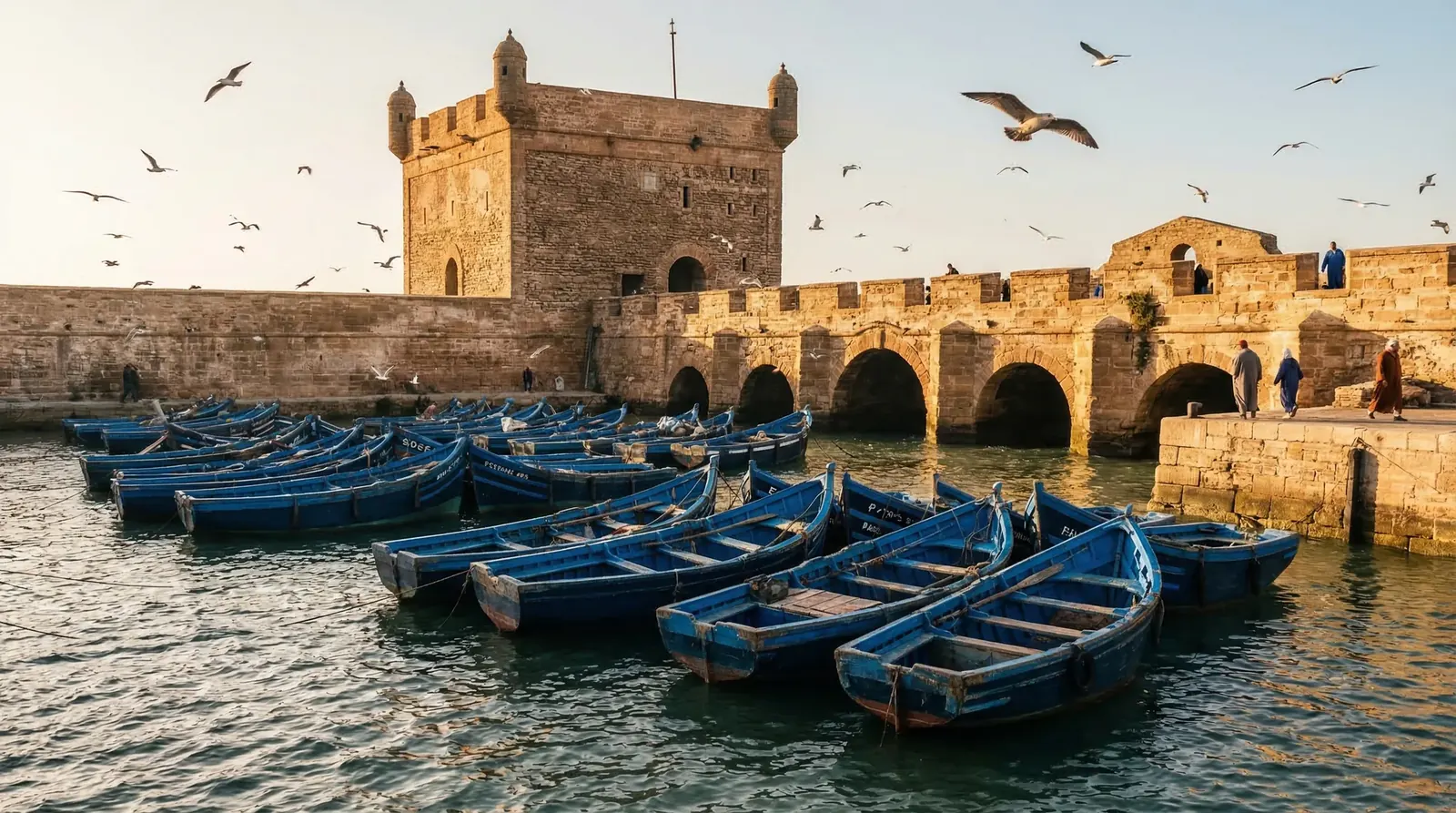
Most journeys to Morocco are drawn inland — to the medinas, the palaces, the Atlas and the dunes — and the long Atlantic coast is too easily overlooked. That is a quiet mistake. Cooled year-round by the ocean and the trade winds, the coast is where Morocco exhales: walled, breezy, arty Essaouira and its windswept beach; serene Oualidia, set around a tidal lagoon and famous for its oysters; the surf-and-wellness world of Taghazout and Tamraght in the south; and the broad resort coast around El Jadida and Mazagan, beside a Portuguese-built UNESCO town. Coastal luxury here is a different register from the desert and the imperial cities — sea-view suites and spa rituals, fresh seafood and lagoon oysters, privacy and watersports arranged in, and air that stays mild when the interior bakes. This is our honest guide to the refined coast: what each place is, what defines luxury by the Atlantic, when to go, and how to pair the cool ocean with the heat and theatre of Marrakech. The settings and seasons described reflect the general character of the coast rather than any one property; we match the place, the stay and the pace to your dates and party, and confirm every detail before you commit.
In this guide
- 01Why the Atlantic coast — the cool counterpoint
- 02Essaouira — the breezy, walled, arty port
- 03Oualidia — the serene oyster lagoon
- 04Taghazout & Tamraght — surf-luxury and wellness
- 05El Jadida & Mazagan — the resort coast and a Portuguese UNESCO town
- 06What defines coastal luxury here
- 07When to go — the cool coast through the year
- 08Pairing the coast with Marrakech and a wider journey
- 09Frequently asked
Why the Atlantic coast — the cool counterpoint
Morocco's Atlantic coast runs for hundreds of kilometres, and its defining quality is the ocean itself. The cold Canary Current and the steady trade winds keep the whole seaboard markedly cooler and fresher than the interior — so while Marrakech, Fes and the south can swelter past 40°C in high summer, the coast stays temperate, breezy and comfortable. That single fact reshapes how the coast feels: it is Morocco's natural refuge from the heat, a place of long beach walks, open horizons and air that moves. For a journey that otherwise leans into the intensity of the medinas and the stillness of the dunes, the coast is the cool counterpoint — the chapter where the pace drops and the light turns silver over the water.
It is also a different aesthetic. Where the imperial cities turn inward around courtyards and the desert is all vastness and silence, the coast is whitewashed walls and blue shutters, working fishing ports, ramparts above the surf, and a relaxed, slightly bohemian ease — especially in Essaouira, long beloved of artists and musicians. The luxury here is less about gilded palace-riads and more about sea-view calm: a suite facing the Atlantic, a spa after a windy walk, a plate of fish landed that morning. It rewards travellers who want their Morocco to breathe.
- Cooled year-round by the cold current and trade winds — temperate and breezy when the interior bakes past 40°C.
- Morocco's natural escape from the heat — long beach walks, open horizons and fresh, moving air.
- A relaxed, slightly bohemian aesthetic — whitewashed walls, fishing ports, ramparts above the surf.
- Coastal luxury is about sea-view calm, spa and fresh seafood rather than gilded palace-riads.
Essaouira — the breezy, walled, arty port
Essaouira is the coast's best-known escape and, for many, the easiest to love. A walled eighteenth-century port roughly two and a half hours by road west of Marrakech, it wears its history lightly: ochre ramparts and sea-bastions above the Atlantic, a compact, UNESCO-listed medina of whitewashed houses and blue shutters, a busy working fishing harbour where the catch comes in, and a wide, windswept beach stretching south. It is smaller, calmer and more bohemian than Marrakech — long a haven for artists, painters and musicians, and home to the Gnaoua World Music Festival each June. The wind, which is near-constant, keeps it cool and gives the town its character; it is a bolt-hole, not a sunbathing resort.
For a refined stay, Essaouira's appeal is the boutique riads and sea-view suites set within or just beyond the ramparts, the easy rhythm of medina galleries and rooftop cafés, and dinner built around grilled fish and seafood straight off the boats. Days here are unhurried: a walk along the ramparts and the long beach, an hour among the woodworkers and galleries, an afternoon hammam, then the catch at sunset. The same wind that cools the town makes it one of Morocco's premier spots for kitesurfing and windsurfing, easily arranged for those who want it. It is the ideal decompression after the heat and intensity of the city or the desert.
- A walled, UNESCO-listed port roughly 2.5 hours west of Marrakech — ramparts, a fishing harbour and a long beach.
- Smaller, calmer and more bohemian than Marrakech — an artists' and musicians' town (the Gnaoua festival each June).
- Boutique riads and sea-view suites, medina galleries, rooftop cafés and grilled fish straight off the boats.
- Near-constant wind keeps it cool and makes it a top kitesurf and windsurf spot — a bolt-hole, not a sun-lounger resort.
Oualidia — the serene oyster lagoon
If Essaouira is the coast's lively port, Oualidia is its quiet, chic secret. Set on a sheltered tidal lagoon partway between El Jadida and Safi, it is a small, low-key seaside town that has long carried a royal-holiday association — a place historically favoured as a discreet summer retreat. The lagoon is the whole point: a calm, protected stretch of water, separated from the open Atlantic by a sandbar, that makes for gentle, safe swimming away from the surf, and that nurtures the oyster beds for which Oualidia is famous across Morocco. Fresh oysters and seafood, eaten beside the water they came from, are the town's defining pleasure.
This is a retreat in the truest sense — serene, understated and unhurried, with little of the bustle of the bigger coastal towns. Beyond the lagoon swimming and the oysters, it is known for its birdlife: the wetlands and lagoon draw flamingos and migratory birds, and quiet boat trips and walks reward anyone who slows down to look. The refined stays here trade on calm and privacy rather than scene — sea- and lagoon-view rooms, a spa, a terrace over the water, and a table of just-shucked oysters. For travellers who want the coast at its most peaceful, Oualidia is the choice.
- A serene tidal-lagoon town with a long, discreet royal-holiday association — understated and unhurried.
- Calm, protected lagoon swimming behind a sandbar — gentle water away from the open-Atlantic surf.
- Famous across Morocco for its oysters — fresh oysters and seafood eaten beside the lagoon are the defining pleasure.
- Rich birdlife — flamingos and migratory birds on the wetlands, with quiet boat trips and walks.
Taghazout & Tamraght — surf-luxury and wellness
Further south, near Agadir and within easy reach of its airport, the once-sleepy fishing village of Taghazout and neighbouring Tamraght have become Morocco's capital of surf and wellness. This stretch of coast is blessed with consistent Atlantic swells and a string of celebrated point breaks, and around them has grown a relaxed, design-led world of boutique surf lodges, yoga retreats and wellness houses. It is warmer and sunnier than the coast further north, and the mood is laid-back and barefoot rather than grand — surf in the morning, yoga and a smoothie after, a spa treatment and a sundowner over the breaks.
The luxury here is contemporary and wellness-driven: stylish, low-rise design lodges built into the hillside above the beach, a strong yoga, surf-coaching and retreat culture, and a calm, healthy rhythm of sea, sun and movement. It suits travellers who want their coastal days active and their evenings simple — and it pairs naturally with Agadir's broad beaches and airport for an easy in-and-out. As a region of independent lodges and retreats, the offer varies a great deal from place to place, so the right fit depends on whether you want serious surf, a gentle wellness reset, or simply a stylish base by warm, surf-fed water.
- Taghazout and Tamraght, near Agadir — Morocco's surf-and-wellness coast, with consistent Atlantic point breaks.
- Design-led surf lodges, yoga retreats and wellness houses — laid-back and barefoot rather than grand.
- Warmer and sunnier than the northern coast; a healthy rhythm of surf, yoga, spa and sundowners.
- Easy access via Agadir's airport and beaches — a stylish, active base by warm, surf-fed water.
El Jadida & Mazagan — the resort coast and a Portuguese UNESCO town
North toward Casablanca, the coast takes a broader, more developed form around El Jadida. The town itself is built around the Cité Portugaise — the compact, UNESCO-listed Portuguese fortified town of Mazagan, with its sea ramparts, ramparts-top walks and the remarkable vaulted, water-mirrored Portuguese Cistern. Beside it stretches a long resort coast, anchored by the large-scale Mazagan development, which gathers a sizeable beach resort, a championship golf course and broad sands into one place. This is a different proposition from the boutique intimacy of Essaouira or the seclusion of Oualidia — bigger, more facility-driven, geared to families, golf and beach days.
For travellers who want resort scale with their coast — generous pools and beach, golf, kids' facilities and the easy logistics of a single large property — this stretch delivers, and its proximity to Casablanca makes it an easy add-on at the start or end of a trip. Paired with a wander through the atmospheric Portuguese citadel and its cistern, it offers a coast day with a real historical anchor. As with everywhere on the coast, the character of a stay depends entirely on which property you choose; we match the resort or the boutique alternative to what you actually want from your days by the sea.
- El Jadida is built around the Cité Portugaise (Mazagan) — a UNESCO Portuguese fortified town with sea ramparts and a famous vaulted cistern.
- A broad resort coast nearby — large-scale beach resort, championship golf and wide sands.
- Bigger and more facility-driven than Essaouira or Oualidia — geared to families, golf and beach days.
- Close to Casablanca, so an easy start- or end-of-trip add-on with a genuine historical anchor.
What defines coastal luxury here
Luxury on the Atlantic coast is defined less by grandeur than by setting and ease. The first thing it trades on is the view and the air — a suite or terrace facing the ocean or a lagoon, the sound and movement of the sea, and the temperate, breezy climate that makes the coast a relief rather than an endurance. Around that, the pleasures are simple and well done: a spa and hammam after a windy walk, privacy and calm away from the crowds, and dining built on the sea — grilled line-caught fish and seafood in Essaouira, just-shucked oysters in Oualidia, eaten as close to the water as possible. It is a register of refined simplicity rather than gilded excess.
The other half of the coast's appeal is what can be arranged into it. Watersports are a natural fit and easily organised at the right base — kitesurfing and windsurfing on Essaouira's wind, surfing and surf-coaching at Taghazout, gentle lagoon swimming and boat trips at Oualidia, golf along the resort coast. Spa and wellness run through all of it, and a private chef, a seafood-market visit or a sunset sail can be woven in. Because the coast is a patchwork of independent boutique riads, design lodges and large resorts rather than a single style, the facilities and feel vary widely from place to place — so it is worth confirming exactly what a given property offers (sea views, spa, pool, dining, watersports access) rather than assuming. We match the base to the experience you want.
- Sea- or lagoon-view suites and terraces, and the temperate, breezy climate, are the heart of coastal luxury.
- Spa and hammam, privacy and calm, and seafood dining — grilled fish in Essaouira, oysters in Oualidia.
- Watersports arranged in — kitesurf and windsurf at Essaouira, surf at Taghazout, lagoon swimming at Oualidia, golf on the resort coast.
- Facilities vary widely across boutique riads, design lodges and resorts — confirm what a specific property offers.
When to go — the cool coast through the year
The Atlantic coast is mild and welcoming for much of the year, and its great seasonal trick is to be at its best precisely when the interior is at its worst. Through high summer (June to August), while Marrakech, Fes and the Sahara turn punishing, the coast stays temperate and breezy — making it Morocco's summer escape, the place to put the beach-and-spa chapter of a trip. Spring (March to May) and autumn (September to October) are lovely and settled across the whole coast, with warm, comfortable days and a sea that holds its warmth into the autumn; these shoulder seasons are arguably the all-round sweet spot.
The crucial caveat is the wind, and Essaouira in particular. The same near-constant breeze that keeps Essaouira cool and makes it a world-class kitesurf and windsurf spot also means it is rarely a still, sunbathing kind of beach — wonderful if you want movement and watersports, less so if you picture lying motionless on hot sand. For calmer water, Oualidia's sheltered lagoon and the more protected southern beaches around Taghazout are the gentler choice. Winter (November to February) is cooler and can be grey or wet, though often mild and quiet, and the surf coast keeps its appeal year-round. We match the stretch of coast and the dates to whether you want wind and watersports or warm, sheltered calm — and confirm the seasonal character before you commit.
- At its best when the interior bakes — high summer (Jun–Aug) is the coast's moment as Morocco's heat escape.
- Spring and autumn are settled and warm across the coast, with a sea that holds its warmth into autumn — the all-round sweet spot.
- Essaouira is windy by nature — superb for kitesurf and windsurf, less so for still sunbathing.
- For calm water, choose Oualidia's sheltered lagoon or the more protected southern beaches; winter is cooler and quieter.
Pairing the coast with Marrakech and a wider journey
The coast is at its best not as a whole holiday but as the cooling, decompressing counterpoint to a richer inland trip — and Essaouira makes this easy. At roughly two and a half hours by road west of Marrakech, it is the natural coastal finish to a city-and-desert journey: a few days of medina, palaces, souks and rooftop dinners, then a transfer to the Atlantic to slow down among the ramparts, the galleries and the grilled fish before flying home. The contrast — the heat and theatre of Marrakech against the breezy calm of the coast — is one of the most satisfying rhythms a Morocco itinerary can have, and the classic shape is to end gently by the sea after the intensity of the interior.
The other coastal towns slot in according to where a trip begins or ends. Oualidia and El Jadida sit on the road between Marrakech and Casablanca, making either a graceful pause or final night before a flight from Casablanca. Taghazout pairs with Agadir and its airport for a self-contained surf-and-wellness escape, easily reached and easily left. A common, well-balanced journey runs Marrakech, then the High Atlas or the Sahara, then a coastal finish at Essaouira or Oualidia — city, mountain or desert, and sea, in one unhurried loop. We sequence the legs, transfers and drive times so the coast lands where it does most good, as the calm close to a fuller trip, and confirm the practicalities of each leg before you commit.
- Essaouira is roughly 2.5 hours west of Marrakech — the natural coastal finish to a city-and-desert journey.
- The contrast of Marrakech's heat and theatre against the breezy coast is one of the trip's most satisfying rhythms.
- Oualidia and El Jadida sit on the Marrakech–Casablanca road; Taghazout pairs with Agadir's airport.
- A classic loop runs city, then mountains or desert, then a coastal finish — sequenced so the coast lands as the calm close.
Frequently asked
Where is the best luxury coastal escape in Morocco?
It depends on the mood you want. Essaouira — a walled, arty UNESCO port about 2.5 hours west of Marrakech — is the best-known, with boutique riads, sea-view suites, grilled-fish dining and a breezy, bohemian ease; it is the natural coastal finish to a city-and-desert trip. Oualidia, a serene tidal-lagoon town famous for oysters, is the choice for quiet, private calm and gentle lagoon swimming. Taghazout, near Agadir, is the surf-and-wellness coast of design lodges and yoga retreats. El Jadida and the Mazagan resort coast suit families, golf and beach days. We match the place to what you want from your days by the sea.
Is the Moroccan coast cooler than Marrakech?
Yes, markedly. The cold Atlantic current and steady trade winds keep the whole coast temperate and breezy year-round, so while Marrakech, Fes and the Sahara can pass 40°C in high summer, the coast stays comfortable. That is exactly why the coast is Morocco's natural summer escape and the ideal cool counterpoint to a hot inland trip — a place for beach walks and sea air when the interior is at its most punishing.
Why is Oualidia known for oysters?
Oualidia sits on a sheltered tidal lagoon — a calm stretch of water separated from the open Atlantic by a sandbar — and these protected, nutrient-rich waters nurture oyster beds that have made the town famous for oysters across Morocco. Fresh oysters and seafood, eaten beside the lagoon they came from, are the defining pleasure of a stay. The same calm lagoon also gives gentle, safe swimming away from the surf and draws flamingos and migratory birds to the surrounding wetlands.
Is Essaouira too windy for a beach holiday?
Essaouira is genuinely windy — the near-constant breeze is its defining feature, which keeps the town cool and makes it one of Morocco's top kitesurf and windsurf spots. That is wonderful if you want movement and watersports, but it means it is rarely a still, sunbathing beach. If you picture lying motionless on hot sand, the sheltered lagoon at Oualidia or the more protected southern beaches around Taghazout are calmer. Essaouira's real pleasures are the ramparts, the medina galleries, the seafood and the breezy beach walks rather than static sunbathing.
When is the best time to visit the Moroccan coast?
The coast is mild for much of the year and is at its best precisely when the interior bakes: high summer (June–August) is its moment as Morocco's heat escape. Spring (March–May) and autumn (September–October) are settled and warm across the whole coast, with a sea that holds its warmth into autumn — arguably the all-round sweet spot. Winter (November–February) is cooler and can be grey or wet, though often mild and quiet, while the surf coast keeps its appeal year-round. Bear in mind Essaouira is windy in every season.
How do I combine the coast with the rest of Morocco?
The coast works best as the cooling finish to a richer inland trip rather than the whole holiday. Essaouira, about 2.5 hours west of Marrakech, is the classic coastal end to a city-and-desert journey — slow down by the Atlantic after the medinas and the dunes. Oualidia and El Jadida sit on the Marrakech–Casablanca road, making a graceful pause or final night before a Casablanca flight, while Taghazout pairs with Agadir's airport for a self-contained surf-and-wellness escape. A well-balanced loop runs Marrakech, then the Atlas or the Sahara, then a coastal finish, with the sea as the calm close. We sequence the transfers and pace to suit.
Planning a trip?
Let our team handle the details.
Tell us your dates and style and we'll send a written itinerary and a transparent quote. We confirm by email within 24 hours.
Request an itineraryKeep reading
Planning
Things to Do in Essaouira: The Essential Guide
Essaouira is Morocco's elegant Atlantic counterpoint to Marrakech — a fortified white-and-blue port city of ramparts, a working harbour, superb seafood, beautifully restored riads and a calm, liveable medina. Three hours from Marrakech and a world apart in mood, it is the perfect coastal finish to a luxury journey or a honeymoon.
Planning
Best Beaches in Morocco
Morocco has over 3,000 km of Atlantic and Mediterranean coastline — from the windswept ramparts of Essaouira to the oyster lagoon of Oualidia, the sheltered bays of Agadir, the surf points of Taghazout and the quiet coves of the north. For a luxury coastal escape or a refined beach finish to a journey, here is where to go and when.
Planning
Surfing in Morocco: Taghazout, Agadir & Imsouane
Morocco's Atlantic coast offers consistent surf from September to April, warm winters and a relaxed surf culture centred on Taghazout — and these days a boutique side too, with design-led surf villas, private coaching and beachfront spa retreats alongside the long right-hand points of Anchor and Imsouane.