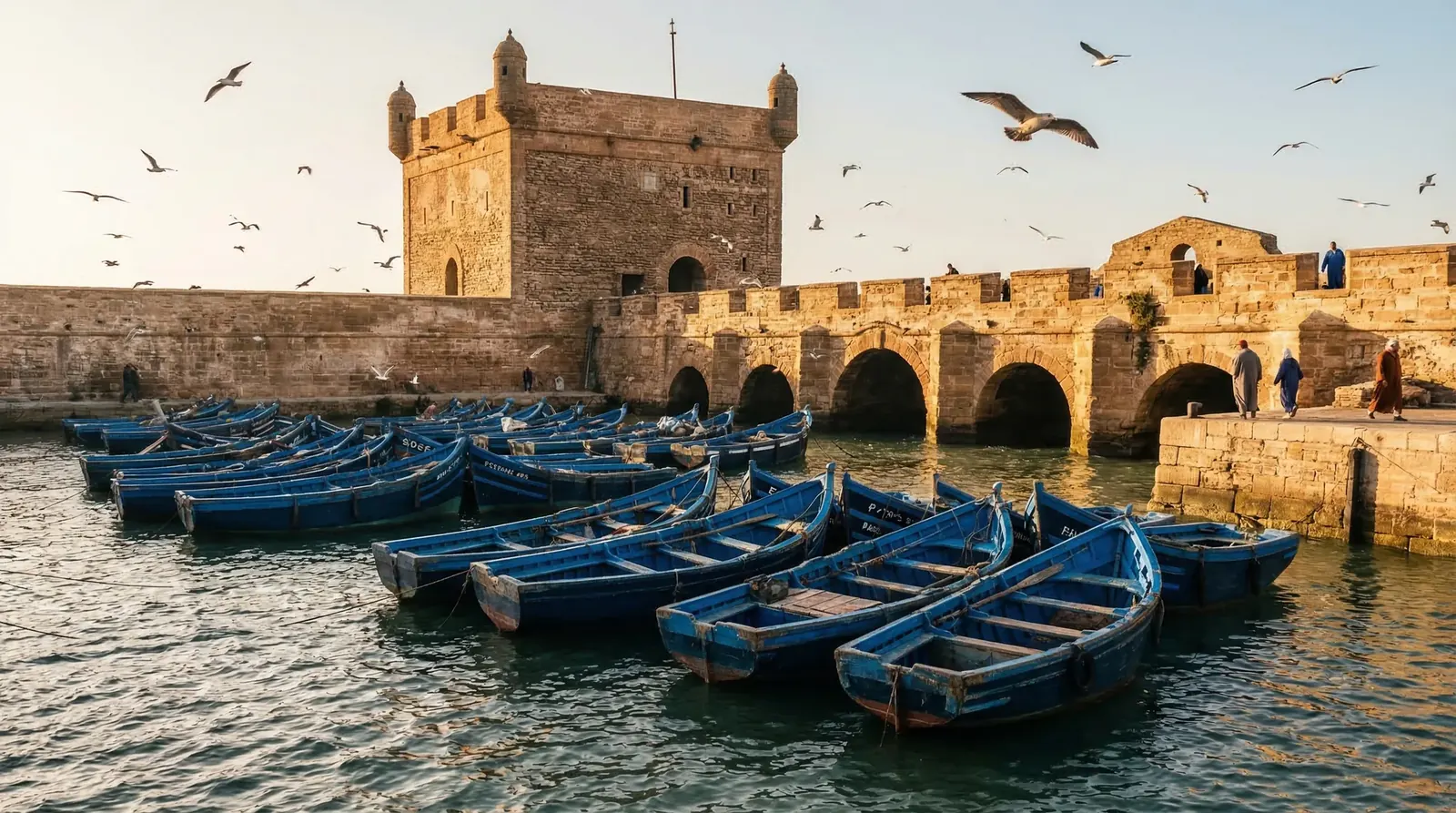
Essaouira is Morocco's elegant Atlantic counterpoint to Marrakech — a fortified white-and-blue port city of ramparts, a working harbour, superb seafood, beautifully restored riads and a calm, liveable medina. Three hours from Marrakech and a world apart in mood, it is the perfect coastal finish to a luxury journey or a honeymoon.
In this guide
What are the top things to see in Essaouira?
The Skala de la Ville — the sea bastion built by the Portuguese in the 18th century — is the city's defining image: a sequence of antique brass cannons pointing west over the Atlantic from a white rampart walk. The afternoon light here is extraordinary; the spray and the wind are constant. The Skala du Port, the older harbour fortification, looks south over the working fishing port where blue boats come and go and men gut fish on the dockside — one of the most photogenic harbour scenes in Morocco.
The medina itself is a UNESCO World Heritage site, built to a regular Portuguese grid plan that makes it unusually easy to navigate compared with the organic tangle of Fes or Marrakech. The main artery — Avenue de l'Istiqlal and its continuation Rue Mohammed el-Qory — runs straight through the medina and connects the main gate to the harbour. Thuja wood workshops, where craftsmen produce extraordinarily intricate marquetry from the fragrant roots of the Thuya tree, line the lane behind the Skala de la Ville.
- Skala de la Ville — sea bastion with antique cannons; best at sunset.
- Skala du Port and fishing harbour — working port; fresh catch auctions at dawn.
- Medina ramparts walk — full circuit takes about 40 minutes.
- Thuja wood workshops — behind the Skala; unique fragrant marquetry craft.
- Musée Sidi Mohammed Ben Abdallah — 19th-century regional museum of music and crafts.
- Galerie Frederic Damgaard — important contemporary Essaouira art gallery.
What is the windsurfing and kitesurfing like in Essaouira?
Essaouira is consistently ranked among the world's top windsurfing destinations. The Alizé — a reliable north-east trade wind that blows at 20–35 knots through much of the year — creates consistent flat-water and side-shore conditions on the broad beach south of the medina (Plage d'Essaouira). The wind peaks from April to October, with June, July and August the most consistent months; outside these months the wind still blows but with greater variability.
Ocean Vagabond and Explora are two well-established water sports centres on the beach offering kit hire, lessons and storage. Kitesurfers and windsurfers share the beach with a reasonable amount of space; the shallower water near the Oued Ksob river mouth is recommended for learners. Body surfers and swimmers should note that the Atlantic here is powerful — rip currents near the river mouth are real — and the water temperature (17–20°C) demands a wetsuit year-round.
- Best wind months: June–September (20–35 knots Alizé trade wind).
- Windsurfing level: intermediate to advanced; consistent side-shore conditions.
- Kitesurfing: established and popular; local schools offer IKO-certified tuition.
- Surfing: bodyboarding and shortboard surfing work in autumn and winter swells.
- Camel and horse rides on the beach — offered by licensed operators south of the medina.
Where should you eat seafood in Essaouira?
The harbour fish market — where the morning's catch is laid out on ice and grilled on the spot at open-air stalls — is one of the best food experiences in Morocco. Point to what you want, agree a price, and eat it grilled with bread and harissa at a plastic table on the dockside. Sardines, sea bass (loup de mer), sole and monkfish are typical; lobster and prawns appear in season. Budget around MAD 60–120 for a full grilled fish meal.
For a refined dinner, La Table by Madada presents a considered contemporary Moroccan seafood menu, while several rampart-side rooms and rooftop restaurants pair the catch of the day with Moroccan wine and an Atlantic sunset; the harbourside institution Chez Sam endures for its salt-worn charm. Better still, arrange a private chef to prepare the day's langoustine and line-caught fish on your riad terrace. The medina's café culture — strong coffee, fresh orange juice, warm bread — sets the gentle morning rhythm.
What day trips can you do from Essaouira?
The argan forest between Essaouira and Agadir is the world's only habitat for the Argania spinosa tree. Goats famously climb these gnarly trees to eat the fruit; the pits are collected by women's co-operatives to produce argan oil. The roadside is lined with co-ops where you can see the labour-intensive extraction process and buy certified products. A morning excursion south towards the co-ops of the Sous Valley combines authentically with a beach stop.
Sidi Kaouki — a windswept beach village 25 km south of Essaouira — is popular with surfers and travellers seeking even more solitude. The beach is wilder and less crowded than Essaouira's; a small number of guesthouses make it viable as an overnight stay. Diabat, 5 km south of Essaouira past a river ford, is a tiny village with the ruins of the Fortress of Mogador visible on a sand spit — the kind of deserted, wind-swept scene that puts the Atlantic in context.
What is the Gnaoua Music Festival and when does it take place?
The Gnaoua World Music Festival is Essaouira's signature annual event — typically held over four days in late June — and transforms the city into one of the world's most atmospheric music venues. Gnaoua is a centuries-old tradition of trance music and healing ritual brought to Morocco by sub-Saharan enslaved people; the festival pairs Gnaoua master musicians (mâalems) with international jazz, blues, reggae and world-music artists for free outdoor concerts in the medina squares and on the ramparts. Accommodation books out months in advance; if you plan to attend, reserve a full year ahead.
Frequently asked
How far is Essaouira from Marrakech?
Approximately 180 km, around 2.5–3 hours by private car or CTM bus. The route passes through the argan forest and is largely straightforward. Buses run several times daily; a private driver allows stops at the argan co-operatives along the way.
Is Essaouira worth visiting?
Absolutely. It offers a completely different experience from Marrakech's medina intensity — calmer, cooler, lighter and centred on the sea. The harbour, the ramparts, the seafood and the wind are unique in Morocco. Most visitors who come for a day wish they had stayed longer.
What is the weather like in Essaouira?
Mild and windy year-round. The Alizé trade wind blows consistently from spring through autumn, keeping summer temperatures in the low-to-mid 20s°C even when Marrakech is at 38°C. Winter is mild (14–18°C), occasionally rainy, and notably quieter. Essaouira is the best summer city in Morocco for those who dislike heat.
Can you swim at the beach in Essaouira?
The beach is broad and beautiful, but the Atlantic here is powerful with a persistent rip current near the Oued Ksob river mouth. Swimming is possible but demands caution and confidence in the water. The wind makes sunbathing bracing rather than peaceful. The beach is primarily used for windsurfing, kitesurfing and walking.
What is thuja wood and why is it special to Essaouira?
Thuya (Tetraclinis articulata) is an Atlas cypress whose roots grow into dense, fragrant burr-wood with a naturally occurring geometric pattern. Essaouira's craftsmen have worked it into marquetry boxes, chess sets, frames and decorative objects for centuries. The scent is distinctive and long-lasting; a small thuya box is one of the most authentic souvenirs you can take from the city.
Planning a trip?
Let our team handle the details.
Tell us your dates and style and we'll send a written itinerary and a transparent quote. We confirm by email within 24 hours.
Request an itineraryKeep reading
Planning
The Best Time to Visit Morocco in Luxury
For a private, riad-led journey, spring (March–May) and autumn (September–November) are the connoisseur's windows — warm days, cool palace-courtyard evenings, and the desert, the Atlas and the imperial cities all showing their finest. The season you choose shapes the entire mood of the trip.
Itineraries
Morocco Itinerary: 10 Days
Ten days is the sweet spot for a bespoke Morocco journey — long enough to combine Marrakech, a luxury Sahara camp and the imperial north in one unhurried, privately guided loop, with a coastal spa finish as a tempting option.
Planning
Surfing in Morocco: Taghazout, Agadir & Imsouane
Morocco's Atlantic coast offers consistent surf from September to April, warm winters and a relaxed surf culture centred on Taghazout — and these days a boutique side too, with design-led surf villas, private coaching and beachfront spa retreats alongside the long right-hand points of Anchor and Imsouane.
Planning
Things to Do in Marrakech: The Essential Guide
Marrakech is sensory enchantment — a medieval medina hiding palatial riads, world-class gardens, hammam rituals, candlelit rooftop dinners and a square that becomes, each night, one of the world's great spectacles. With a private guide opening hidden doors, here is where to spend your time in style.