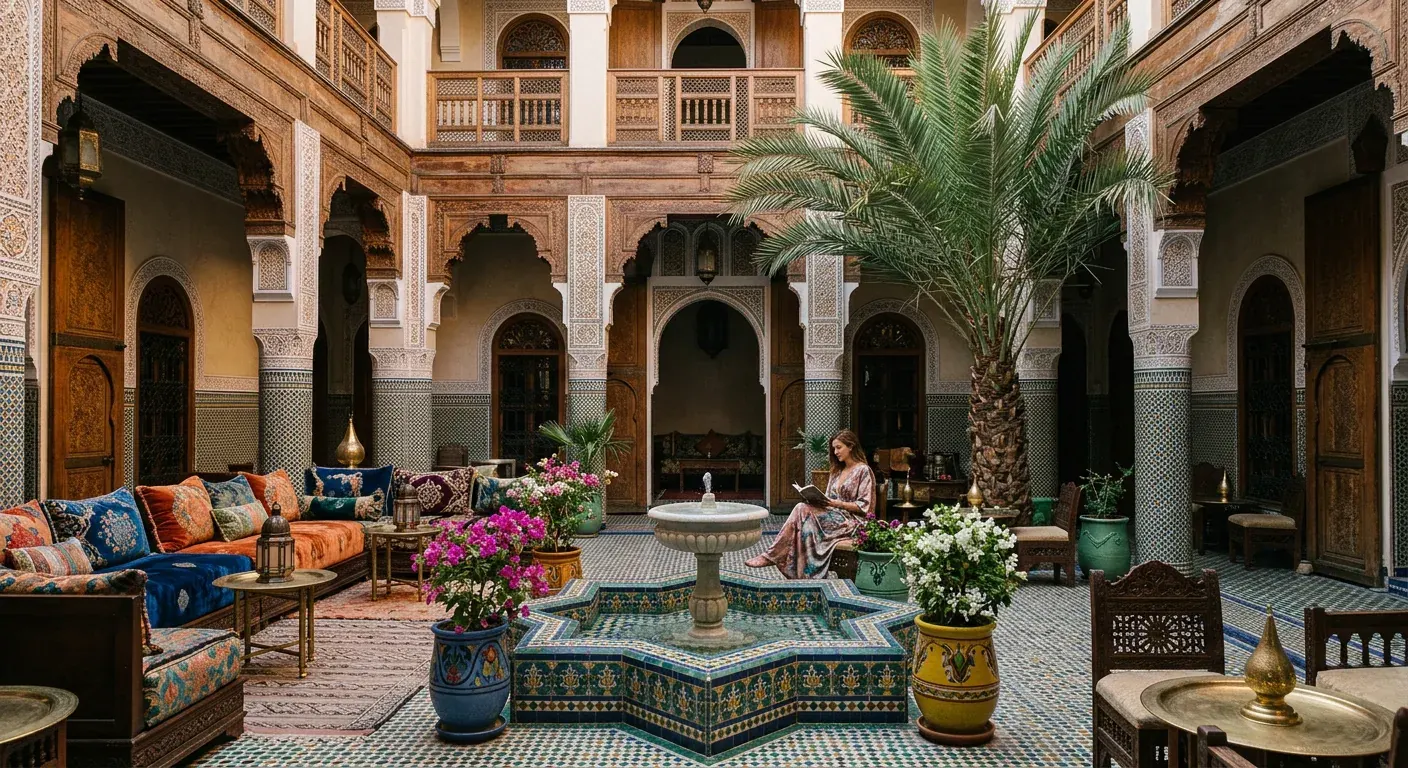
Few places stage a celebration quite like Morocco. A palatial riad in the Marrakech medina, a restored kasbah behind candlelit ramparts, a private camp pitched beneath the Agafay desert or the great dunes of the Sahara, a terrace above the Atlantic at Essaouira — these are settings that need almost no embellishment. Woven through them is a culture of feasting and ceremony, music and ornament, that gives a wedding here a depth few destinations can match. This is our considered guide to marrying or celebrating in Morocco: the settings, the cultural elements worth weaving in, the planners and lead time that make it effortless, an honest note on the legal questions, the seasons that flatter the day, and the experience your guests will carry home. Venue, climate and legal notes reflect general realities rather than guarantees — we plan around the specifics of your date, party and paperwork, and always advise confirming legal requirements through official and consular channels.
In this guide
- 01The settings — riads, palaces, kasbahs, desert and coast
- 02Weaving in Moroccan culture — the rituals that make the day
- 03Planners and logistics — engaging the right team early
- 04The legal question — symbolic ceremonies and a note on paperwork
- 05Seasons — when to hold the celebration
- 06The guest experience — making it a journey
- 07Frequently asked
The settings — riads, palaces, kasbahs, desert and coast
The first decision is the stage, and Morocco offers several distinct ones. In the heart of the Marrakech medina, a palatial riad or a restored private palace — courtyards of zellige and carved cedar, fountains, orange trees and lantern-lit roof terraces — gives an intimate celebration extraordinary atmosphere within ancient walls. Taken on an exclusive-use basis, a grand riad becomes your own private world for the days around the wedding; for larger parties, several neighbouring riads or a palace-scale property hold a fuller guest list without losing the sense of secrecy that the medina does so well.
Beyond the medina, the country opens into more theatrical settings. Opulent kasbahs and the great gardens on the edge of Marrakech lend a sense of arrival and space — long tables under olive and palm, lawns for a ceremony, room for music to carry. The most cinematic choice of all is a private desert camp: the rolling Agafay, an hour from Marrakech, offers lunar hills and Atlas views within easy reach of the city, while the Sahara and the dunes of Erg Chebbi reward those willing to travel for a celebration under a sky thick with stars. On the Atlantic, Essaouira brings a different mood entirely — sea air, ramparts, the light of the coast and a relaxed, windswept elegance that suits a celebration as readily as a wedding.
- Marrakech medina: palatial riads and restored private palaces — intimate, atmospheric, taken exclusive-use; neighbouring riads or palace-scale venues for larger parties.
- Opulent kasbahs and the great gardens on the city's edge — space, lawns and long tables for a more theatrical day.
- Private desert camps: the Agafay near Marrakech (lunar hills, Atlas views, easy access) or the Sahara and Erg Chebbi dunes for a star-lit celebration worth travelling for.
- Atlantic coast at Essaouira: sea air, ramparts and relaxed coastal elegance for a wedding or celebration.
Weaving in Moroccan culture — the rituals that make the day
What sets a Moroccan celebration apart is how much ceremony there is to draw on, and the most memorable weddings here borrow generously from it. At the centre is the diffa — the lavish feast of pastilla, slow-cooked tagines and a whole mechoui (spit-roasted lamb), served at a long, unhurried table. The night before, a henna night gathers the women: a henna artist (the harqus and henna traditions) paints the bride's hands and feet with intricate patterns said to bring blessing and good fortune, amid music, sweets and laughter. These are not mere photo opportunities but genuine rites of welcome and celebration, and guests of any background are moved by them.
The procession and adornment are where the spectacle peaks. Traditionally the bride is carried aloft on the amaria, an ornate palanquin, and presented to the celebration in a succession of resplendent kaftans and takchitas — the whole sequence orchestrated by the negaffa, the wedding dresser whose role is to robe, jewel and present the bride through the evening's changes of dress. Music carries the night: the trance-driven Gnaoua with their qraqeb and guembri, or a dakka troupe with hand-drums and chant, fill the courtyard with rhythm, while lanterns, candlelight and drifts of rose petals do the rest. Threaded together — a henna night, a diffa, an amaria entrance, a negaffa's kaftans, Gnaoua musicians under the lanterns — these elements give even a small wedding a richness that feels entirely of this place.
- The diffa: a lavish feast of pastilla, tagines and whole-roast mechoui at a long, unhurried table.
- The henna night: a henna artist paints the bride's hands and feet amid music and sweets, the evening before.
- The amaria: the bride carried aloft on an ornate palanquin and presented to the celebration.
- The negaffa (wedding dresser): orchestrates the bride's succession of kaftans and takchitas and her jewels through the night.
- Gnaoua and dakka musicians, lanterns, candlelight and rose petals to set the atmosphere.
Planners and logistics — engaging the right team early
A destination wedding in Morocco is only as effortless as the team behind it, and the single most important decision after the venue is engaging an experienced local wedding planner. A good planner is fluent in both worlds: the expectations of international couples and the realities of Moroccan suppliers, permits, staff and timing. They source and negotiate the venue, the negaffa and her kaftans, the caterers and the mechoui, florists and lighting, the musicians, and the photographers — and, just as importantly, they manage the day itself in a place where much runs on relationship and rhythm rather than rigid schedule. Trying to coordinate this remotely, without someone on the ground, is where destination weddings most often come undone.
Lead time is the other quiet luxury. The finest riads, palaces and camps — and the best planners, photographers and negaffas — are reserved far in advance, and the prime spring and autumn dates fill first of all; we advise beginning well ahead, often a year or more for a larger celebration. Build the days around the wedding into the plan, not just the day itself: private transfers and a chauffeur-guide for the party, welcome dinners and a henna night, hammam and spa time, and excursions for guests who arrive early or linger after. And plan the guest journey with care — airport meet-and-greet, exclusive-use accommodation where possible, and clear guidance on dress, customs and the medina's walking-only lanes. The more the logistics are handled invisibly, the more the celebration feels like pure pleasure.
- Engage an experienced local wedding planner — they source and negotiate suppliers and run the day on the ground.
- Allow generous lead time; the finest venues, planners, photographers and negaffas book far ahead, prime dates first.
- Plan the surrounding days too: welcome dinner, henna night, hammam and spa, guest excursions and private transfers.
- Curate the guest journey — airport meet-and-greet, exclusive-use stays, and clear guidance on dress and the walking-only medina.
The legal question — symbolic ceremonies and a note on paperwork
It is worth being clear-eyed about the legal side, because it shapes how you plan. Many international couples who marry in Morocco choose to complete the legal marriage at home — a registry or civil ceremony before or after the trip — and then hold a full symbolic ceremony in Morocco, with all the setting, ritual and celebration intact but without the legal formalities attached to the day itself. This is a common and entirely satisfying approach: the symbolic ceremony can include everything that makes the day feel like a wedding, while the paperwork is handled simply and reliably in your own jurisdiction.
A legally binding civil marriage of foreign nationals within Morocco is possible, but it carries specific requirements — documentation, translations, authentication and procedures that can vary by nationality and over time, and that are not something to take on trust from a guide of this kind. We deliberately do not state the requirements here, because they change and because the consequences of getting them wrong are serious. The right course is to confirm the current rules directly through official Moroccan authorities and your own country's embassy or consulate, and to let your wedding planner and, where needed, a local legal adviser handle the process. Treat anything you read about Moroccan marriage law — including this paragraph — as a prompt to verify, not as the final word.
- A common path: complete the legal marriage at home and hold a symbolic ceremony in Morocco with full ritual and celebration.
- A binding civil marriage of foreigners in Morocco is possible but has specific, variable requirements (documents, translations, authentication).
- Requirements change and differ by nationality — confirm current rules through official Moroccan authorities and your embassy or consulate.
- Let your planner, and a local legal adviser where needed, handle any legal process; treat all general guidance (this included) as a prompt to verify.
Seasons — when to hold the celebration
Season shapes the day more than almost any other choice. Spring (roughly March–May) and autumn (roughly October–November) are the ideal windows for a Morocco wedding, and especially for an inland one in Marrakech, a kasbah or the Agafay: comfortable, sun-warmed days, balmy evenings for a courtyard or desert dinner, gardens at their best, and the kindness of light that flatters every photograph and terrace. These are the most coveted dates precisely because they are the loveliest — which is the strongest argument for booking early.
High summer is best avoided inland. Marrakech, a kasbah courtyard or the desert can be punishingly hot from June to August, which is hard on guests in formal dress and harder still on an outdoor feast. If a summer date is fixed, the elegant solution is the coast: Essaouira and the Atlantic stay markedly milder, with sea air taking the edge off the heat, making a coastal celebration the natural summer choice. Winter has its own quiet appeal — mild, sun-flooded Marrakech days and crisp, star-bright desert nights — but desert and Atlas evenings turn genuinely cold, so a winter celebration wants fire pits, heaters, blankets and a warm indoor heart to the party. Whatever the season, evenings are cooler than days across most of the country, and an outdoor celebration should plan for the night air.
- Spring (roughly March–May) and autumn (roughly October–November) are ideal — comfortable days, balmy evenings, the loveliest light.
- Avoid peak summer inland (Marrakech, kasbahs, the desert can be punishingly hot); if summer is fixed, choose the milder Atlantic coast.
- Winter offers mild sun-flooded city days but cold desert and Atlas nights — plan fire pits, heaters, blankets and a warm indoor heart.
- Evenings are cooler than days almost everywhere; plan an outdoor celebration around the night air.
The guest experience — making it a journey
The finest Morocco weddings are not a single evening but a journey shared, and the guest experience is worth designing as deliberately as the ceremony. Bring guests into the country gently: an airport meet-and-greet and private transfers, exclusive-use riads or a cluster of fine ones where the party can gather, and a welcome dinner on the first night to dissolve the travel and let everyone settle. From there, the days around the wedding become a celebration in themselves — a hammam and spa morning, a guided medina or souk wander, a cooking class, a sunset in the Agafay, a day on the Essaouira coast — so that guests leave having truly experienced Morocco, not merely attended an event within it.
Small considerations carry a long way. Brief guests warmly and clearly on dress and custom — modest, beautiful attire is appreciated, and many couples invite guests to embrace kaftans and djellabas for the celebration itself, which guests almost universally love. Guide them on the medina's walking-only lanes, the rhythm of Moroccan hospitality and the warmth with which they will be received. Thoughtful welcome gifts — a lantern, local sweets, argan oil, a hand of henna offered on the night — and the steady presence of a planner's team to answer every question turn attendance into immersion. Done well, a celebration here gives your guests the rarest gift a wedding can: a few days they will talk about for years.
- Design the whole journey: airport meet-and-greet, private transfers, exclusive-use stays and a first-night welcome dinner.
- Fill the surrounding days — hammam and spa, guided medina, cooking class, an Agafay sunset, a coastal day — so guests experience Morocco fully.
- Brief guests on dress and custom; many couples invite guests into kaftans and djellabas for the celebration, to universal delight.
- Thoughtful welcome gifts and an ever-present planning team turn attendance into immersion.
Frequently asked
What kinds of venue can you marry or celebrate in across Morocco?
Four distinct settings stand out. A palatial riad or restored private palace in the Marrakech medina gives an intimate, atmospheric celebration within ancient walls; opulent kasbahs and the great gardens on the city's edge offer space and theatre for larger parties; a private desert camp — the Agafay near Marrakech or the Sahara dunes of Erg Chebbi — stages a celebration under the stars; and the Atlantic coast at Essaouira brings sea air, ramparts and relaxed coastal elegance. Grand riads and camps are typically taken on an exclusive-use basis, becoming your own private world for the days around the wedding.
Which Moroccan traditions can we weave into the wedding?
As many as you wish. The most beloved are the diffa (a lavish feast of pastilla, tagines and whole-roast mechoui), a henna night the evening before (a henna artist paints the bride's hands and feet amid music and sweets), the amaria (the bride carried aloft on an ornate palanquin), the negaffa (a wedding dresser who orchestrates the bride's succession of kaftans, takchitas and jewels), and Gnaoua or dakka musicians under lanterns, candlelight and rose petals. These are genuine rites of welcome and celebration, and guests of every background find them moving.
Do we need a local wedding planner in Morocco?
Strongly recommended. An experienced local planner is fluent in both international expectations and Moroccan realities — venues, permits, the negaffa, caterers and the mechoui, florists, lighting, musicians and photographers — and, crucially, manages the day on the ground in a place where much runs on relationship and rhythm. Coordinating remotely without someone local is where destination weddings most often come undone. The best planners book far in advance, so engage one early.
Can foreigners legally get married in Morocco, or is the ceremony symbolic?
Many international couples complete the legal marriage at home and hold a full symbolic ceremony in Morocco — keeping all the setting and ritual while handling the paperwork simply in their own jurisdiction. A legally binding civil marriage of foreign nationals in Morocco is possible but carries specific requirements (documents, translations, authentication) that vary by nationality and over time. We do not state them here because they change and the consequences of error are serious; confirm the current rules directly through official Moroccan authorities and your embassy or consulate, and let your planner and, where needed, a local legal adviser handle the process.
When is the best time of year for a Morocco wedding?
Spring (roughly March–May) and autumn (roughly October–November) are ideal — comfortable days, balmy evenings and the loveliest light, especially for an inland celebration in Marrakech, a kasbah or the Agafay. Avoid peak summer inland, where Marrakech and the desert can be punishingly hot; if a summer date is fixed, choose the milder Atlantic coast at Essaouira. Winter offers mild, sun-flooded city days but cold desert nights that call for fire pits, heaters and blankets. Plan any outdoor celebration around cooler evening air.
How long before the wedding should we start planning?
Generously — often a year or more for a larger celebration. The finest riads, palaces and desert camps, and the best planners, photographers and negaffas, are reserved far in advance, and the prime spring and autumn dates fill first of all. Early planning also lets you build the surrounding days — a welcome dinner, henna night, hammam and spa time, and guest excursions — into a proper journey rather than a single event.
Planning a trip?
Let our team handle the details.
Tell us your dates and style and we'll send a written itinerary and a transparent quote. We confirm by email within 24 hours.
Request an itineraryKeep reading
Planning
Morocco Honeymoon Guide
Morocco is one of the world's most romantic honeymoon destinations: private riad suites with plunge pools, candlelit desert camps under a galaxy of stars, rose-strewn hammam rituals for two, fine dining on Atlantic ramparts, and the seamless privacy of a journey planned around just the two of you. Here is how to design an unforgettable honeymoon.
Planning
Luxury Morocco by Season — When to Go for the Trip You Want
Morocco rewards travellers in every season — but the season you choose quietly decides the entire character of the journey. This is our connoisseur's calendar: not a list of temperatures, but a guide to which experiences come into their own, and which luxury choices — a private desert camp, an Atlantic retreat, an Atlas lodge, a plunge-pool riad — best match each window. Climate notes are typical norms rather than guarantees; we plan around the realities of the year you travel.
Planning
Things to Do in Marrakech: The Essential Guide
Marrakech is sensory enchantment — a medieval medina hiding palatial riads, world-class gardens, hammam rituals, candlelit rooftop dinners and a square that becomes, each night, one of the world's great spectacles. With a private guide opening hidden doors, here is where to spend your time in style.