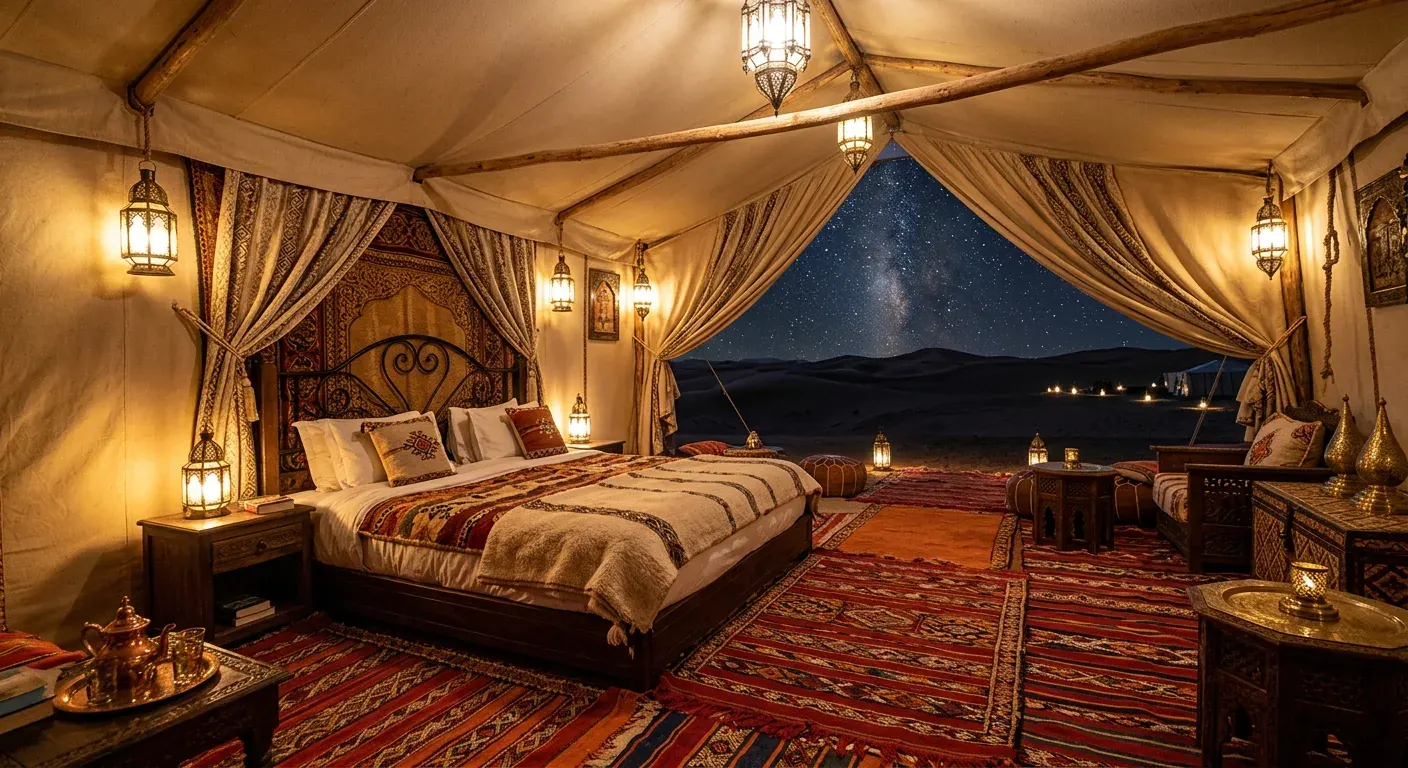
Morocco rewards travellers in every season — but the season you choose quietly decides the entire character of the journey. This is our connoisseur's calendar: not a list of temperatures, but a guide to which experiences come into their own, and which luxury choices — a private desert camp, an Atlantic retreat, an Atlas lodge, a plunge-pool riad — best match each window. Climate notes are typical norms rather than guarantees; we plan around the realities of the year you travel.
In this guide
Autumn and spring — the prime windows
If you let us choose, we choose the shoulders of the year. Through autumn (roughly October–November) and spring (roughly March–May), the whole country tends to align: comfortable days across the imperial cities, balmy desert nights ideal for a private camp, gardens and orchards coming into colour, and a kindness to the light that flatters every terrace dinner. These are the windows in which a single journey can move gracefully from city to Sahara to Atlas without compromise.
This is why most bespoke itineraries that combine Marrakech or Fes with a Sahara night and a day in the mountains are designed for these months. The permanent desert camps are at their finest, the medinas are warm rather than punishing, and a long, unhurried afternoon can end comfortably on a candlelit roof. Because these are also the most sought-after weeks, the best suites, the finest camps and the most coveted tables are reserved many months ahead — early planning is itself part of the luxury.
- Best for: combining cities, the Sahara and the Atlas in one seamless journey.
- Luxury choices that shine: a permanent private desert camp under settled skies; a garden-riad terrace at golden hour; a chauffeur-guided Atlas day with a long mountain lunch.
- Plan early — the calendar's two peaks are when the finest rooms and camps fill first.
Winter — desert camps, winter sun and riad fires
Winter (roughly December–February) is one of Morocco's quiet privileges. Days in Marrakech and across the south tend to be mild and sun-flooded, the great sights are at their least crowded, and this is the prime season for the Sahara — the dunes are walkable rather than scorching, and a private camp with a fire pit and heavy blankets becomes genuinely magical after dark. Pack warm layers: desert and Atlas nights are cold, and the high peaks hold snow.
It is also the season the country offers two very different luxuries at once. On the Atlantic, Agadir and the southern coast become a dependable winter-sun retreat for poolside and spa days. Inland, the High Atlas turns alpine — Oukaïmeden can see real snow — while back in the medina, the pleasure is quieter still: a fire lit in a riad salon, a long hammam, and the city's grandest monuments enjoyed almost to yourself.
- Best for: the prime private desert-camp season; winter sun on the coast; crowd-free cities.
- Luxury choices that shine: a fire-pit dinner under desert stars; a winter-sun coastal retreat near Agadir; a plunge into riad-fireside calm with a hammam ritual.
- Bring warm layers for cold desert and Atlas nights, and expect snow on the high peaks.
Summer — the coast, the mountains and poolside palace days
Summer (roughly June–August) asks for a different shape of trip. Inland, Marrakech, Fes and the desert can turn extreme, so the elegant move is to pivot toward the breezy Atlantic — Essaouira with its ramparts and wind, the lagoon calm of Oualidia — and up into the cool of the High Atlas. The country is still entirely open to you; it simply rewards a coast-and-mountain itinerary over a desert-and-medina one.
Where you do spend time inland, the rhythm shifts to early mornings and unhurried afternoons. We arrange sightseeing at first light, then retreat to the shade of a plunge-pool riad or a palace-hotel garden for the heat of the day, with air-conditioned chauffeured transfers in between. It is, in its own way, a deeply luxurious tempo — the sights without the crowds or the swelter, and long, languid pool hours that the cooler seasons never quite allow.
- Best for: the breezy Atlantic coast (Essaouira, Oualidia) and the cool High Atlas.
- Luxury choices that shine: a coastal retreat with sea air; an Atlas lodge for mountain cool; poolside palace-hotel and plunge-pool riad days with early-morning sightseeing.
- Save the Sahara and the long medina afternoons for a cooler return.
Ramadan and dates worth designing around
One date moves each year: Ramadan shifts roughly eleven days earlier annually, so it drifts steadily across the calendar through the decade. During the holy month the daily rhythm changes — some restaurants adjust their hours, the pace of the day softens, and the nightly iftar can be a quietly moving thing to witness. Private riads, spa rituals and chauffeur-guided touring continue seamlessly throughout, but we always advise checking the year's dates so your dining and timings are planned with intention rather than surprise.
Beyond Ramadan, a handful of moments are worth either seeking out or planning around: the Gnaoua festival fills Essaouira in early summer, the Marrakech rose harvest scents the south in spring, and the city's film festival draws crowds in late autumn. For any of these, the best suites and tables are spoken for far in advance — tell us early and we design around them.
Frequently asked
What is the best season for a luxury Morocco trip overall?
For most travellers, autumn (roughly October–November) and spring (roughly March–May) are the prime windows: comfortable across the cities, ideal for a private desert camp, and the only seasons in which combining the cities, the Sahara and the Atlas all feel effortless in one journey. They are also the busiest, so the finest rooms and camps are reserved many months ahead.
Is winter a good time to visit Morocco?
Yes — it is the prime private desert-camp season, with mild, sun-flooded days in Marrakech and the south, crowd-free monuments, and the coast near Agadir as a dependable winter-sun retreat. Expect cold desert and Atlas nights and snow on the high peaks, which is exactly why a riad fire, a hammam and a desert fire-pit dinner feel so special this time of year.
Where should I go in Morocco in summer?
Pivot to the breezy Atlantic coast — Essaouira, Oualidia — and the cool High Atlas, where a mountain lodge offers respite from the inland heat. If you stay in Marrakech or Fes, we plan sightseeing for the early morning and retreat to a plunge-pool riad or palace-hotel garden through the hottest hours, saving the Sahara for a cooler return.
How does Ramadan affect a luxury trip to Morocco?
Ramadan shifts about eleven days earlier each year, so its dates vary — always worth checking before you book. Some dining hours and the daily rhythm change, but private riads, spas and chauffeur-guided touring run seamlessly throughout, and the nightly iftar can be a genuine privilege to experience. We plan your meals and timings around it so nothing is left to chance.
Planning a trip?
Let our team handle the details.
Tell us your dates and style and we'll send a written itinerary and a transparent quote. We confirm by email within 24 hours.
Request an itineraryKeep reading
Planning
The Best Time to Visit Morocco in Luxury
For a private, riad-led journey, spring (March–May) and autumn (September–November) are the connoisseur's windows — warm days, cool palace-courtyard evenings, and the desert, the Atlas and the imperial cities all showing their finest. The season you choose shapes the entire mood of the trip.
Planning
Best Time to Visit the Sahara in Morocco
October to April is the Moroccan Sahara's golden window for a luxury camp stay — warm days, crisp star-filled nights, and dunes lit by low golden light at sunrise and sunset. July and August are punishing, when the finest camps quieten, and best avoided.