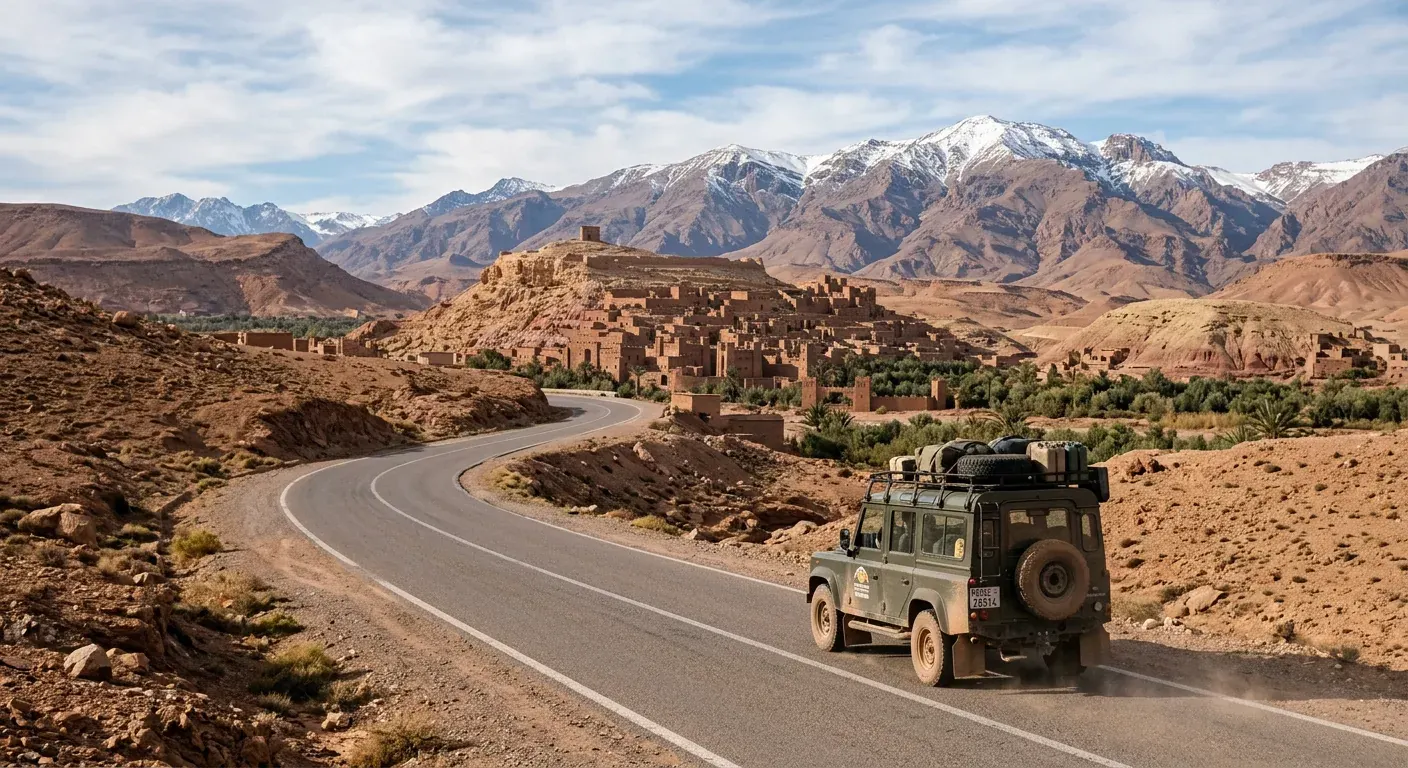
A private photography journey treats the light as the itinerary. With a dedicated driver-guide — and, if you wish, a professional photographer travelling alongside — you reach Aït Ben Haddou at dawn, the Erg Chebbi dunes at sunrise and the blue lanes of Chefchaouen before the day arrives, then wait, unhurried, for the moment a place gives its best. It is travel designed around the hour the picture happens, not the schedule of a coach.
In this guide
What a private photography journey actually is
The difference between a good photograph of Morocco and a great one is almost always time and access — being in the right place when the light is right, with the freedom to stay until it is. A private journey is built to give you exactly that. A dedicated driver-guide carries your itinerary, opens doors, manages the encounters and, crucially, lets you linger when a group tour would have moved on.
Many travellers add a professional photographer or photo-guide for some or all of the trip — someone who knows where the sun falls at each season, the terrace with the unobstructed view, the lane that empties at a particular hour. Others prefer to shoot alone and simply want the logistics and timing handled invisibly. Both are easy to arrange; the point is that the journey bends around your photography rather than the other way round.
- A private vehicle and driver-guide, so you move on the light's timetable, not a coach's.
- Optional professional photographer or local photo-guide — for tuition, location knowledge, or simply a second eye.
- Pre-arranged access: rooftop terraces, artisan workshops, quiet monument hours your guide can secure.
- Genuinely unhurried timing — the freedom to wait twenty minutes for a cloud to move or a square to empty.
The icons, at the hour they are best
Morocco's most photographed places reward those who arrive early or stay late. The golden hour after sunrise and before sunset, and the blue hour that follows dusk, transform every one of them — and a private journey is what makes those hours yours.
Aït Ben Haddou is extraordinary at first light from the far riverbank, the earthen kasbah catching the low sun before the day's visitors cross. Erg Chebbi at Merzouga is at its most cinematic in the first hour after sunrise, when the dunes hold long shadows and deep orange — best reached on a private dawn ride that beats any day-tripper to the crest. Chefchaouen's blue-washed lanes are loveliest in the soft early light before the buses arrive, and again in the warm wash of late afternoon. In Fes, the Chouara tannery is best seen from a leather shop's terrace in the morning, when the sun drops directly into the vats.
- Aït Ben Haddou — dawn, from the opposite bank, before the crossing fills.
- Erg Chebbi, Merzouga — the first hour after sunrise on a private camel or 4x4 approach.
- Chefchaouen — the blue lanes early, before tour groups, and again late afternoon.
- Fes tanneries — mid-morning from a terrace, when the light falls into the basins.
- Marrakech — rooftops and gardens (Majorelle, the Menara) at the day's edges; Jemaa el-Fnaa in the blue hour.
- The Atlas passes and the Draa Valley's palm groves — late afternoon side-light along the road.
Permissions, etiquette and photographing people
The single rule that matters most: ask before photographing a person, every time. A shopkeeper in a spice souk, a woman at a loom, an elder in a doorway — each deserves the choice. The phrase in Moroccan Arabic is 'mumkin sura?' (may I take a photo?). Many will agree warmly; some will ask a small token in return, where a few dirhams is fair and gracious; some will decline, and that is simply respected, without a second attempt or a long lens used to take it anyway.
Candid long-lens street photography of unwilling subjects sits poorly in Morocco's medinas and has caused real friction. The portraits that last come from a brief connection — a few words, a shared glance, sometimes a tea — and a private guide is invaluable here, easing the introduction and translating where needed. Be mindful too of sensitive places: photography is restricted or forbidden inside many active mosques and at some official or military sites, and the performers and henna artists of Jemaa el-Fnaa expect payment for their image. Your guide will tell you, quietly, where the camera is welcome and where it should stay in the bag.
The desert night sky and astrophotography
Away from city light, the Moroccan Sahara offers some of the clearest night skies most travellers will ever stand under, and the dunes make a foreground like nowhere else. From a private camp at Erg Chebbi or the remoter Erg Chigaga, a moonless night reveals the Milky Way arcing over the sand. The window matters: aim for nights around the new moon, plan for the Sahara's cool season (roughly October to April, when the dunes are comfortable rather than punishing), and allow time for the sky to fully darken after dusk.
Astrophotography here is unhurried by nature — a sturdy tripod, warm layers for the cold desert night, and patience for long exposures while the camp's fire burns nearby. A photo-guide who knows the season's moon phase and the camp's darkest sight-lines turns a beautiful night into a genuinely memorable frame.
Styled shoots in riads and desert camps
Beyond the landscapes, Morocco's interiors are a gift to the camera: candlelit riad courtyards, zellij and carved cedar, a breakfast laid on a rooftop above the medina, a table set in the silence of the dunes. With privacy comes the freedom to style — a couple at golden hour on the camp's crest, an anniversary portrait in a palace riad, the slow ritual of mint tea poured for the frame. These are arranged calmly, in your own riad or camp, with the staff's blessing and without an audience.
Couples marking a honeymoon or anniversary often add a short professional shoot at one location; others simply want the time and the setting to make their own images well. Either way, a private journey makes the space for it.
Gear, luggage and logistics with private transfers
Morocco's range — tight souks, vast dunes, mountain passes — is well served by a versatile mid-range zoom rather than a wall of long lenses; a fast prime earns its place for low-light interiors and the blue hour. Sahara dust is the real adversary: keep a sealed bag, change lenses sparingly outdoors, and carry spare batteries, which drain faster on cold desert nights. A compact tripod pays for itself at dawn on the dunes and for blue-hour and astro work.
The quiet luxury of a private journey is logistical. Your kit travels door to door in the vehicle rather than being hauled between transfers; your driver-guide watches the bags while you shoot, knows the terrace with the view and the lane that empties, and adjusts the day's timing on the spot when the light turns. One honest note on drones: flying in Morocco requires prior authorisation from the civil aviation authority (DGAC), unauthorised drones have been confiscated at customs, and for most travellers it is best left at home — the country is extraordinary enough at ground level.
- A versatile zoom plus one fast prime covers souks, landscapes and dim interiors.
- Sealed bag, lens cloths and spare batteries for the dust and cold of the Sahara.
- A compact tripod for dawn dunes, blue-hour medinas and desert astrophotography.
- Door-to-door luggage in your private vehicle — and a guide who minds the kit while you work.
- Drones need DGAC authorisation; without it, leave them at home.
Frequently asked
What is a private photography journey in Morocco?
It is a privately guided trip designed around photography rather than sightseeing — a dedicated driver-guide who moves on the light's timetable, secures terrace and workshop access, and lets you linger for the moment a place gives its best. You can travel with a professional photographer or photo-guide alongside you, or simply have the timing and logistics handled while you shoot on your own.
Do I need to hire a professional photographer, or can I shoot myself?
Either works. Many travellers add a professional photographer or local photo-guide for location knowledge, tuition or a styled portrait session; others prefer to shoot independently and just want the access, timing and luggage logistics arranged invisibly. The journey is built around whichever you choose.
When is the best light for photographing Morocco's icons?
Golden hour — the hour after sunrise and before sunset — and the blue hour after dusk transform every major location. Aït Ben Haddou is best at dawn from the far bank, Erg Chebbi in the first hour after sunrise, Chefchaouen's lanes early before the crowds, and the Fes tanneries mid-morning from a terrace. A private journey is what makes those specific hours yours.
Is it allowed to photograph people in Morocco?
Only with permission. Always ask first — 'mumkin sura?' means 'may I take a photo?'. Many people agree warmly, some ask a small token of a few dirhams, and some decline, which must be respected. Avoid long-lens candid shots of unwilling subjects, and note that photography is restricted at many active mosques and some official sites. A guide quietly advises where the camera is welcome.
Can I photograph the Sahara night sky?
Yes — the desert offers exceptionally dark, clear skies, and from a private camp at Erg Chebbi or Erg Chigaga the Milky Way over the dunes is unforgettable. Plan for nights near the new moon and the cooler season (roughly October to April), and bring a tripod and warm layers for the long exposures on a cold desert night.
Planning a trip?
Let our team handle the details.
Tell us your dates and style and we'll send a written itinerary and a transparent quote. We confirm by email within 24 hours.
Request an itineraryKeep reading
Culture
Morocco Photography Guide
Morocco is among the world's great photography destinations: extraordinary light, vivid colour, ancient architecture and a landscape that shifts from blue city lanes to red dunes in a day. With a private guide opening doors and timing your visits to the golden hour — even arranging a hot-air-balloon dawn or a quiet, after-hours monument — the images come effortlessly.
Planning
Sahara Desert Tour Guide: Merzouga, Chigaga & Zagora
Three Saharan gateways await the luxury desert traveller: Erg Chebbi at Merzouga for accessibility and grandeur, the wild and exclusive Erg Chigaga near M'Hamid for true seclusion, and Zagora for a shorter escape. Here is how to choose, what a genuine luxury camp is really like, and when to go.
Planning
Best Time to Visit the Sahara in Morocco
October to April is the Moroccan Sahara's golden window for a luxury camp stay — warm days, crisp star-filled nights, and dunes lit by low golden light at sunrise and sunset. July and August are punishing, when the finest camps quieten, and best avoided.