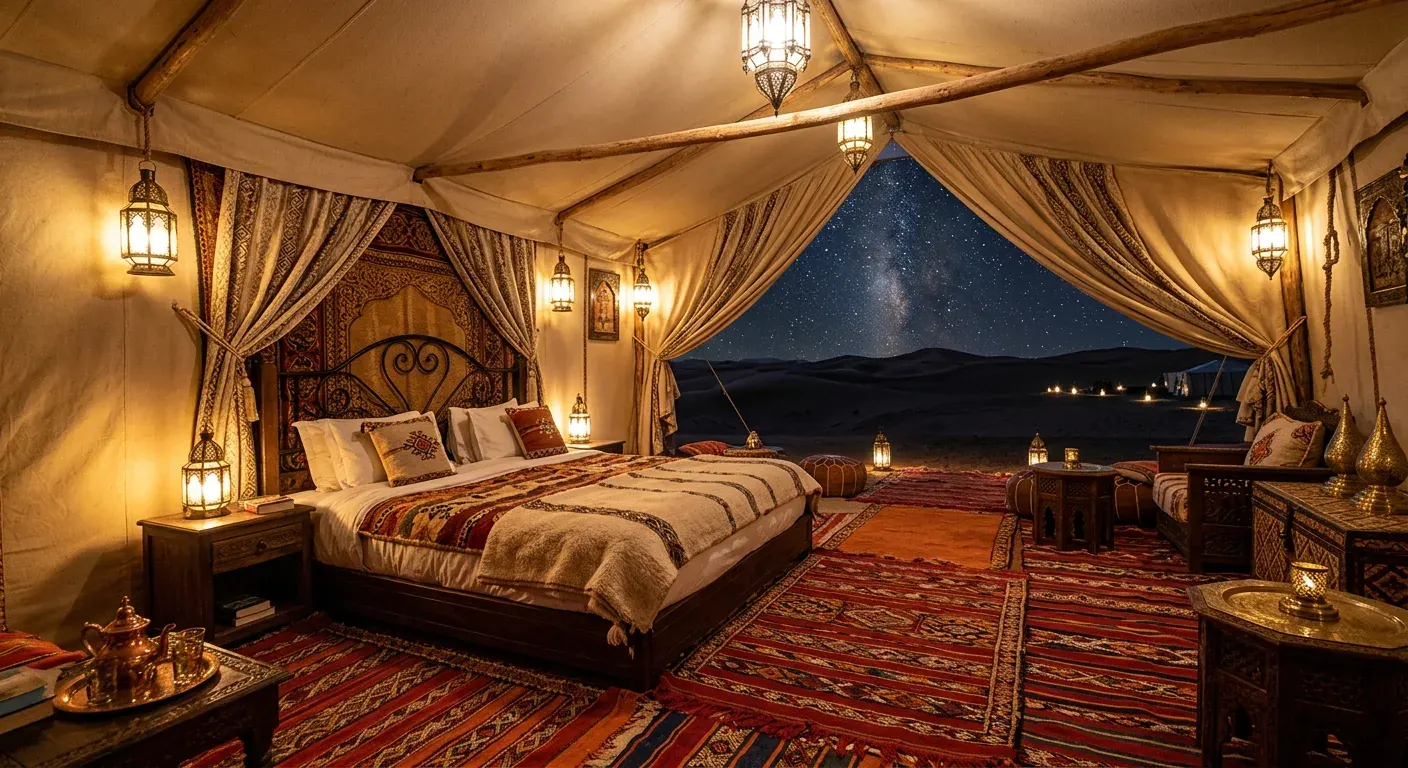
Three Saharan gateways await the luxury desert traveller: Erg Chebbi at Merzouga for accessibility and grandeur, the wild and exclusive Erg Chigaga near M'Hamid for true seclusion, and Zagora for a shorter escape. Here is how to choose, what a genuine luxury camp is really like, and when to go.
In this guide
Merzouga vs Chigaga vs Zagora — which desert should you choose?
Morocco's three Saharan destinations offer meaningfully different experiences. Erg Chebbi at Merzouga is the postcard: a sea of photogenic orange dunes rising to 150 metres, reachable in 8–9 hours from Marrakech. It has the best-developed luxury camp infrastructure, and the dunes are genuinely dramatic. Erg Chigaga, near M'Hamid el Ghizlane, is wilder and more remote — roughly 11–12 hours from Marrakech, with the final 50 km on a desert piste. There are fewer camps, no dune-edge road, and on a quiet day you might have a ridge entirely to yourself.
Zagora is closest to Marrakech (around 6 hours) and is popular for quick overnight excursions, but its dunes (Erg Chegaga to the south, Tinfou nearby) are modest compared with Erg Chebbi. A camel trek and a night under the stars are fully achievable, but first-time visitors who have seen photos of towering Saharan dunes may be mildly surprised. Choose Zagora if time is tight; choose Merzouga for the dramatic experience; choose Chigaga for solitude.
What is a luxury desert camp actually like?
The gap between budget and luxury camps in the Moroccan Sahara is vast, and worth understanding before you book. Budget camps offer shared open-air 'bedouin tents' — a mat and blankets, shared washblocks, a communal dinner. They are not unpleasant, but they are basic and often noisy when a coach group arrives.
A true luxury camp — and there are only a handful genuinely worthy of the name across Merzouga and Chigaga — feels like a boutique hotel set down among the dunes: permanent ensuite tents or geo-domes with proper beds, fine linens, hot showers, electricity and climate control. Private fire pits, candlelit three-course dinners under a canopy of stars, Berber musicians, sandboarding, star-gazing with a telescope and private sunrise camel rides before any day-tripper stirs are all part of the experience. At Erg Chigaga, the best operators position their camps so that no other camp is in sight — a degree of seclusion rare at Merzouga, and ideal for honeymooners.
- Luxury camp hallmarks: private ensuite bathrooms; permanent fixed tents or domes with proper beds and fine linen; a small number of tents; attentive butler-style service and quiet hours.
- Genuine luxury camp rates: roughly US$300–600+ per person per night, all meals, transfers and activities included.
- Worth arranging: a private candlelit dinner, a musician, a telescope session, a champagne sundowner on the dune, a dawn hot-air-balloon flight.
- At Erg Chebbi, camps on the western edge of the dune field enjoy cleaner sand, finer sunrise light and fewer neighbours.
When is the best time to visit the Moroccan Sahara?
October to April is the Saharan window. In this period daytime temperatures are comfortable at 18–30°C, and the golden dune light at sunrise and sunset is at its most beautiful. Desert nights from November to February are cold — single digits Celsius — so pack a proper warm layer; good luxury camps provide blankets and many include fleece jackets.
July and August are genuinely harsh in the desert: daytime temperatures at Merzouga can reach 45–50°C, the camel trek becomes a brief, sweaty formality, and many higher-end camps close or reduce operations. If your trip must fall in summer, plan desert activities entirely for the first and last hours of daylight and expect limited time outdoors.
How do you get to the Moroccan Sahara?
For Merzouga: the most common route from Marrakech crosses the High Atlas via the Tizi n'Tichka pass (2,260 m), continues through Ouarzazate and the Dadès and Todra gorges, with an overnight stop en route. The full drive is approximately 550 km and is best split into two days. Buses (CTM and Supratours) reach Ouarzazate; connecting onward is harder. From Fes, Merzouga is about 6–7 hours' drive through Ifrane and Midelt — a single long day.
For Chigaga: M'Hamid el Ghizlane is the last tarmac town; from there, a 4WD is required to reach the Chigaga dunes (approximately 50 km). Your camp operator will arrange the piste transfer from M'Hamid. M'Hamid is itself roughly 9–10 hours from Marrakech via Ouarzazate and the Drâa Valley.
Frequently asked
How many days do you need in the Sahara?
One night is the minimum for a meaningful experience — you arrive by afternoon for a camel trek and sunset, sleep under the stars, watch the sunrise and depart. Two nights allows a more relaxed pace, a longer walk into the dunes, and time to sit in silence once the day-trippers have left. For Erg Chigaga's remote camps, two nights is strongly recommended given the transfer involved.
Is Merzouga or Chigaga better for the Sahara?
Merzouga (Erg Chebbi) for first-timers: more dramatic dunes, better camp infrastructure, easier to reach. Chigaga (Erg Chigaga) for those who have seen Merzouga or want genuine remoteness — fewer visitors, wilder atmosphere, more demanding logistics.
Is a camel trek in the Sahara worth it?
Yes, for most people. A 20–45-minute ride into the dunes to reach your camp is a genuine experience, not a tourist gimmick — the silence, the scale and the slow movement across the sand are difficult to replicate any other way. Longer treks (2–3 hours) are also available and suit those who want a more physical desert experience.
Can you see the Milky Way in the Moroccan Sahara?
On clear, moonless nights away from the camp generator — yes, spectacularly. Erg Chigaga, with less light pollution than Merzouga's road edge, is marginally better. The clearest skies are typically between late autumn and early spring. A new moon coinciding with your visit is ideal.
What should you pack for a Sahara camp night?
Warm layers regardless of season (desert nights are cold October–March), a headlamp for navigating between tent and facilities at night, and a small bag of camera essentials. Luxury camps supply towels, blankets and toiletries. Sandals or slip-ons for moving through sand are far more practical than lace-up shoes.
Is the Sahara desert safe to visit?
Morocco's Saharan region (Merzouga, Chigaga, Zagora) is politically stable and well visited by international tourists. The security situation in the Moroccan Sahara is not comparable to the instability further south and east in the Sahel. Standard travel precautions apply; travel with a registered operator.
Planning a trip?
Let our team handle the details.
Tell us your dates and style and we'll send a written itinerary and a transparent quote. We confirm by email within 24 hours.
Request an itineraryKeep reading
Planning
The Best Time to Visit Morocco in Luxury
For a private, riad-led journey, spring (March–May) and autumn (September–November) are the connoisseur's windows — warm days, cool palace-courtyard evenings, and the desert, the Atlas and the imperial cities all showing their finest. The season you choose shapes the entire mood of the trip.
Itineraries
Morocco Itinerary: 10 Days
Ten days is the sweet spot for a bespoke Morocco journey — long enough to combine Marrakech, a luxury Sahara camp and the imperial north in one unhurried, privately guided loop, with a coastal spa finish as a tempting option.