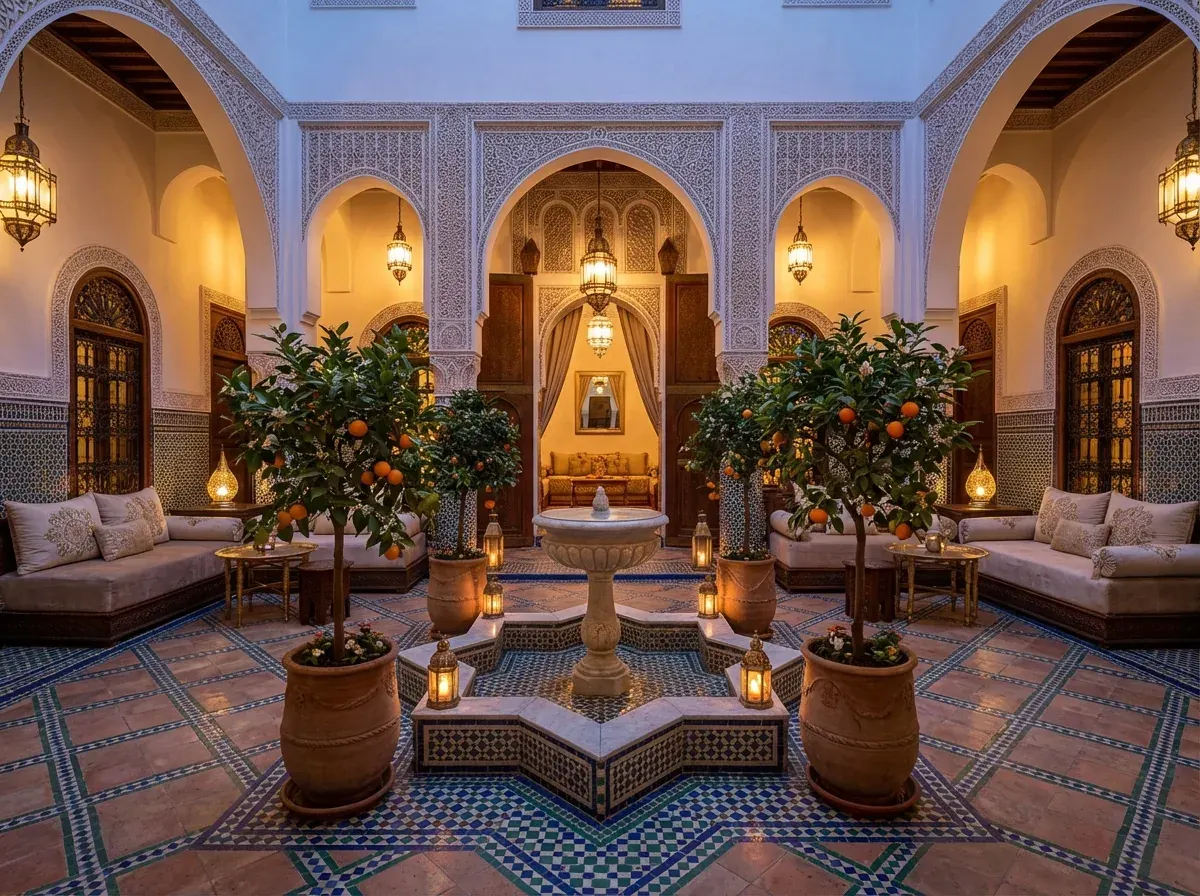
There is a particular kind of Moroccan stay that the medina, for all its romance, cannot give you: space. A staffed private villa or country estate — most famously in the palm groves of the Marrakech Palmeraie, in the countryside and Atlas foothills beyond the city, and on the coast near Essaouira — hands an entire property to a single party. A private pool, landscaped gardens, walls and gates that keep the world out, and a dedicated household team who cook, keep house and look after you. It is the natural choice for families, multi-generational gatherings, groups of friends and celebrations, and it answers a different question from the riad. This is our honest guide to the exclusive-use villa: how it differs from a riad, where the houses are, what the staffed experience really involves, who it suits, the dining and services woven in, and the practical trade-off of seclusion versus being in the heart of things. Property locations and offerings described here reflect general realities rather than any specific house — we match a villa to your party, dates and priorities, and confirm every detail before you commit.
In this guide
- 01Villa or riad? Choosing the right kind of stay
- 02Where the villas are — the Palmeraie and beyond
- 03The staffed-villa experience — exclusive use and a household team
- 04Who it suits — families, groups and celebrations
- 05In-villa dining and services — the chef, the table and beyond
- 06Location and logistics — the trade-off of seclusion
- 07Frequently asked
Villa or riad? Choosing the right kind of stay
The first thing to understand is that a villa and a riad answer different needs, and the choice is not about which is grander but about how you want to live. A riad is an intimate courtyard house in the medina — inward-looking by design, built around a small open court or pool, its rooms wrapped tightly around a quiet centre within the old walled city. Its magic is atmosphere and location: you step from your door into the lanes, the souks and the life of the medina. What it rarely offers is space, a real garden, or a pool you can swim laps in — the medina is dense, and its houses are vertical and compact by nature.
A villa is the opposite proposition: horizontal, outward-looking and generous. It trades the medina's immediacy for room to breathe — a proper swimming pool, lawns and landscaped gardens, several bedrooms spread across a single private property, terraces and shaded living rooms, and the seclusion of being behind your own walls and gates. Villas typically sit outside the medina — in the Palmeraie, the countryside or the foothills — so they suit travellers for whom privacy, the pool, the garden and space for a group matter more than walking out into the souk. Many discerning visitors do both across a single trip: a few nights in a fine riad for the medina's romance, and the rest in a villa to unwind, swim and gather. The two are complements, not rivals.
- Riad — an intimate courtyard house inside the medina; atmosphere and location, but compact and vertical.
- Villa — a private, outward-looking property with space, a pool, gardens and seclusion, usually outside the medina.
- Choose a riad for the heart of the old city; choose a villa for privacy, the pool, the garden and group space.
- Many travellers combine both — a few riad nights for atmosphere, the rest in a villa to gather and unwind.
Where the villas are — the Palmeraie and beyond
The most famous address for the Marrakech villa is the Palmeraie — the historic palm grove on the northern edge of the city, a green expanse of date palms threaded with quiet lanes and walled estates. Here, within a short drive of the medina, properties sit in their own grounds with mature gardens, pools and Atlas views on a clear day, combining seclusion with relative proximity to the city. It is the classic choice for those who want a true garden retreat without straying far from Marrakech's restaurants, sights and airport.
Beyond the Palmeraie, the choice broadens with the landscape. The countryside and the Atlas foothills south of Marrakech — toward the mountains, with the Agafay's lunar hills and the High Atlas on the horizon — hold rural estates and farmhouse-style villas where the setting is wilder, the silence deeper and the views more dramatic, at the cost of a longer drive to the city. On the Atlantic coast around Essaouira, villas trade the heat of the interior for sea air, windswept gardens and a more relaxed, coastal mood. A handful of properties sit higher in the Atlas itself, among the Berber villages and walnut groves. The right region depends on what you want from the days: easy access to Marrakech, deep countryside calm, or the coast.
- The Marrakech Palmeraie — the historic palm grove just outside the city; walled garden estates with pools, close to the medina and airport.
- Countryside and Atlas foothills south of Marrakech — rural estates and farmhouse villas, wilder settings and big views, a longer drive to town.
- The Atlantic coast near Essaouira — sea air, relaxed gardens and a cooler, coastal mood than the interior.
- The High Atlas itself — a few properties among the Berber villages and valleys, for mountain seclusion.
The staffed-villa experience — exclusive use and a household team
The defining luxury of a villa of this kind is that it is yours alone — taken on an exclusive-use basis, the whole property belongs to your party for the length of the stay, with no other guests, no shared spaces and no front desk. You set the rhythm of the day: when breakfast appears, whether lunch is by the pool or not at all, when the household sleeps. That sense of having an entire estate to yourselves, behind your own gate, is the thing villa guests value above all, and it is what no hotel or shared riad can quite replicate.
What makes it effortless rather than merely empty is the staff. A well-run private villa comes with a dedicated household team, the heart of which is almost always a cook or chef and housekeeping — meals prepared and served in the house, beds made, the property kept and the pool and garden maintained. Larger or more formal estates may add a butler or house manager who coordinates everything, a driver or chauffeur for the inevitable trips into the city, and a gardener. The team is discreet by training: present when you want them, invisible when you do not. Exact staffing varies enormously from house to house, so it is worth confirming precisely who is included — and who is on call rather than resident — before you book, rather than assuming a full brigade comes as standard.
- Exclusive use — the entire property is yours; no other guests, no shared spaces, no front desk.
- A dedicated household team, almost always built around a cook or chef and housekeeping.
- Larger estates may add a butler or house manager, a driver and a gardener; smaller villas keep a leaner team.
- Staffing varies house to house — confirm exactly who is included, and who is resident versus on call.
Who it suits — families, groups and celebrations
The villa comes into its own for parties rather than couples, and three groups in particular. Families are the most natural fit: a gated property with a private pool, a garden to run in and space to spread out removes almost every friction of travelling with children, while a cook and housekeeping take the daily labour off the parents. Multi-generational gatherings — grandparents, parents and children under one roof — work beautifully when everyone has their own room and bathroom, a ground-floor suite is available for anyone who finds stairs hard, and there is a shared terrace or pool to gather on at the day's end. And groups of friends travelling together find a villa both more sociable and, divided across the party, often better value than separate hotel rooms.
Celebrations are the other strong case. A milestone birthday, an anniversary, a small wedding or a family reunion all suit the exclusive-use villa, where the privacy, the space and the in-house catering let a gathering unfold on its own terms — a long lunch in the garden, a dinner under the stars, a relaxed few days rather than a single event. For couples seeking pure romantic intimacy, a small riad or boutique hotel often suits better; the villa's gift is space and seclusion for a group, and it rewards a party that will fill the house and use the garden.
- Families — a gated pool, garden and space, with a cook and housekeeping removing the daily strain.
- Multi-generational groups — a room and bathroom for everyone, a ground-floor suite where needed, a shared pool or terrace to gather on.
- Groups of friends — more sociable and often better value than separate hotel rooms.
- Celebrations — birthdays, anniversaries, reunions and small weddings, on your own private terms.
In-villa dining and services — the chef, the table and beyond
Dining is where the staffed villa quietly outshines almost any restaurant, because the kitchen is yours. A villa cook or private chef prepares meals in the house and serves them where you like — breakfast on the terrace, a light lunch by the pool, a Moroccan feast at the long table under the stars. Menus are bespoke: agree the style and rhythm in advance, from honest home-style tagines and fresh salads to a more elaborate diffa for a special night, and let the kitchen handle market shopping, dietary needs and children's portions. Many guests find that this in-villa dining — unhurried, private and tailored entirely to the party — becomes the highlight of the stay, and it removes the nightly logistics of booking and travelling to restaurants from a property that may sit some way out of town.
Beyond the table, the pleasure of the private villa is that services come to you. A spa or wellness day can be arranged in the house — a masseuse, a yoga teacher or a hammam ritual brought to the property rather than sought out in the city. Private transfers and a chauffeur-guide handle the trips into Marrakech for the sights, the souks and dinners out, so the seclusion of the villa never becomes a trap. Grocery provisioning, additional staff for an event, a babysitter or nanny, cooking classes, in-house celebrations and excursions are all readily woven in. The model is simple: the villa is the calm, private base, and the experiences — cultural, culinary, restorative — are brought to it or arranged around it.
- A villa cook or private chef preparing bespoke meals in the house — breakfast, poolside lunch, a feast under the stars.
- Agree menus, dietary needs and children's portions in advance; the kitchen handles market shopping.
- Spa, massage, yoga and an in-house hammam ritual arranged at the property rather than sought out in town.
- Private transfers and a chauffeur-guide for trips into the city, plus provisioning, nannies, classes and event staff as needed.
Location and logistics — the trade-off of seclusion
The single practical truth of the private villa is the one to be honest about from the start: seclusion has a cost, and that cost is distance. Because villas sit outside the medina — in the Palmeraie, the countryside or by the coast — you are not stepping out of your door into the souk. Reaching Marrakech's sights, restaurants and markets means a drive, typically of fifteen minutes to the better part of an hour depending on the house, and that makes a car and driver effectively essential rather than optional. A villa without arranged transfers can leave a party stranded in beautiful isolation; the well-planned villa stay builds a chauffeur-guide into the package so the city is always easy to reach.
This is the trade-off to weigh clearly. A villa gives you space, a pool, a garden, total privacy and calm — and asks, in return, that you accept being a drive from the action and that you organise transport. A medina riad gives you the heart of the old city on your doorstep — and asks, in return, that you accept compact rooms, no real garden and the constant, wonderful hum of the medina. Neither is better; they suit different trips and different parties. Our counsel is simply to go in with eyes open: if the pool, the privacy and space for a group are what you are after, the villa is unmatched, provided the transfers are arranged so seclusion never tips into inconvenience. And as ever with private houses, confirm the specifics — location and drive times, exactly what staff and services are included, pool and garden, and how the city is reached — before you commit, rather than assuming.
- Villas sit outside the medina, so a car and driver are effectively essential — build transfers into the stay.
- Reckon on a fifteen-minute to near-hour drive into Marrakech depending on the property's setting.
- The trade-off: a villa offers space, pool, garden and privacy at the cost of distance; a riad offers the medina on your doorstep at the cost of space.
- Confirm the specifics — drive times, included staff and services, pool and garden — before committing.
Frequently asked
What is the difference between a private villa and a riad in Morocco?
A riad is an intimate courtyard house inside the medina — compact, vertical and inward-looking, its magic being atmosphere and a location at the heart of the old city, though it rarely offers a real garden or a proper pool. A villa is the opposite: an outward-looking private property, usually outside the medina, with space, a swimming pool, landscaped gardens, several bedrooms and the seclusion of its own walls and gates. Choose a riad for the medina's romance and a villa for privacy, the pool, the garden and room for a group. Many travellers combine both across one trip.
Where are luxury private villas located in Morocco?
The most famous address is the Marrakech Palmeraie — the historic palm grove just outside the city, where walled estates sit in their own gardens with pools, close to the medina and airport. Beyond it, the countryside and Atlas foothills south of Marrakech hold rural estates and farmhouse villas with wilder settings and bigger views (and a longer drive to town), the Atlantic coast near Essaouira offers sea air and a cooler, relaxed mood, and a few properties sit higher in the High Atlas itself. The right region depends on whether you want easy access to Marrakech, deep countryside calm, or the coast.
What staff come with a private villa in Morocco?
A well-run exclusive-use villa comes with a dedicated household team, almost always built around a cook or chef and housekeeping — meals prepared and served in the house, beds made, and the pool and garden maintained. Larger or more formal estates may add a butler or house manager, a driver or chauffeur, and a gardener; smaller villas keep a leaner team. Staffing varies enormously from house to house, so confirm precisely who is included, and who is resident versus on call, before booking rather than assuming a full team comes as standard.
Who is a private villa best suited to?
Parties rather than couples. Families love the gated pool, the garden and the space, with a cook and housekeeping removing the daily strain; multi-generational groups suit a house where everyone has their own room, a ground-floor suite is available where needed, and there is a shared pool or terrace to gather on; and groups of friends find a villa both more sociable and often better value than separate hotel rooms. Celebrations — birthdays, anniversaries, reunions and small weddings — also suit the exclusive-use villa. Couples seeking pure romantic intimacy are often better served by a small riad or boutique hotel.
Can a chef cook for us in the villa?
Yes — in-villa dining is one of the great pleasures of a staffed villa. A villa cook or private chef prepares meals in the house and serves them where you like, from breakfast on the terrace to a Moroccan feast at the long table under the stars. Menus are bespoke: agree the style and rhythm in advance, from home-style tagines to a more elaborate diffa, and the kitchen handles market shopping, dietary needs and children's portions. Spa treatments, massage, yoga and an in-house hammam can also be arranged at the property.
Do you need a car when staying in a villa?
Effectively, yes. Because villas sit outside the medina — in the Palmeraie, the countryside or by the coast — reaching Marrakech's sights, restaurants and markets means a drive, typically fifteen minutes to the better part of an hour depending on the house. That makes a car and driver essential rather than optional, and the well-planned villa stay builds a chauffeur-guide into the package so the city is always easy to reach. The trade-off is real: a villa offers space, a pool, gardens and privacy at the cost of distance, so arrange transfers so that seclusion never tips into inconvenience.
Planning a trip?
Let our team handle the details.
Tell us your dates and style and we'll send a written itinerary and a transparent quote. We confirm by email within 24 hours.
Request an itineraryKeep reading
Planning
Luxury Family Morocco — A Multi-Generational Travel Guide
Travelling Morocco as a family — and especially across three generations — is one of the most rewarding journeys we arrange. The country is genuinely devoted to children, the privacy of a riad or villa keeps everyone comfortable, and a private chauffeur-guide removes the friction that makes family travel tiring. This is our considered guide to doing it beautifully: where to stay so grandparents, parents and children all have their own space; how to pace a trip around naps and downtime as much as sightseeing; and which experiences quietly delight every age at once. Climate and logistics notes reflect typical conditions; we plan around the realities of the dates and ages travelling.
Planning
Where to Stay in Morocco: Riads, Hotels & Desert Camps
Morocco offers one of the world's great luxury accommodation experiences — palatial medina riads with plunge-pool suites and private chefs, landmark palace hotels, kasbah retreats, and Sahara tented camps that rival fine hotels among the dunes. Choosing the right one for each chapter of a journey is where a tailored trip truly shows its hand.
Culture
Luxury Dining & Private Chefs in Morocco
Morocco rewards the appetite as richly as the eye. The finest tables here are rarely the loudest — they are a private chef's hands in your own riad kitchen, a feast laid beneath the stars in the deep desert, a candlelit roof above the medina rooftops. This is a guide to dining beautifully across the kingdom, from the traditional diffa to a modern tasting menu, planned with the same discretion as the rest of your journey.