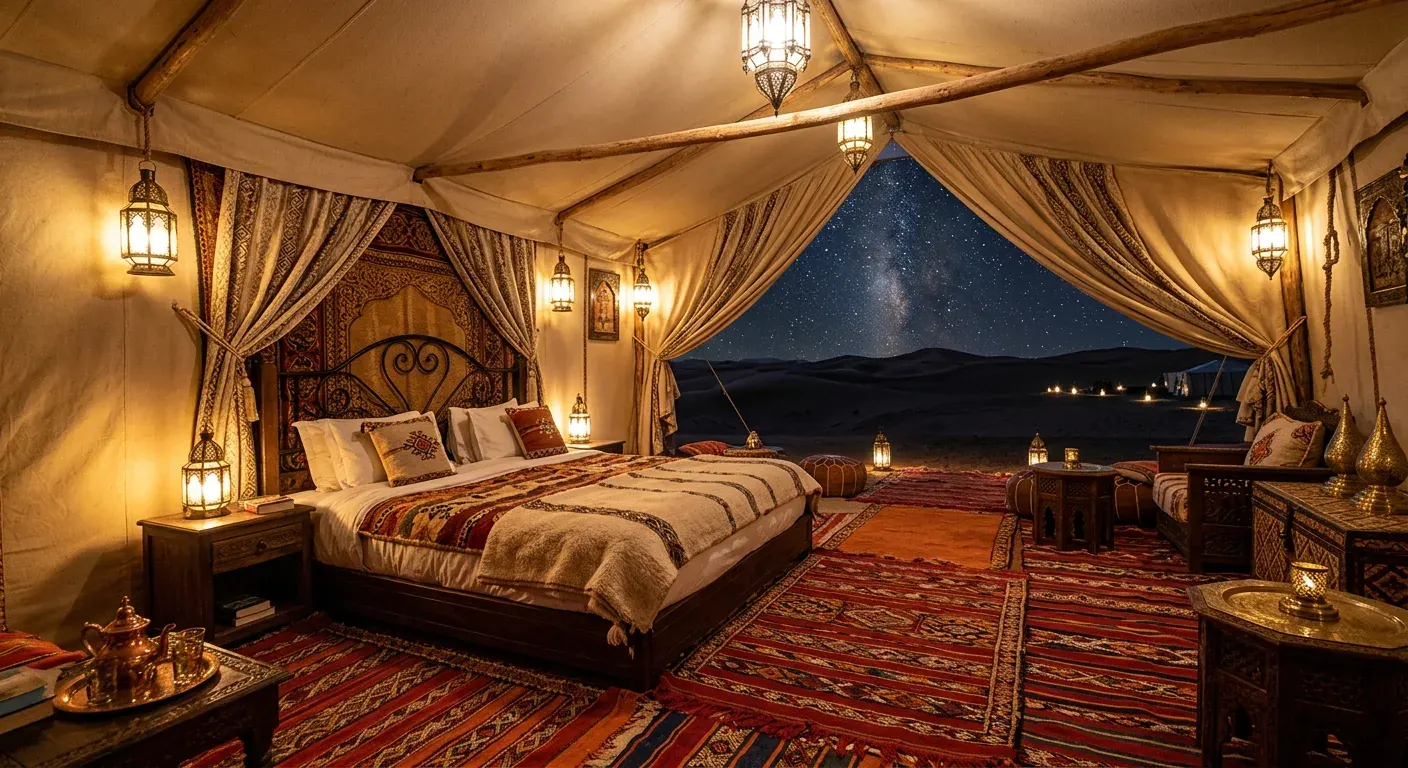
The private desert journey from Marrakech — over the Tizi n'Tichka pass, through the kasbahs and gorges to a luxury camp at Merzouga — is one of the world's great overland experiences. This guide covers every stage of a chauffeur-guided circuit, from the route and the camps to timings and the touches that make it unforgettable.
In this guide
How long does a desert tour from Marrakech take?
The distance from Marrakech to Merzouga (Erg Chebbi dunes) is approximately 560 km one-way via the N9 Tizi n'Tichka pass and Ouarzazate. A full circuit — Marrakech out, Merzouga, return via a different route — covers roughly 1,100–1,200 km. The standard tour runs three to five days; three days is the bare minimum to reach the dunes and return without the journey feeling entirely rushed.
For a luxury trip, a private chauffeur-guide is the only way to do this journey justice — your own pace, your own stops, fine kasbah-lodges and a genuine luxury camp, with everything pre-arranged. We typically build in three to four days so the gorges, the kasbahs and the dunes can each be savoured rather than glimpsed; for the time-pressed, a private helicopter can replace the outbound drive entirely.
- 1-day: dunes not reachable — only Ouarzazate and Aït Ben Haddou are feasible.
- 2-day: reaches Merzouga but the return journey is punishing with no overnight in the dunes.
- 3-day: the standard — Marrakech → Aït Ben Haddou → Dades → Merzouga → Marrakech.
- 4–5 day: adds Todra Gorge, Drâa Valley, Erg Chigaga or proper Atlas trekking.
What is the route from Marrakech to the Sahara?
The classic outbound route crosses the High Atlas via the Tizi n'Tichka pass (2,260 m), the highest paved mountain pass in Morocco. The road climbs through Berber villages and pine forests before descending into the pre-Saharan plains around Ouarzazate. After an optional stop at the UNESCO-listed ksar of Aït Ben Haddou — a mud-brick fortified village used as a film set for Gladiator, Game of Thrones and Lawrence of Arabia — the route follows the Valley of a Thousand Kasbahs south-east through Skoura, the Dadès Gorge and the Rose Valley towards Merzouga.
Many tours take a different return route via Rissani, Er Rachidia and the Ziz Valley, avoiding repetition and offering a different perspective on the Moroccan south. Some operators extend the circuit to include Erg Chigaga (reached via M'Hamid, to the west of Merzouga), a more remote and less-visited dune field that requires a 4WD for the final piste approach.
What should you expect at the Sahara?
At Merzouga, the Erg Chebbi dune field rises directly from the flat hammada to a height of up to 150 m. At a luxury camp the late-afternoon arrival is by private camel; the evening unfolds with a candlelit dinner, Gnaoua musicians and a sky thick with stars; and the private sunrise over the dunes, before any day-tripper stirs, is the moment most guests remember above all. A telescope session, a champagne sundowner on the dune or a dawn balloon flight can be added.
The choice of camp transforms the experience. A true luxury camp offers private ensuite tents with fine linen, hot showers, refined dining and butler-style service in genuine seclusion — worlds apart from a basic tented affair. We match you to the right one. In high summer (July–August), Merzouga exceeds 45°C and the desert becomes endurance; October to April is the ideal Sahara window.
- Sunrise or sunset dune climb: 30–60 minutes each way on foot; the view from the crest is worth it.
- Camel trek: 45–90 minutes each way; dromedaries (one hump) are comfortable for most adults.
- Sandboarding: basic boards available at most camps; conditions vary by wind.
- Quad biking: widely offered but noisy and disruptive to the dune environment — a personal choice.
What does a desert tour from Marrakech cost?
A luxury private circuit — a chauffeur-guide throughout, boutique kasbah-lodges en route and a top-tier luxury camp at the dunes — typically starts from around USD 1,500–2,500 per person for three or four days, rising with signature camps, helicopter legs and bespoke touches such as private dining or a balloon flight. The figure reflects the standard of accommodation and the degree of seclusion rather than the distance covered.
A more pared-back private circuit using comfortable guesthouses sits lower, while the absolute top end — the finest camps, full helicopter transfers, private experiences throughout — climbs well beyond. We tailor each element to your taste so the spend lands where it matters most to you.
Practical tips for the Marrakech desert tour
Book your Marrakech accommodation flexibly: a reputable riad in the medina will hold your bags while you are on the desert circuit and let you check back in on your return without requiring a booking for each night. Bring cash (Moroccan dirhams) for guesthouses that do not accept cards and for any roadside stops. ATMs at Ouarzazate and Zagora are reliable; Merzouga village has a basic ATM that sometimes runs low on cash.
Pack a scarf or shemagh for the desert — sand gets into everything. A head torch is essential for navigating camp in the dark. Leave valuables locked in your car or the riad safe; there is no security risk at camps but there is no need to carry them.
- Depart Marrakech early (07:00–08:00) to reach Aït Ben Haddou before midday crowds.
- Tizi n'Tichka pass closes in heavy snow (Jan–Feb) — check conditions in winter.
- The road from Ouarzazate to Merzouga is fully paved; no 4WD needed on the standard route.
- Book the desert camp in advance for October–March — demand is high during peak season.
Frequently asked
Can you do a desert tour from Marrakech without a guide?
Yes — the route to Merzouga is fully paved and self-drivable. That said, a driver-guide adds real value: local knowledge of the best kasbahs, off-the-beaten-track stops, and the ability to arrange the desert camp and handle any logistics issues. Many travellers hire a car in Marrakech and self-drive, booking guesthouses and the camp independently online.
Is the Marrakech to Merzouga drive safe?
Yes. The main route via N9 and N10 is paved throughout and in reasonable condition. The Tizi n'Tichka mountain pass involves steep switchbacks but is manageable in a standard car. Avoid night driving on mountain sections; plan to arrive at your overnight stop before dark.
When is the best time for a desert tour from Marrakech?
October to April for the Sahara: comfortable temperatures in the dunes (15–25°C daytime in winter), cool nights and reliable sunrises. Spring (March–May) is the best all-round season — the Atlas is green, the roses bloom in the Dadès and the desert is warm but not punishing. Avoid July–August in the south unless you are heat-adapted.
What is Aït Ben Haddou and is it worth a stop?
Aït Ben Haddou is a UNESCO World Heritage-listed ksar (fortified mud-brick village) on the outskirts of Ouarzazate. It is genuinely impressive — a well-preserved example of southern Moroccan vernacular architecture — and worth an hour's walk through. It has been used as a film location for dozens of productions. Most desert tours stop there naturally en route; skip it only if you are pressed for time.
Do I need to book the desert camp in advance?
Yes, particularly October to March (peak season) and around Moroccan public holidays. In summer, walk-in is possible but camp quality drops as the best operators are already booked. Book at least two to three weeks ahead in high season; a month ahead for the top luxury camps.
Planning a trip?
Let our team handle the details.
Tell us your dates and style and we'll send a written itinerary and a transparent quote. We confirm by email within 24 hours.
Request an itineraryKeep reading
Planning
Sahara Desert Tour Guide: Merzouga, Chigaga & Zagora
Three Saharan gateways await the luxury desert traveller: Erg Chebbi at Merzouga for accessibility and grandeur, the wild and exclusive Erg Chigaga near M'Hamid for true seclusion, and Zagora for a shorter escape. Here is how to choose, what a genuine luxury camp is really like, and when to go.
Practical
Marrakech to Merzouga: Routes, Times & Transport Options
Merzouga and the Erg Chebbi dunes lie roughly 550 km from Marrakech — and with a private chauffeur-guide, the journey across the High Atlas and the kasbah road becomes one of the great drives of North Africa rather than a transfer to endure. Here are the routes, the timings, and how to do it in comfort (including by helicopter).