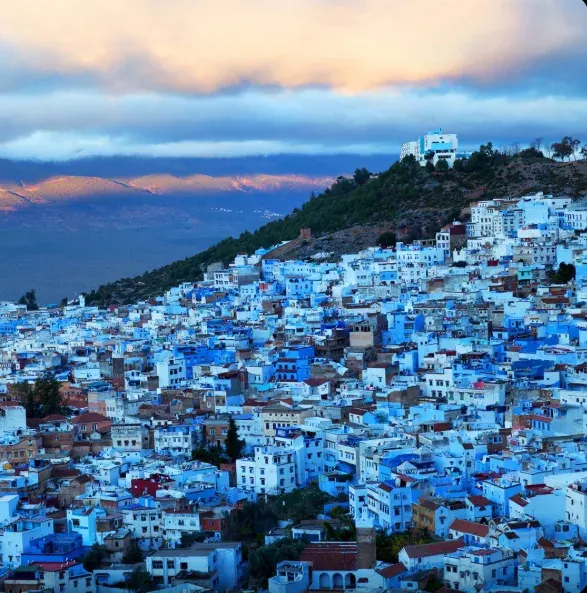
Chefchaouen — Morocco's famous blue city in the Rif Mountains — is more than a photographer's dream. Its medina is small, walkable and genuinely beautiful, best savoured at dawn before the crowds with a private guide; its mountains reward gentle walks; its Rifian food is distinctive; and its slow, hushed pace makes it a serene interlude on a luxury northern itinerary.
In this guide
What is there to see in Chefchaouen's medina?
The medina of Chefchaouen is compact — you can walk it end to end in 20 minutes — which makes it one of the most manageable in Morocco. The Place Uta el-Hammam, the central square, is where most visitors converge: a café-ringed space with an 18th-century kasbah on one side and a 15th-century mosque on the other. The kasbah (now a museum with ethnographic displays and a terraced garden) offers the best elevated view of the square and the red-tile rooftops above the blue walls.
The real pleasure of Chefchaouen is wandering without a fixed itinerary. Every lane produces a new shade of blue — indigo, cobalt, powder, sky — applied to walls, steps, pots and doorframes. The blue is a historical tradition with debated origins: some attribute it to the Jewish community that settled here in the 15th century (blue being a sacred colour in Jewish tradition); others say it was applied wholesale in the 1930s to deter mosquitoes. Whatever the source, the effect is genuinely beautiful and photographs effortlessly in the morning and late-afternoon light.
- Place Uta el-Hammam — the central square; cafés, kasbah gate, mosque minaret.
- Kasbah museum — ethnographic displays and gardens; best viewpoint in the medina.
- Ras el-Maa waterfall — 5-minute walk from the medina; local women do laundry in the stream above.
- Bab Onsar — the eastern gate; quieter neighbourhood beyond it worth exploring.
- The blue lane (Rue Targui and side alleys off Rue Ibn Askar) — the most photogenic passages.
What outdoor activities are there near Chefchaouen?
The Rif Mountains surrounding Chefchaouen are underappreciated as a hiking destination. The most popular walk is to the Spanish Mosque on the hill above the medina — a 30-minute climb, the ruined mosque has a spectacular view of the city's blue roofscape against the mountain backdrop and is best at sunset. The Talassemtane National Park, immediately above the city, has marked trails through cedar and fir forest with panoramas over the Rif.
For a more serious hike, the Jbel el-Kelaa circuit (1,616 m summit) takes a full day and requires a local guide; the trail passes through Berber villages and forested ridge-lines. A gentler option is the Cascades d'Akchour — a 7 km trail from a car park east of the city that follows a river gorge past a series of waterfalls, culminating in the 'God's Bridge' natural arch. This is one of the most beautiful half-day walks in northern Morocco.
- Spanish Mosque — 30 min climb; best sunset view of the blue city.
- Cascades d'Akchour — 7 km river gorge walk; waterfalls and God's Bridge natural arch.
- Talassemtane National Park — cedar forest trails; panoramic ridge views.
- Jbel el-Kelaa — full-day summit hike with a local guide.
What is Rifian food like in Chefchaouen?
The cuisine of Chefchaouen is distinct from the Marrakchi tagine tradition. The Rif Mountains produce good goat's cheese, olives, wild herbs and a locally grown cannabis crop (kif) that has been cultivated here for centuries — evident in the prevalence of kif-selling in the hills above the city, though purchase and possession are illegal. The food is simpler and fresher than in the imperial cities: herb-crusted trout from the river, msemen flatbreads with honey and olive oil, and a goat's cheese (jben) that appears on every breakfast table.
The square is lined with cafés that serve good coffee and mint tea. The best restaurants in the medina are small family-run operations in the lanes off Place Uta el-Hammam: Bab Ssour and Chez Aziz are consistently well-regarded for Rifian lamb and trout dishes. For an evening meal with a medina view, the rooftop restaurants on the southern edge of the square are atmospheric if not always the most accomplished kitchens.
Where to stay in Chefchaouen and how to get there?
Chefchaouen's guesthouses (called dar rather than riad in the north) are mostly small, family-run and beautifully positioned in the medina; the most charming sit in the upper, quieter quarter near the Bab Onsar gate, away from the square's evening hum, with roof terraces overlooking the blue rooftops and the Rif beyond. The town has no grand hotels — its luxury is in atmosphere, seclusion and a perfectly placed terrace at sunset. We select the most characterful houses and pair them with a private guide and a chauffeur for the scenic transfers in and out.
Getting to Chefchaouen: there is no airport. CTM buses connect from Fes (4–5 hours), Tangier (3 hours) and Casablanca (5–6 hours). Private drivers from Fes (the most common approach) take 3.5–4 hours through mountain scenery. From Tangier it is a spectacular 2.5–3 hour mountain drive. There are no buses from Marrakech — a private driver or a flight to Fes then road transfer is the approach.
Frequently asked
Why is Chefchaouen blue?
The predominant theory attributes the blue-washing to the Jewish community that settled here after the Reconquista of 1492 — blue being a sacred colour in Jewish tradition representing the sky and divinity. A secondary theory links it to a 1930s application intended to deter mosquitoes. Whatever the origin, the practice was adopted by the wider community and has been maintained and intensified as a point of civic pride and identity ever since.
How many days should you spend in Chefchaouen?
Two nights is the comfortable standard: a day to explore the medina and hike to the Spanish Mosque, and a second day for the Cascades d'Akchour or a longer Rif mountain hike. One night is possible but feels rushed; three nights suits those who want to slow down and hike properly.
Is Chefchaouen worth visiting?
Yes — but go with calibrated expectations. The blue medina is genuinely beautiful, the mountains are excellent, and the pace is the most relaxed in Morocco. It is not, however, a city of great historic monuments on the scale of Fes or Marrakech; the reward is atmosphere, walking and scenery rather than architectural landmarks.
What is the best time to visit Chefchaouen?
Spring (March–May) and autumn (September–October) are ideal — the mountains are green or golden, temperatures are comfortable (15–22°C in the medina), and the light in the blue lanes is beautiful. Summer is warm and busy with Moroccan domestic tourists. Winter brings rain and sometimes snow on the Rif peaks; the medina is quiet and atmospheric if you don't mind cold evenings.
Is Chefchaouen safe?
Yes. It is one of the most relaxed and tourist-friendly medinas in Morocco. The kif trade is visible in the hills above the city but is not a safety issue for visitors who do not seek it out. The medina is compact enough that getting seriously lost is unlikely.
Planning a trip?
Let our team handle the details.
Tell us your dates and style and we'll send a written itinerary and a transparent quote. We confirm by email within 24 hours.
Request an itineraryKeep reading
Planning
The Best Time to Visit Morocco in Luxury
For a private, riad-led journey, spring (March–May) and autumn (September–November) are the connoisseur's windows — warm days, cool palace-courtyard evenings, and the desert, the Atlas and the imperial cities all showing their finest. The season you choose shapes the entire mood of the trip.
Itineraries
Morocco Itinerary: 14 Days — The Grand Two-Week Route
Two weeks is enough to savour Morocco's full sweep in true comfort: the imperial cities of the north, the High Atlas, the kasbah road, a luxury night in the Sahara and the wild Atlantic coast — all privately guided, riad to riad, at a genuinely unhurried pace.
Planning
Things to Do in Fes: The Essential Guide
Fes el-Bali is the world's largest inhabited medieval city — a UNESCO medina of 9,400 lanes, 14th-century madrasas, the planet's oldest university and the Chouara tanneries. It is Morocco's most spellbinding city for the cultured traveller, best explored with a private historian-guide, a palace-riad for a base, and unhurried time.
Culture
Morocco Photography Guide
Morocco is among the world's great photography destinations: extraordinary light, vivid colour, ancient architecture and a landscape that shifts from blue city lanes to red dunes in a day. With a private guide opening doors and timing your visits to the golden hour — even arranging a hot-air-balloon dawn or a quiet, after-hours monument — the images come effortlessly.