Seven days is the perfect measure for a first journey through Morocco — long enough to feel the full arc of the country, short enough to spare you the fatigue of chasing everything. The loop below we have refined over hundreds of private journeys: imperial cities, mountain passes, the desert and canyon roads, with not a single wasted hour and a beautiful place to rest at the end of each.
Day 1 — Arrive in Marrakech: settle and slow down
Most flights land in the afternoon. Resist plunging straight into the medina — jet lag and sensory rush make poor companions. Let your riad receive you instead: a glass of mint tea, the roof terrace at sunset, a candlelit dinner in the courtyard. This first evening sets the tempo for the week. Your chauffeur-guide meets you at arrivals and, with a porter, walks you through the lane to the door — part of the welcome.
Day 2 — Marrakech: the medina at its own pace
Begin early, before the heat builds and Djemaa el-Fna fills with smoke. The souks at nine are another world: traders arranging their stalls, light falling through the reed ceiling, no pressure to buy. The Ben Youssef Medersa rewards a slow hour with your private guide. Lunch in an intimate medina room rather than the tourist tables on the square. The afternoon is yours — the silversmiths of the Mellah, the garden quarter, or a long hammam and a rest before a fine dinner.
Day 3 — The High Atlas and Ouarzazate: over the Tizi n'Tichka
Leave Marrakech by eight to take the pass before the midday heat. The Tizi n'Tichka (2,260 m) is Morocco's highest paved road and among its most dramatic — red rock faces, Berber villages on improbable ledges, argan giving way to bare scree. We pause at Aït Ben Haddou for a private walk through the ksar and a leisurely lunch, then continue to Ouarzazate for the night, with dinner on a rooftop above the kasbah walls.
Day 4 — The Road of a Thousand Kasbahs to the Dades Gorge
The N10 east of Ouarzazate is one of Africa's great drives. We pause at Skoura to wander the palmery and Kasbah Amerhidil, the kasbahs multiplying as the road sinks into the pre-Saharan plain — Kelaa M'Gouna in rose season (April–May) is heady with scent. We reach the Dades Gorge by late afternoon, the canyon turning blood-red at dusk, and settle into a lovely lodge above the valley floor for a simple, excellent dinner.
Day 5 — Todra Canyon and on to Merzouga
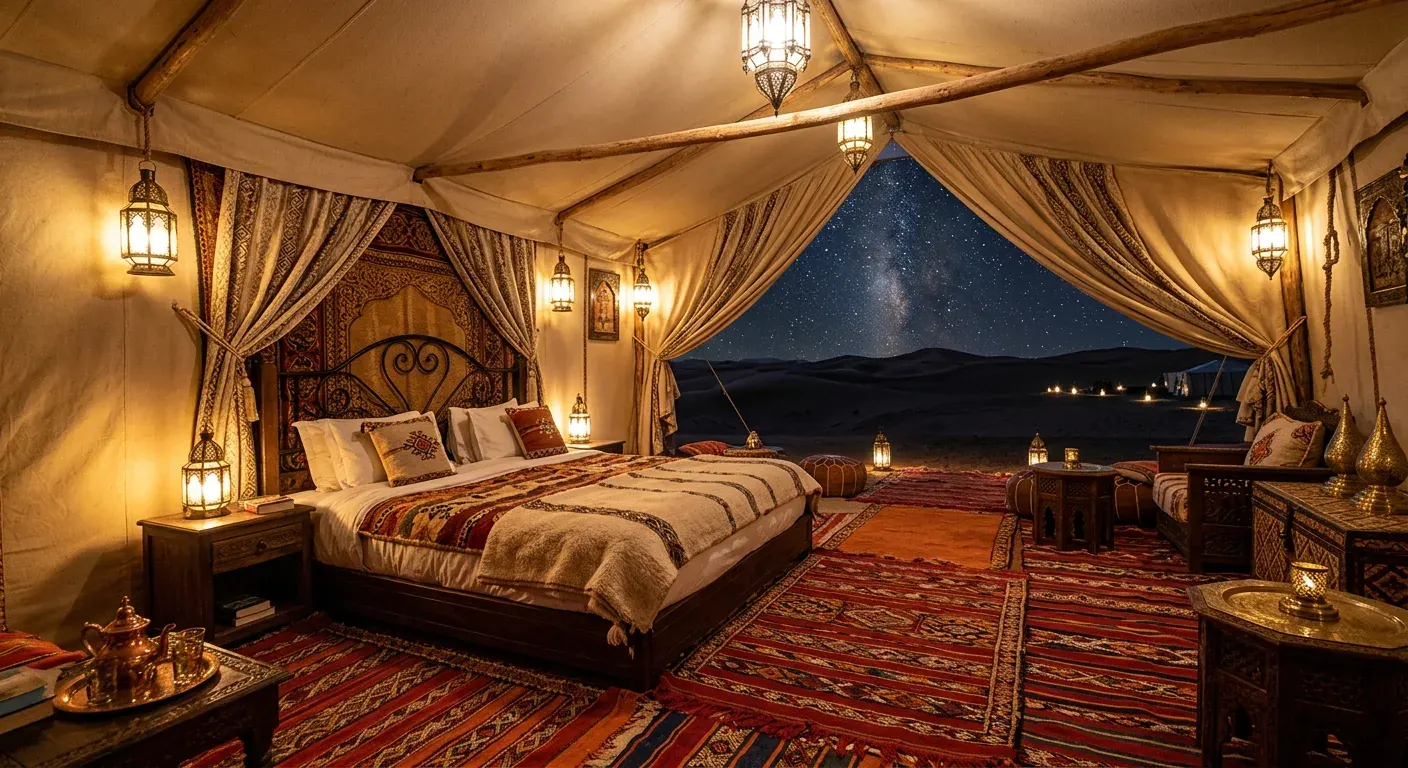
An early drive north brings you to the Todra Gorge by nine — a slot canyon with 300-metre walls that narrows to eight at its tightest, the morning light at its most beautiful. We walk the canyon floor before the coaches arrive, then cross the stony hammada to Merzouga and the Erg Chebbi dunes, reaching your luxury camp before sunset. The camel ride into the dunes is yours to choose; the candlelit dinner beneath an unpolluted sky is the reason you came.
Day 6 — Sahara dawn and the road north to Fès
Wake before dawn — the early hour forgiven the moment the dunes turn amber. Coffee in camp, then the long northward drive through Erfoud and Rich and the Middle Atlas cedar forests, arriving in Fès by early evening. It is a travel day, but the scenery through Azrou and Ifrane rewards open eyes, and we break it gracefully. Settle into your riad in Fès el-Bali — the largest car-free old city in the world — before a Fassi dinner.
Day 7 — Fès el-Bali: tanneries, medersa and farewell
Fès deserves an unhurried final day. The Bou Inania Medersa is among the finest stucco and zellige work in the country; the Chouara tanneries are loveliest from the leather-shop terraces before eleven, when the vats are alive with colour. The Andalusian quarter across the river is quieter and almost untouristed. A last lunch in an intimate room, then a private transfer to the airport for your evening flight. Seven days, one country, a lifetime of memory.
Frequently asked
Is seven days enough to experience Morocco?
Seven days makes for a deeply rewarding first journey when the loop stays elegant: Marrakech, the High Atlas, Aït Ben Haddou, the Dades Gorge, the Sahara at Merzouga, and Fès. Adding the north (Chefchaouen, Tangier) in the same week only rushes everything. We pace it so each place is savoured, never ticked off.
What is the best time of year for this journey?
March–May and September–November bring the loveliest balance of mild days and clear skies. The Sahara and desert valleys can touch 40°C in July and August, turning a sunrise camel ride from magical into trying. December–February is delightful in the cities, though the high passes occasionally close after snow.
Should we fly into Marrakech or Casablanca?
For this loop, Marrakech in and Fès out (or the reverse) is the most graceful, sparing you any doubling back; both airports connect directly to most European hubs. A short internal flight between the two cities is easy if you prefer to begin and end in one place. We arrange every transfer and the private welcome at arrivals.
How is a private seven-day journey arranged?
Entirely around you — a private chauffeur-guide, hand-chosen riads and a luxury desert camp, most meals and all transfers, with the pace, the houses and the detours shaped to your wishes. We can take a riad as an exclusive-use buy-out for couples, and quote precisely once we understand how you like to travel.
Could we do this itinerary without a guide?
You could — the roads are paved and the riads speak English. But a private chauffeur-guide unlocks the local knowledge, handles the medina parking, opens the right doors and reroutes around any closure, leaving you free simply to enjoy the country. For a first visit, our guests find it transforms the journey entirely.
What should we pack for a seven-day journey?
Light layers serve year-round: High Atlas mornings are cool even in summer, desert afternoons hot. Comfortable shoes are essential — medina cobbles defeat suitcase wheels. A light scarf covers shoulders at mosques and keeps the dust at bay in the desert. Bring a small daypack and leave the larger luggage in your riad; we move it ahead for you.
Ready to plan?
We will compose this journey around you.
Every Morocco Honeymoons journey is private and bespoke — the pace, the riads and camps, and the detours all shaped to your wishes. Share your dates and we will return a tailored proposal within 24 hours.