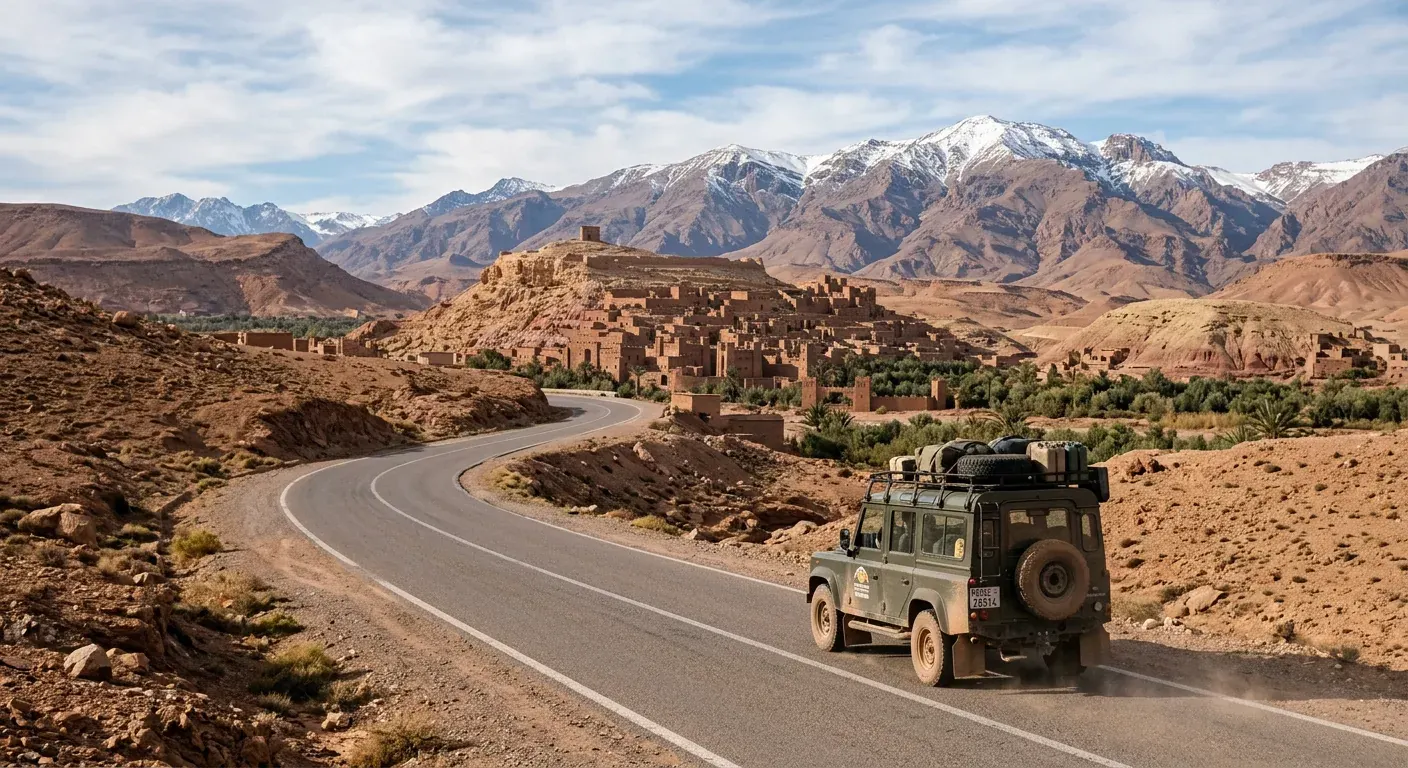
Few countries reward travel by road like Morocco — the landscapes change by the hour, the mountain passes are sublime, and the chance to pause at a roadside souk on a whim is genuine. It is also a country where the driving demands your whole attention. Here is what we tell guests who ask, candidly, whether to take the wheel themselves — and why most decide the view is better savoured from the passenger seat.
What are Moroccan roads truly like?
The motorway network — the autoroutes — linking Casablanca, Rabat, Fès, Marrakech and Tangier is excellent: smooth, tolled, clearly signed. Beyond them the picture varies. National routes (prefixed N) through the south and east are paved and generally sound, but narrow — two lorries passing can leave only centimetres. Provincial roads (R-prefix) deteriorate quickly after rain. Pistes — the unpaved tracks into the mountains and pre-Saharan valleys — call for a high-clearance 4x4, the kind our chauffeurs drive with ease and you would never want to attempt in a standard hire car.
How do police checkpoints work?
Checkpoints (barrages) are simply part of Moroccan road travel. An officer steps into the road with a baton; you slow and stop. Passport, licence and rental contract should be to hand. Officers check speed by radar and occasionally breathalyse — Morocco holds a zero-tolerance drink-driving law, the limit being 0.0 g/L. A calm, courteous word and you are on your way; any fine is settled in dirhams on the spot, with a receipt (un reçu, s'il vous plaît). With our chauffeur driving, these exchanges unfold in fluent local language while you sit back undisturbed.
Can you park inside the medinas?
The historic medinas of Marrakech, Fès, Meknès and most old cities are car-free. You park in a supervised lot outside the walls — gardiens charge 10–20 MAD a day — and walk in through the gates. In Fès el-Bali there is no alternative: the lanes are too narrow for a motorbike in places. Your riad sends someone to meet you at the nearest landmark and carry the luggage in. When we manage the journey, your chauffeur and a porter handle every handover, so arriving feels like part of the welcome rather than a puzzle.
What does car hire actually cost in Morocco?
A small manual (Dacia Sandero category) runs roughly US$25–40 per day from the international agencies (Avis, Hertz, Europcar) at Marrakech or Casablanca airports. Local outfits advertise less, but their insurance and breakdown cover are often thin — read the fine print, and pay for full collision damage waiver and theft protection. Petrol is around US$1.20 a litre, diesel a touch less, with stations plentiful on main routes. Worth knowing, even if you ultimately prefer to leave the arithmetic and the wheel to us.
Why most of our guests travel by private chauffeur
We arrange private chauffeur-guides for a living, so take our view as you will — yet the reasons guests give, often after trying to self-drive first, are remarkably consistent: the passes were more nerve-testing than expected, parking at every stop drained hours, the checkpoints felt awkward, and the holiday became about the road rather than the country. A chauffeur-guide dissolves all of it. You gain a local confidant, a fixer and a translator — someone who knows exactly which viewpoint to pause at on the Tizi n'Tichka, which café pours the best mint tea, which artisan is worth your afternoon. The drive becomes part of the journey rather than a tax on it. See our chauffeur-guide service for details.
If you do choose to self-drive
- Never drive after dark beyond the cities — livestock and unlit mopeds are serious hazards.
- Download offline maps (Maps.me or Google Maps offline) before you set out — signal vanishes in the mountains and desert.
- Keep a physical copy of your rental contract, insurance and passport page in the car.
- Refill whenever you drop below half a tank — stations thin out east of Ouarzazate and between Erfoud and Merzouga.
- Stay on paved roads unless you have a 4x4 and a trusted contact at your destination.
- At a checkpoint: engine off, window down, hands visible on the wheel — unhurried and calm.
Frequently asked
Is it safe to drive in Morocco as a foreigner?
Morocco can be driven, but it asks for more attention than Western European roads. City rules are loosely observed, pedestrians step out without warning, and mountain roads run without barriers. For a holiday meant to feel effortless — and certainly for a honeymoon — most of our guests prefer to leave the wheel to a private chauffeur-guide and simply watch the country unfold.
What documents do I need to rent a car in Morocco?
For most nationalities a valid home driving licence suffices — no International Driving Permit is required. Add your passport, a credit card in your name, and a minimum age of 21 (sometimes 23 for larger vehicles). The rental contract and insurance certificate must stay in the car. When we arrange a chauffeured vehicle, of course, none of this falls to you.
Do police in Morocco stop tourists frequently?
Checkpoints are routine on intercity routes — an officer steps into the road with a baton, you slow and stop. Have your passport and rental contract to hand; a brief, courteous exchange and you are waved on. With a chauffeur-guide at the wheel, these moments pass in fluent local French or Arabic while you remain entirely at ease.
What is the speed limit in Morocco?
Urban areas: 40–60 km/h. Open roads: 100 km/h. Motorways (autoroutes): 120 km/h. Speed cameras are common and radar is used at checkpoints, with fines settled on the spot in dirhams. Road signs follow European conventions. Our chauffeurs know every limit and every camera on the route, so the journey stays smooth.
Is it better to hire a driver than self-drive in Morocco?
For most discerning travellers, unreservedly yes. A private chauffeur-guide removes every friction — medina parking, mountain nerves, checkpoints, navigating without signal — and adds a depth of local knowledge no app can match: the right viewpoint, the unmarked lunch, the artisan worth meeting. Over a week or more, it transforms the trip from logistics into pure pleasure.
Can I drive between cities at night in Morocco?
We strongly advise against it. Unlit mopeds, livestock on the carriageway, unmarked speed bumps and fatigue make night driving the single greatest risk for visitors. We plan every transfer to arrive before dusk — and where an evening drive is unavoidable, our chauffeurs, who know the roads intimately, handle it for you.
Leave the road to us
Let a private chauffeur-guide take the wheel.
The chauffeur-guides we work with are English-speaking and intimately familiar with every route in this guide. We can pair your chauffeur with a specialist local guide at each destination, for an even richer, more personal immersion.