We are asked this more than anything else. The short answer: yes, Morocco is safe for the great majority of travellers, and has been for decades. The fuller answer — the one worth reading — turns on where you go, how you travel, and what you are genuinely weighing. Here is what we tell our guests candidly, with no marketing gloss, and how travelling privately removes almost every friction from the equation.
What do the official advisories actually say?
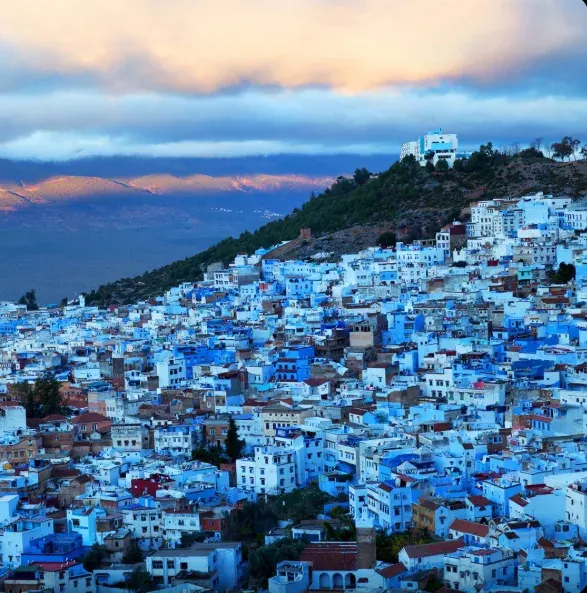
As of 2026, both the UK Foreign, Commonwealth & Development Office (FCDO) and the US State Department rate Morocco as exercise normal precautions for the main tourist areas — the same rating applied to France, Spain and Portugal. The caution level rises to exercise increased caution near the Algerian border and in certain Saharan border areas, which are already off the standard tourist circuit. The popular routes — Marrakech, Fès, Chefchaouen, the Drâa Valley, Merzouga, Essaouira — fall within the lowest advisory tier.
Morocco's tourist police (police touristique) are uniformed and visible in every major medina, and CCTV across Marrakech's Djemaa el-Fna and the main souks has grown markedly in recent years. This is a country whose prosperity rests on tourism, and which invests accordingly in protecting its visitors.
Is it safe for women travelling alone?
Candidly, solo female travel in Morocco is wholly feasible and very common — though it asks for a different alertness than, say, Scandinavia. Verbal attention — comments, persistent shop invitations — exists and is more frequent than in northern Europe, but it is almost always words alone; physical crime against solo women travellers is genuinely rare.
What makes the real difference: a modest layer over bare shoulders in the medinas; walking with purpose; a vetted riad whose staff know your name and your plans; a private guide for those first medina hours rather than navigating alone; and your host a message away. With a private chauffeur-guide carrying the logistics, almost every point of friction simply dissolves — and the women we host overwhelmingly describe a relaxed, joyful trip.
What approaches should you know about?
Morocco's well-known schemes are social and financial, never violent. The most common:
- The helpful guide: someone offers to walk you to your destination "for free," then asks payment. Decline unsolicited offers; your private guide makes them moot.
- The closed attraction: a stranger says a mosque, museum or square is shut and proposes an alternative — often a family shop. Your guide or riad confirms the truth in a moment.
- The tea invitation: a shopkeeper invites you upstairs for mint tea, then presses you to buy once seated. Tea is a sincere Moroccan welcome, but in a shop it often carries an expectation. Accept if you wish to browse; leave warmly if not.
- Unofficial taxis: unlicensed drivers at airports and stations. We arrange your transfers in advance, so you step straight into a trusted private car.
None involve force; they rely on a traveller's reluctance to seem impolite. A calm, warm "no thank you" always suffices — and travelling with a guide, you will rarely be approached at all.
How safe are rural Morocco and the mountains?
The High Atlas, Drâa Valley, anti-Atlas and pre-Saharan villages are, in terms of crime, among the safest places in the country. Rural Berber communities hold a profound tradition of hospitality, and petty crime is far rarer than in the busy medinas. The real concerns here are of the landscape — flash flooding in narrow valleys between October and March, and altitude above 3,000 metres. For any multi-day trek we arrange a licensed local mountain guide, so the wild beauty comes with quiet expertise alongside.
The 2023 earthquake near Al Haouz damaged villages across the High Atlas. By 2026 most main trekking routes — the Toubkal circuit among them — have been restored and welcome visitors, though some remote villages remain in reconstruction. We confirm specific trail and lodge access for you before you set out.
What health precautions are worth taking?
Routine vaccinations — tetanus, hepatitis A — are sensible before any visit, with hepatitis B and typhoid worth a word with your doctor for extended rural stays. Tap water outside the finest hotels is not reliably safe; drink sealed bottled water and pass on ice in casual cafés.
Food in proper restaurants is generally very safe, and the kitchens we choose for you all the more so; street food is fine when hot and freshly cooked. A mild upset in the first days usually owes to unfamiliar spice and oil rather than any infection. Pack rehydration sachets and an antihistamine, and carry whatever your doctor advises. Travel insurance with medical evacuation cover is essential, since international-standard private hospitals are concentrated in Casablanca and Marrakech.
Our candid bottom line
Morocco is a rich, vivid country that rewards those who arrive with curiosity and a little common sense. The risks are real but proportionate — on a par with any great city, and well below many. We have designed private journeys here for years, and the overwhelming majority of our guests leave already planning their return. For a trip shaped to feel utterly effortless — private transfers, vetted houses, a chauffeur-guide throughout and discreet support from our team during your trip — we are here to compose it.
For further reading, see our Morocco travel guides and destination overviews.
Frequently asked
Is Morocco safe for solo female travellers in 2026?
Yes, with awareness — and considerably more so when you travel privately. Millions of women visit Morocco each year without incident, and Marrakech, Fès, Chefchaouen and the Atlantic coast are well-trodden and generally safe. Verbal attention in the medinas exists; physical crime against visitors is rare. A private chauffeur-guide, a vetted riad with round-the-clock staff, and a modest wardrobe make the experience feel seamless and unbothered from the moment you arrive.
What approaches targeting tourists are worth knowing about in Morocco?
The familiar ones are social, not violent: a 'friendly local' who walks you to your riad and then asks payment; a shopkeeper who shows you a rooftop view and then presses you to buy tea; a landmark declared 'closed' until a fee appears. They rely on politeness, not force. Travelling with a private guide quietly removes all of it — the medina knows them, and the approaches simply stop.
Is it safe to travel to rural Morocco and the Atlas Mountains?
Very much so. The High Atlas, Drâa Valley and pre-Saharan villages are among the most peaceful places in the country, with a deep culture of hospitality. For trekking we arrange a licensed mountain guide — less for any question of crime than for navigation and weather. We monitor official advisories for the remote border regions, which sit well off the journeys we design.
What health precautions should I take before visiting Morocco?
Routine vaccinations (tetanus, hepatitis A) are sensible; hepatitis B and typhoid are worth a word with your doctor for extended rural travel. Drink sealed bottled water and skip ice in casual cafés. Food in proper restaurants — and certainly in the kitchens we choose for you — is safe, and street food is low risk when hot and freshly cooked. Pack a small kit with rehydration salts, an antihistamine and any medication your doctor advises.
Has the safety situation in Morocco changed for 2026?
Morocco remains one of the most stable and welcoming countries in the region, with steady investment in tourist police, medina CCTV and registered guides. The 2023 earthquake affected parts of the High Atlas; most areas have been rebuilt and welcome visitors again, and we confirm specific site access for you in advance. Major advisories place Morocco at 'exercise normal precautions', as for many popular European destinations.
Should I buy travel insurance for Morocco?
Yes — always, and choose a policy that covers medical evacuation, since the finest private hospitals are concentrated in Casablanca and Marrakech. Helicopter evacuation from the Atlas or Sahara exists but is costly without cover. Declare any pre-existing conditions. We are glad to advise on the level of cover that suits your particular journey.
Travelling with complete peace of mind
We attend to every detail, from door to door.
Every Morocco Honeymoons journey includes WhatsApp support during your trip, vetted guides, hand-screened houses and private pre-arranged transfers — so your attention rests on the experience, never the logistics.
Request an itinerary