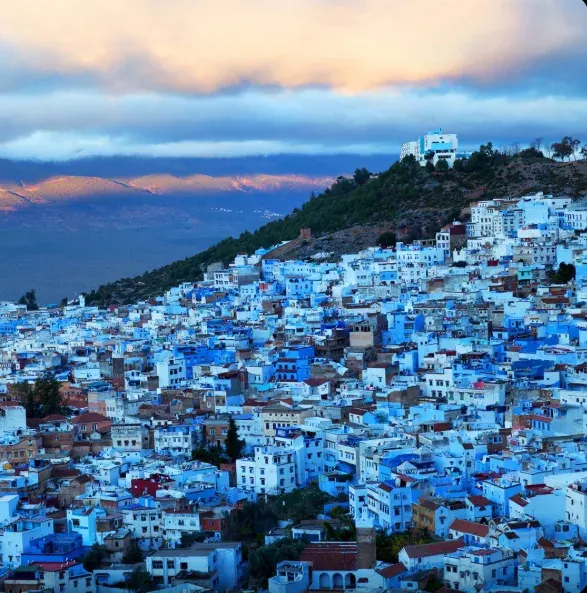
Chefchaouen is beautiful year-round, but spring (March–May) and autumn (September–October) bring the finest mix of mild weather, quieter lanes and exquisite light on the blue-washed medina. With a private guide and a dawn start, you have the famous alleys almost to yourselves. Here is what each season offers.
In this guide
What is the weather like in Chefchaouen throughout the year?
Chefchaouen sits at around 600 m altitude in the Rif Mountains of northern Morocco. Its mountain position gives it a noticeably more temperate climate than Marrakech or Fes — summers are warm rather than hot, and winters bring genuine cold, sometimes snow on the surrounding peaks. Daytime highs in July and August reach 30–34°C, which is entirely comfortable compared to the 40°C+ of inland Morocco. Evenings cool down quickly even in midsummer.
Winter (December–February) is cool and occasionally wet, with temperatures dropping to 3–7°C overnight. Light snow falls in the Rif above the city most winters, and the town itself occasionally sees brief flurries. Spring brings wildflowers and flowing streams in the surrounding hills; autumn delivers golden light and foliage on the mountain slopes.
When are crowds lowest in Chefchaouen?
Chefchaouen has become heavily photographed in recent years, and the iconic blue alleyways around Plaza Uta el-Hammam are busy with tourists and influencers from April through October. The quietest months are January, February and parts of November and December. If you want to photograph the medina with minimal strangers in the frame, plan to be out before 07:30 — the blue light of early morning is also the most photogenic.
August is surprisingly busy despite the heat, as Moroccan domestic tourism fills the town. Weekends throughout the year are busier than weekdays; if you have flexibility, a Monday to Thursday visit will be noticeably quieter than a Friday to Sunday one.
When is the best light for photography in Chefchaouen?
The blue-painted walls of the medina photograph best in the soft light of early morning (06:30–09:00) and the golden hour before sunset (17:00–19:00 in summer, 16:00–18:00 in winter). Midday light in summer is harsh and creates heavy shadows in the narrow alleys. Overcast days — common in winter — can actually produce beautifully even light on the blue walls without the glare.
March and October are considered the best photography months: soft spring and autumn light, wildflowers in March and foliage colour in October, and fewer tourists in the frame than summer.
- Best light: 06:30–09:00 and one hour before sunset.
- Best photography months: March–April and October.
- Avoid: July–August midday — harsh shadows and crowded alleys.
- Overcast days: surprisingly good for even blue-wall tones.
How does Chefchaouen compare to Fes and Marrakech for a visit?
Chefchaouen is a much smaller city than Fes or Marrakech — the medina can be walked fully in an hour or two. Most visitors spend one to two nights here as part of a northern Morocco circuit (Tangier, Chefchaouen, Fes) rather than a standalone trip. The town is significantly more laid-back than either imperial city; hustling and haggling are lower-pressure and the mountain setting gives it a completely different character.
The surrounding Rif Mountains offer trekking in the Talassemtane National Park, swimming in the Ain Tissimane natural pool and day hikes to the Spanish Mosque viewpoint above the town (a 30–45 minute walk, highly recommended at sunset). These activities make Chefchaouen appealing to travellers who want to combine a medina visit with some outdoor activity.
Practical tips for visiting Chefchaouen
Getting there: Chefchaouen has no train station. The most common approaches are by bus (CTM or Supratours) from Tangier (2–3 hours), Fes (3–4 hours) or Casablanca (5–6 hours), or by private transfer. The bus station is a 20-minute walk or short taxi ride from the medina entrance. Road access is good; self-drivers find parking just outside the medina walls.
Accommodation: the medina's most characterful guesthouses are small, family-run and beautifully positioned, with terraces over the blue rooftops; the best should be reserved well ahead for spring and autumn. A medina house is far superior to a hotel on the outskirts — being able to step out into the blue alleys at first light, before anyone else, is the entire point, and exactly what a private dawn stroll with your guide delivers.
- From Tangier: 2–3 hours by bus or taxi; most northern Morocco circuits start or end here.
- From Fes: 3–4 hours; the classic imperial cities extension.
- Time needed: 1–2 nights is standard; 3 nights for trekking and surrounding day trips.
- Book ahead: March–May and September–October see accommodation fill 2–4 weeks out.
- Blue paint: the medina walls are painted by residents for tradition and upkeep; touching respectfully is fine.
Frequently asked
Why is Chefchaouen painted blue?
The precise origins are debated. The most widely accepted account is that the Jewish community who settled here after expulsion from Spain in 1492 introduced the blue and white colour scheme — blue representing the sky and heaven in Jewish tradition. The tradition continued after the Jewish community emigrated and has been maintained by successive generations of residents. Today the medina is repainted regularly, and the shade of blue varies street by street from pale lavender to deep cobalt.
Is one day enough in Chefchaouen?
One full day is enough to walk the medina, visit the kasbah, climb to the Spanish Mosque viewpoint and have a meal in the square. But a single dawn in the blue alleys before the crowds arrive is the moment most travellers remember most — which means an overnight stay is strongly recommended rather than a day trip.
Is Chefchaouen worth visiting in winter?
Yes, if you accept that some days will be cold and overcast. January and February are the quietest months, riad rates are at their lowest and the blue medina is dramatically atmospheric in mist. Bring a warm jacket and waterproof layer; the mountains can be cold. The surrounding Rif are snowcapped in winter, which makes the town setting even more striking.
Can you day trip to Chefchaouen from Fes?
Technically yes — it is 3–4 hours by bus — but a day trip is not recommended. By the time you arrive, have a few hours in the medina and return, you will have spent 7–8 hours on the bus for 3–4 hours in the city. An overnight stay transforms the experience; you get dawn in the alleys and a sunset viewpoint, which are the two best moments.
What is the Spanish Mosque in Chefchaouen?
A ruined mosque on a hill above the medina, built during the Spanish Protectorate era (1920–1956) and never used for prayer. The viewpoint from the hilltop gives the classic panoramic view over the blue-washed medina and the mountains beyond. The walk up from the medina takes 30–45 minutes on a marked path; it is open at all hours and is the standard sunset and sunrise viewpoint for the town.
Planning a trip?
Let our team handle the details.
Tell us your dates and style and we'll send a written itinerary and a transparent quote. We confirm by email within 24 hours.
Request an itineraryKeep reading
Planning
Things to Do in Chefchaouen: The Essential Guide
Chefchaouen — Morocco's famous blue city in the Rif Mountains — is more than a photographer's dream. Its medina is small, walkable and genuinely beautiful, best savoured at dawn before the crowds with a private guide; its mountains reward gentle walks; its Rifian food is distinctive; and its slow, hushed pace makes it a serene interlude on a luxury northern itinerary.
Planning
The Best Time to Visit Morocco in Luxury
For a private, riad-led journey, spring (March–May) and autumn (September–November) are the connoisseur's windows — warm days, cool palace-courtyard evenings, and the desert, the Atlas and the imperial cities all showing their finest. The season you choose shapes the entire mood of the trip.
Planning
Trekking the Atlas Mountains: Toubkal, Imlil & Beyond
The High Atlas rises to 4,167 metres at Jbel Toubkal, North Africa's highest peak — and these mountains can be enjoyed in real comfort, from a gentle private walk with a long lunch at a luxury lodge to a guided multi-day traverse or a summit attempt. With the right season, a private mountain guide and the right base, the Atlas rewards every level.