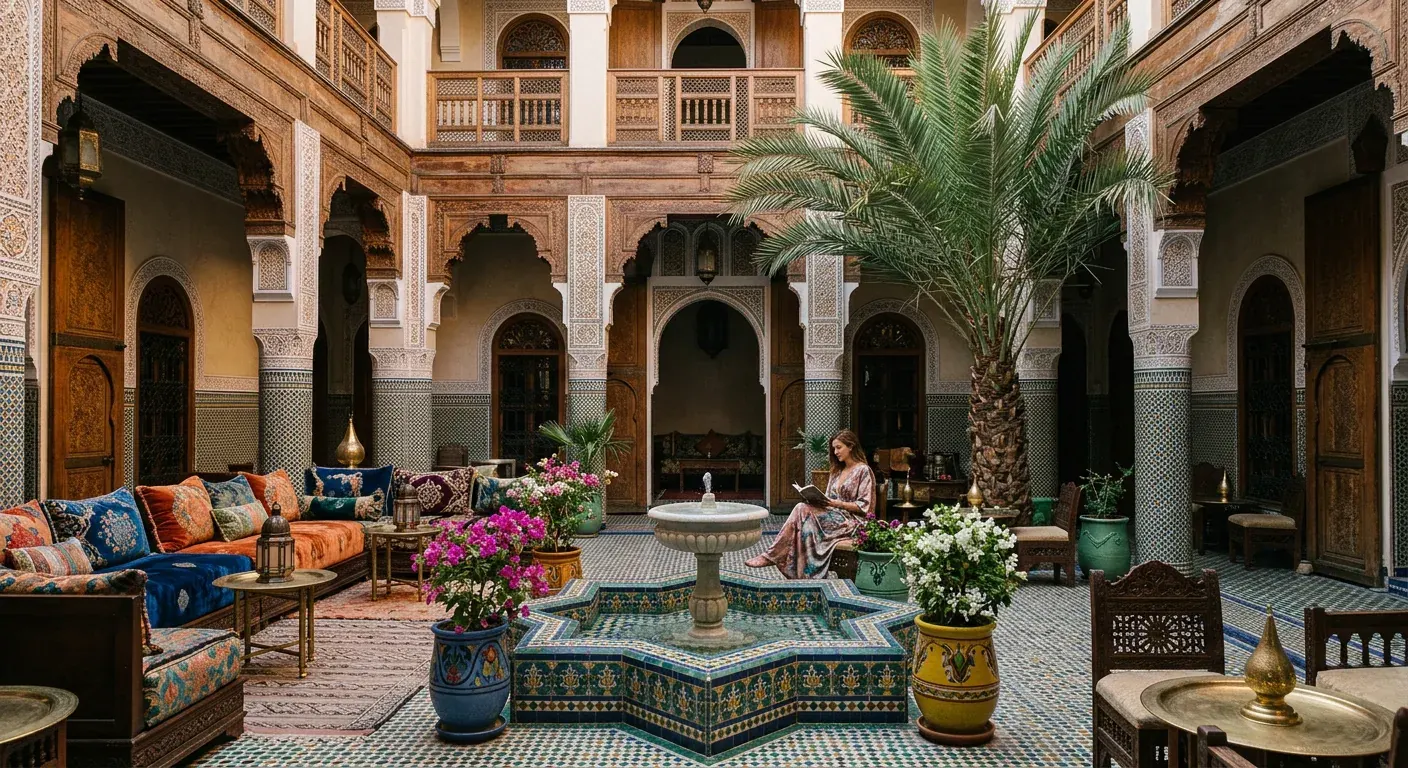
For many travellers, the riad is the defining memory of Marrakech — more so than any single monument or excursion. Yet the word now stretches from a lovingly restored seventeenth-century merchant house to a new-build that borrowed the look without the soul. Knowing what separates the extraordinary from the merely pretty is what turns a stay into something you will talk about for years.
What makes a riad a riad?
A true riad is a townhouse built around an interior courtyard — the wast al-dar — usually with a central fountain or plunge pool, a garden of citrus and olive, and suites arranged over two or three storeys around the open heart. Light pours from above; the street face is plain plaster. Everything beautiful is held within, and discovered only once the door closes behind you.
That inward design was deliberate: these were private family homes, the courtyard their cool, green, social centre. Marrakech's finest examples run two to four centuries old, raised when the Saadian and Alaouite dynasties made this a royal city. The details that reward a discerning eye — hand-cut zellige, carved plaster (stucco), painted cedar ceilings, fretworked moucharabieh screens — carry centuries of craft.
Many modern riads are new-builds or guesthouses that adopted the courtyard without the historic fabric. Some are excellent in their own right, but they are a different experience. If staying in a genuinely old, soulful house matters to you — and on a honeymoon it often does — we steer you toward thick walls, original tiling and hand-carved wood rather than smooth paint and imported ceramics.
Which quarter suits which traveller?
The best riads are all in the medina — but the quarters differ in mood, and the right one matters:
- Mouassine & Bab Doukkala: the most atmospheric quarter, rich in grand traditional riads, gathered around the Mouassine fountain and mosque and close to the dyers' souk and the Saadian Tombs. Tight, evocative lanes. Ideal for those who want to live inside the medina's pulse.
- Riad Laarous & Kennaria: calmer and more residential, a touch further from Djemaa el-Fna and pleasantly off the tourist track. A more local rhythm — lovely for a return visit, or for couples seeking quiet.
- North medina (near Bab el-Khemis): furthest from the bustle, yet home to some of the city's most architecturally remarkable restorations. For those who prize stillness and travel with a private driver.
- Near Djemaa el-Fna: the most convenient, minutes from the square, but also the liveliest — scooters, vendors and music carry late. Worth choosing a house with a roof terrace and well-insulated suites as a retreat.
What sets an exceptional riad apart?
Beyond the photographs, these are the questions that reveal a truly fine house:
- Is it owner-present or agent-run? Houses with an attentive owner tend to offer warmer service, sharper recommendations and a kept-up elegance you feel the moment you arrive.
- How intimate is it? Under ten rooms feels private; above fifteen edges toward hotel. For couples and honeymooners, an exclusive-use buy-out turns the whole house — courtyard, terrace, staff — into yours alone.
- Is there a plunge pool? Through high summer (June–August), with the city at 38–42°C, a cool courtyard pool is less a flourish than a daily refuge.
- Are the suites properly cooled? Riads stay naturally cool by design, but upper rooms warm in July and August. We confirm air-conditioning in the bedroom itself, not just the salon.
- Is the table genuinely Moroccan? The breakfast spread says much about a house — look for msemen, khobz, argan oil, amlou and fresh-pressed orange juice, and a kitchen happy to serve a candlelit dinner in the courtyard.
- How is arrival handled? The deepest riads are beyond a car's reach; a good house meets you at a nearby landmark with a porter. We arrange this seamlessly, so the final lamplit walk feels like part of the welcome.
How we place you — and why it matters
Booking direct, by email or WhatsApp, can secure a better rate than the platforms and opens a line to the house before you arrive. It also lets the right questions be asked — and the quality of the reply tells you a great deal.
When you read reviews, weight those whose priorities mirror your own; a backpacker and a couple marking an anniversary will judge the same house very differently. Look past praise for the décor to notes on quiet, on the kitchen, on how the team handled a hiccup — those reveal the real character of a place.
And if you would rather not sift through it all, we keep a closely held selection of Marrakech riads we have walked through and vetted ourselves. We match you to the house that fits your dates, your party and your idea of romance — then handle every transfer as part of a wider Morocco journey. Begin with our Marrakech destination guide and private tour options.
Frequently asked
What exactly is a riad, and how does it differ from a hotel?
A riad (from the Arabic 'riyadh', garden) is a traditional Moroccan townhouse arranged around a private interior courtyard, often with a fountain, citrus trees and a plunge pool. Where a hotel is built for scale, a riad is built for intimacy — usually five to fifteen rooms, a resident cook, and staff who greet you by name. The architecture turns inward: a discreet street wall, all the beauty kept within. For couples especially, that sense of a private world is the whole appeal.
Which neighbourhood is best for a riad in Marrakech?
The medina is the place to be — particularly the Mouassine, Bab Doukkala, Riad Laarous and Kennaria quarters, all within walking reach of the souks and ten to fifteen minutes of Djemaa el-Fna. The Hivernage and Guéliz districts of the new city hold polished hotels but few true riads, and the feeling is entirely different. For a first visit, and certainly for a honeymoon, we place you in the medina.
How do you tell a genuinely special riad from a pretty façade?
We look for owner-present houses with a personal voice rather than corporate polish, photographs of the actual courtyard and suites rather than staged mood shots, and a kitchen that earns its reputation. The decisive question is whether the riad is let to several parties at once or held for yours alone — it shapes the entire atmosphere. The properties we recommend, we have walked through ourselves.
What should a riad breakfast include?
A proper riad breakfast is one of the quiet pleasures of Morocco. Expect msemen or beghrir (semolina pancakes), warm khobz, argan oil and amlou (almond-argan paste), local honey, fresh orange juice, and mint tea or coffee — often served in the courtyard or on the roof as the city wakes. A spread of toast and jam alone is a sign of corners cut; the houses we work with set a far finer table.
Is it safe to stay in the medina in Marrakech?
Yes. The medina is well patrolled, with tourist police and licensed guides long established. The lanes can disorient on a first arrival after dark, but a good riad always sends someone to meet you — and we coordinate your airport or station transfer in advance, with a trusted driver and a porter for the final walk, so you simply arrive.
How far ahead should you reserve a riad in Marrakech?
The finest small riads — five to eight rooms with a strong following — fill months ahead for the peak windows (March–May, October–November) and over Christmas and New Year. In shoulder or low season, two to four weeks often suffices. For an exclusive buy-out of an entire riad, a favourite for honeymooners and families wanting the house to themselves, allow around six months for peak dates.
Houses we know intimately
We place you in the riad that fits — never simply the one with a free room.
Every house we recommend, our team has walked through. We know which riads are truly quiet, which kitchens reward a candlelit dinner, which hosts go quietly beyond the expected. Tell us how you imagine the stay, and we will match it.
Request an itinerary