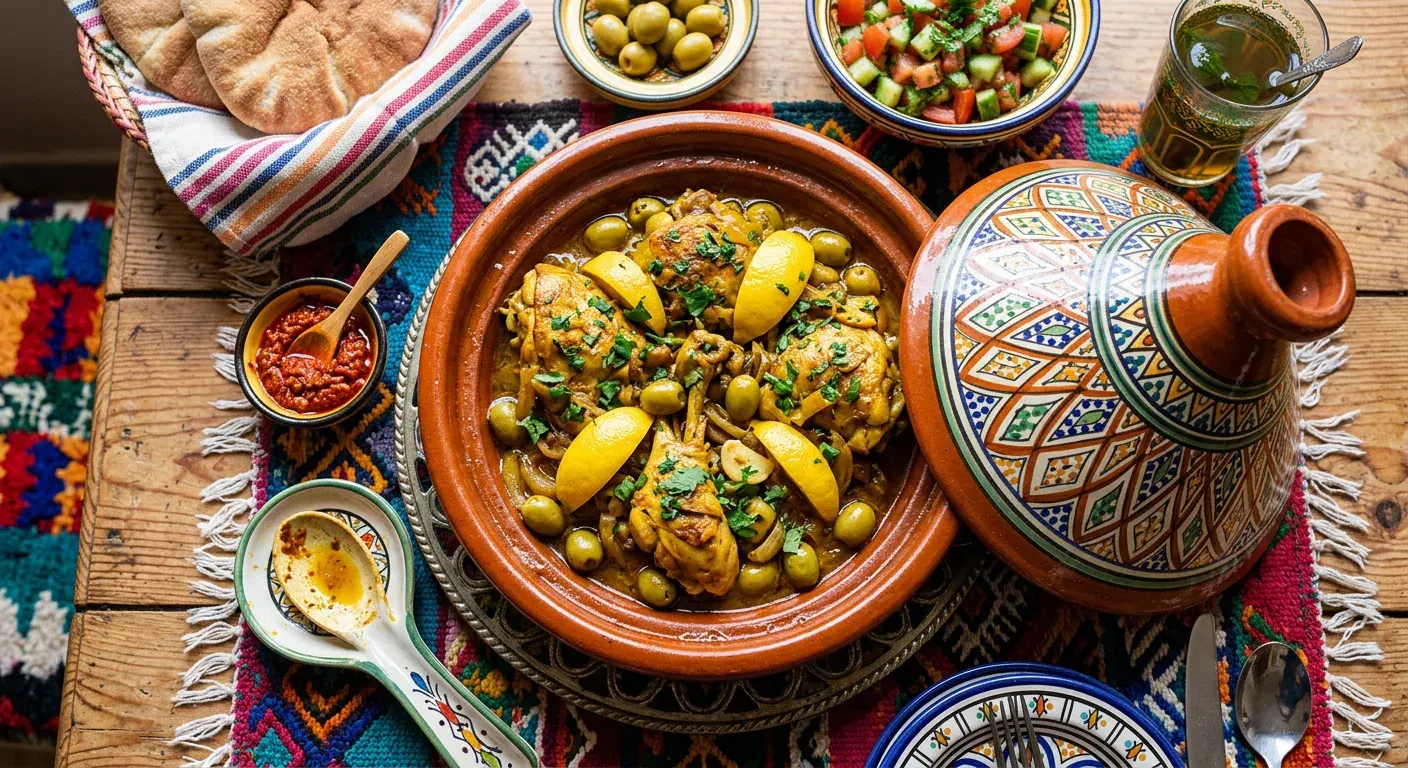
Marrakchi cuisine is rarely what visitors expect. The tagine and couscous you know from abroad are real, yes — but they sit beside dishes that seldom leave the country: slow-braised lamb perfumed with aged butter and honey, gossamer pastry folded around pigeon and almond, and a bread culture so woven into daily life that bakeries glow past midnight. Here is where to begin — and how we set the most memorable tables for you.
The dishes to seek out
Pastilla (b'stilla) is the dish guests most often call a revelation: a great round pie of wafer-thin warka, filled with braised pigeon or chicken shredded with egg, cinnamon and almonds, finished with a veil of sugar. The sweet-savoury interplay is deeply Andalusian — celebratory food, rarely made at home, and the truest test of a serious kitchen.
Mrouzia is braised lamb shoulder with smen (a pungent aged butter), honey, almonds and a layered spice blend. Traditionally an Eid al-Adha dish, it graces fine menus year-round. The sweetness is more restrained than it sounds; the smen lends a depth no other Moroccan dish quite reaches.
Mechoui — whole lamb slow-roasted in a clay oven until it falls from the bone — is one of the most satisfying meals in Morocco, served with cumin salt and eaten, traditionally, by hand. We can arrange it at its source, or reimagined at a private table. Our guides know exactly where it is finest.
The theatre of Jemaa el-Fna
At dusk the square's food stalls rise into being and run past midnight — numbered stalls, vendors calling, charcoal smoke, displays of kefta, merguez and brochettes. It is pure theatre, and the grilling, ordered directly and at an agreed price, is genuinely good. We like to weave a brief guided turn through the spectacle into an evening that ends at a far quieter, candlelit table.
Pass on the set tourist menus pressed on new arrivals; per-item prices are fair when you say what you want. The local quick bites — makouda (potato fritters) and the like — are part of the colour, best sampled with a guide who knows which stall is which.
Riad dinners and the private table
The finest medina rooms cluster around Mouassine, Rue Riad Zitoun el-Qedim and the lanes off Bab Doukkala — and a reliable sign of a serious kitchen is the absence of photographed menus at the door. Beyond them lie the city's jewel-box riad restaurants and rooftop tables, the kind reached by reservation. We hold the quiet corner for you.
The riad dinner, though, is something else entirely. Many houses serve an evening meal cooked by a neighbourhood cook who has made these dishes all her life — proper harira, couscous worked by hand, a tagine simmering since noon. It often surpasses any restaurant, and a private dinner in your own courtyard, by candlelight, is among the most romantic evenings Marrakech can offer. We weave private riad dinners into every itinerary.
Bread, olive oil and argan
Bread in Morocco is treated with reverence — leftover loaves are set aside, never thrown away. The medina's communal ferran (wood-fired oven) still bakes the morning dough families bring to its door. Few visitors find it; your guide can bring you, an unhurried and unstaged moment of the real city.
Culinary argan oil — pressed from roasted nuts — is deep and nutty over warm bread or couscous. Finest of all is amlou, a velvety paste of argan, almond and honey, a breakfast indulgence worth carrying home. Buy from a certified women's cooperative in the Mellah or souks; a private visit to one of the better presses is easily arranged.
Mint tea, coffee and fresh juice
Moroccan atay (mint tea) is gunpowder green steeped with spearmint and sugar, poured from height to crown it with foam. To accept it is a gesture of welcome; to decline in someone's home is gently impolite. In a souk café, a glass costs little and buys you a table for as long as you wish.
The juice stalls around Jemaa el-Fna press orange, pomegranate and mixed fruit to order — the orange juice exceptional. Morocco is largely dry; fine wine and spirits are served at polished restaurants and hotels rather than local cafés, and we ensure the cellar suits your evening. Read our full Marrakech destination guide.
Frequently asked
What is the one dish to seek out in Marrakech?
Mrouzia — a slow-braised lamb shoulder with smen (aged butter), honey and ras el hanout — is rarely met outside Moroccan homes and the finest Marrakchi kitchens, and we can arrange it where it is cooked best. Pastilla, the flaky pigeon-or-chicken pastry with almonds, egg and a dusting of sugar, is the other dish guests most often describe as a revelation. We build a private chef's table around both.
Is the food on Jemaa el-Fna worth the experience?
The square's stalls are atmospheric and the grilling theatrical — kefta, merguez and brochettes cooked to order over charcoal. For a discerning palate we pair a brief, guided turn through the smoke and spectacle with dinner at a refined riad afterward, so you taste the street's energy without surrendering the evening to it. Agree any stall price before you sit.
Where do you find the best dining in the Marrakech medina?
The lanes around Mouassine and Rue Riad Zitoun el-Qedim hold lovely sit-down rooms, and the Mellah near Place des Ferblantiers is known for its fried fish. Beyond these, the city's finest tables — a handful of jewel-box riad restaurants and rooftop kitchens — are best reached by reservation, which we secure for you, complete with the quiet corner table.
Are there refined vegetarian options in Marrakech?
Very much so — Moroccan cooking is naturally vegetable-forward. Zaalouk (smoked aubergine), taktouka (tomato and pepper), bissara (broad bean soup) and the meze-style 'salade marocaine' are all delicious, and a well-made vegetarian tagine is everywhere. We brief the kitchens we choose in advance, so your preferences are met with elegance rather than improvisation.
What is argan oil and where should you buy it?
Argan oil is pressed from the nut of the argan tree, endemic to southwest Morocco. The roasted, culinary oil is rich and nutty over couscous and bread; the unroasted, cosmetic oil nourishes skin and hair. Buy from a certified women's cooperative rather than a street seller, where quality and price vary widely — we can arrange a private visit to one of the better presses.
When do Moroccans dine — are the hours different from Europe?
Mealtimes run later than in northern Europe: lunch from around 12:30 to 3pm, dinner from 8pm, with locals often at the table by 9 or 10. The best riads serve dinner by reservation, frequently from 7:30pm. During Ramadan, restaurants open at iftar (sunset) and fill at once. We hold your tables in advance so the timing is never a worry.
Dine as the city truly does
Our private culinary experiences reach beyond restaurants — into homes, cooperatives and the ferran.
Morocco Honeymoons composes private culinary days in Marrakech — chef's tables, a candlelit riad dinner, a market walk with a Fassi-trained cook — for guests who want to understand what they taste, not merely photograph it.
Enquire about a food experience