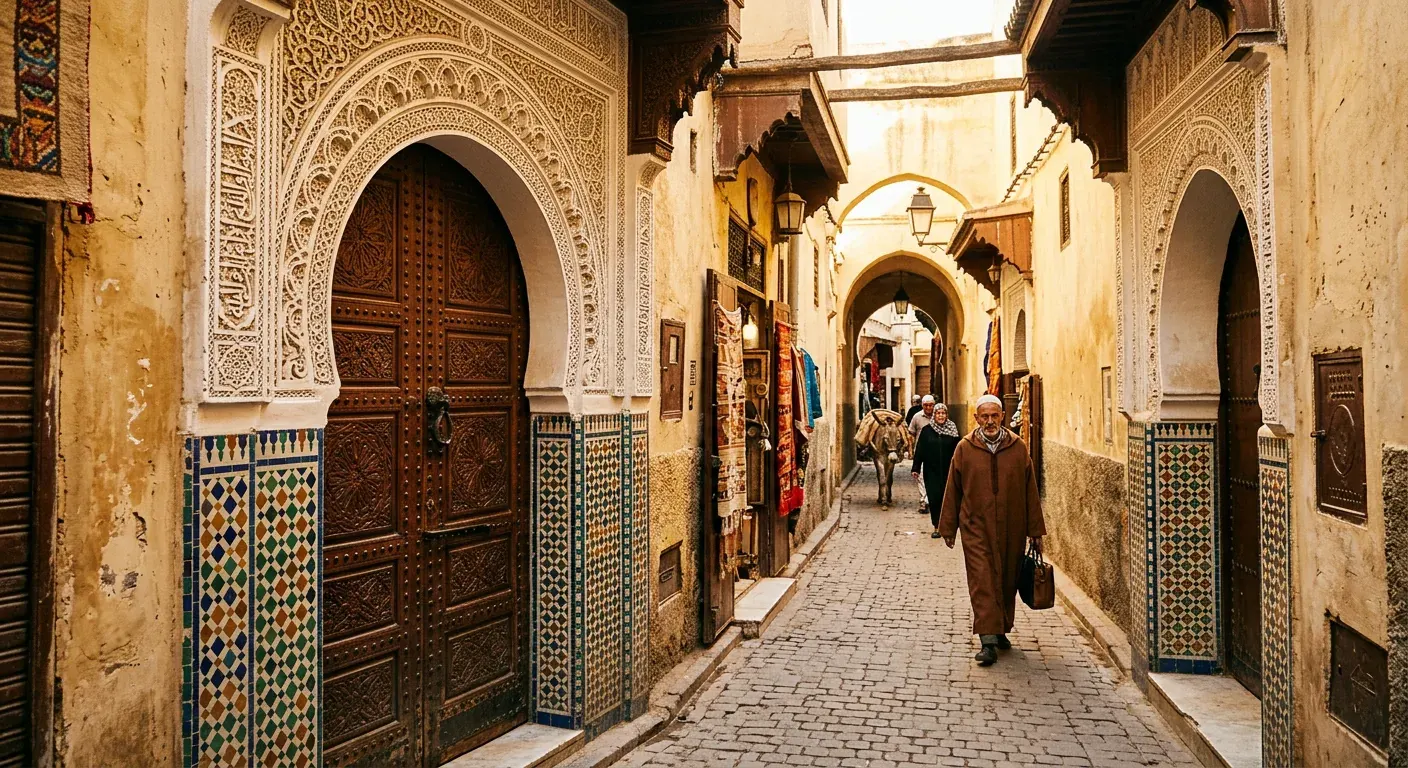
A private driver-guide in Morocco does three jobs at once. They drive you safely between the cities, the Atlas and the Sahara in a private vehicle; they guide and interpret each place — its history, its etiquette, its language; and they manage the quiet logistics that govern whether a trip flows or stalls. In practice that is the road commentary on a long mountain drive, the introduction to a weaver met by name, the table booked before you are hungry, and the hundred small frictions of an unfamiliar country resolved before they ever reach you. The role is less chauffeur than trusted companion who also happens to drive — and on a Morocco journey, it is usually the difference between a good trip and a seamless one.
Driver, guide, driver-guide: what is the difference?
The three words are used loosely, and the distinction genuinely matters when you are booking. Here is the honest version.
| Role | What they do | What they don't |
|---|---|---|
| Driver | Drives between destinations, knows the roads, handles the vehicle and luggage | Not licensed to lead or interpret monuments and medinas |
| Local guide | Licensed expert for one city or site — depth, history, navigation, access | Does not drive you between cities or across the country |
| Driver-guide | Both, in one trusted person for the whole journey — drives, interprets, orchestrates | Defers to a local licensed specialist where a medina or law requires one |
The great advantage of the combined driver-guide role is continuity. The same person for ten days learns your rhythm, your appetite for detail, when you want company on a drive and when you want silence. In the few places where a local specialist adds real depth — Fès el-Bali, the Marrakech medina, the Roman ruins at Volubilis — a good operator simply brings that specialist in for the day, then hands you back to the same familiar face for the road. You can see how we compose this in our private travel services.
What a driver-guide does, hour by hour
Stripped of the brochure language, a good driver-guide is doing four distinct things across a typical day — usually so smoothly you barely notice the work.
- Driving, calmly. Morocco's best routes are also its most demanding — the Tizi n'Tichka pass over the High Atlas, the long run to Merzouga, mountain roads with no margin for error. A driver-guide makes those drives the pleasure rather than the tax: you watch the landscape change while someone who knows every bend, checkpoint and rest stop does the work.
- Interpreting, not just translating. The real value is cultural, not linguistic. A good driver-guide reads a situation — why a price is being quoted, what a gesture means, when to accept the mint tea and when it is fine to decline — and lets you move through the country with dignity rather than guesswork.
- Opening doors. The introduction to a tannery foreman, the weaver whose rugs are real, the rooftop table with the view, the artisan's workshop that is not on any list — access in Morocco runs on relationships, and a trusted guide carries years of them. This is where the most memorable hours of a trip tend to happen.
- Orchestrating quietly. Timings so you reach the Sahara for sunset, not after dark; the medina entrance nearest your riad; the lunch that suits the day's pace; a plan reshaped on the spot when you fall for a town and want an extra night. The logistics are handled in the background so you are free to simply be present.
Do you legally need a guide in Morocco?
For most general travel and outdoor sights, no. But Morocco does license official guides, and inside the historic medinas — Fès el-Bali above all — and at major monuments, a licensed local guide is either required to enter certain sites or simply the only sane way to navigate streets built over a thousand years to disorient. On a private journey this is never your problem to solve: your driver-guide covers the road and the everyday, and a vetted, licensed specialist is arranged wherever the place or the law calls for one. What a private arrangement specifically removes is the unsettling alternative — an unvetted stranger who attaches himself in the street and calls himself a guide. For the broader picture of travelling Morocco without that friction, see our honest take on safety in Morocco.
Driver-guide vs self-driving: the honest trade-off
Self-driving Morocco is entirely possible and cheaper in headline cost. The trade-off is what it spends in return: your attention and time, poured into navigation, city parking, police checkpoints and the long Atlas and desert drives where the scenery deserves your eyes rather than the road. A driver-guide turns those drives into the journey and replaces guesswork with judgement — where to stop, where to eat, which workshop is honest. We say so plainly even when it costs us the booking: if you have generous time, base yourself in one or two cities and genuinely enjoy logistics, self-driving can be a joy. The more your trip compresses, covers the grand circuit, or simply matters, the more clearly a driver-guide earns its place. We weigh this fully in driving in Morocco and in whether a private luxury tour is worth it.
What separates an excellent driver-guide from an available one
Availability is easy to find in Morocco; judgement and trust are the rare part. The travellers who remember their guide for years tend to describe the same five qualities.
- Real, licensed knowledge — depth that comes from years and a licence, not borrowed patter repeated to every car.
- Language and tact — fluent English, usually French and Arabic too, and the cultural fluency to interpret rather than merely translate.
- A calm, safe way at the wheel — unhurried and unflappable on roads that ask a lot of a driver.
- Judgement — knowing which workshop is genuine, which table is worth it, when to add a stop and, crucially, when to simply leave you in peace.
- Discretion — the quiet resolution of changes and problems before they ever reach your day.
This is the part that cannot be bought as a commodity, and the reason the role is the quiet centre of a well-made private journey. See how it shapes a trip across our private journeys, or read what a fully private Morocco tour includes.
Frequently asked
What does a private driver-guide in Morocco actually do?
A private driver-guide in Morocco does three jobs at once: they drive you safely between cities, the Atlas and the Sahara in a private vehicle; they guide and interpret each place — its history, its etiquette and its language; and they manage the logistics that quietly govern a good trip — timings, tickets, where to stop, when to arrive, who to trust. In practice that means the school-of-the-road tour commentary on a long drive, the introduction to a weaver or a tannery foreman, the table booked before you are hungry, and the hundred small frictions of an unfamiliar country handled before they ever reach you. The role is less chauffeur, more a trusted companion who happens to also drive.
What is the difference between a driver, a guide and a driver-guide in Morocco?
A driver moves you and the luggage and knows the roads, but is not licensed to lead you through monuments or interpret them. A guide is a licensed expert for a city or site — often required by law inside the imperial medinas — but does not drive between destinations. A driver-guide combines both in one trusted person for the whole journey: they drive the long stretches and guide the everyday, then, in cities where a local licensed specialist adds real depth (Fès el-Bali, the Marrakech medina, Volubilis), a great operator brings that specialist in for the day. The benefit of the combined role is continuity — the same face for ten days builds a rapport a rotating cast never can.
Do I legally need a guide to visit monuments and medinas in Morocco?
For most outdoor sights and general travel, no. But Morocco licenses official guides, and inside the historic medinas — particularly Fès el-Bali — and at major monuments, a licensed local guide is either required or strongly advisable, both to enter certain sites and to navigate genuinely labyrinthine streets. The practical answer for a private journey is that your driver-guide covers the road and the everyday, and a licensed city specialist is arranged where the law or the place demands one. You should never be handed to an unvetted 'guide' who attaches himself in the street; that is precisely the friction a private arrangement removes.
Is a private driver-guide worth it, or should I just hire a car and self-drive?
It depends on time and temperament. Self-driving Morocco is entirely possible and cheaper in headline cost, but it spends your scarcest resource — attention and time — on navigation, parking in cities not built for cars, police checkpoints, and the long Atlas and desert drives where the scenery deserves your eyes. A private driver-guide turns those drives into the trip rather than the tax on it, and replaces guesswork with judgement: where to stop, where to eat, which workshop is real. For a short or first visit, or any trip covering the grand circuit, the driver-guide almost always earns its place.
Will a private driver-guide make my trip feel rigid or chaperoned?
A good one does the opposite. The point of the role is to remove friction so spontaneity becomes possible — to free you to change your mind at lunch and let the afternoon rearrange itself. You are never obliged to keep them at your side; many travellers want company and commentary on a drive, then privacy for a dinner or an unhurried afternoon. A well-judged driver-guide reads that, appears when wanted and recedes when not. The structure carries the logistics; you keep the freedom.
How much should I tip a private driver-guide in Morocco?
Tipping is customary and genuinely appreciated, though never built into a quoted price. As an honest frame rather than a rule, many travellers give in the region of US$10–20 per day for an excellent private driver-guide, more for an exceptional one or a longer journey, and a separate, smaller gratuity to any local city specialist who joins for a day. Tip in dirhams where you can, discreetly and directly. For the fuller picture, our guide to tipping in Morocco sets out who to tip and roughly how much across the whole trip.
What makes an excellent driver-guide, as opposed to merely an available one?
Five things: a licence and genuine knowledge, not borrowed patter; fluent English (and often French and Arabic) with the tact to interpret culture, not just translate words; a safe, calm, unhurried way at the wheel on demanding roads; the judgement to know which workshop is honest, which table is worth it and when to simply leave you in peace; and discretion — the quiet handling of changes and problems before they reach you. Availability is easy to find in Morocco. Judgement and trust are the rare part, and the whole reason the role transforms a journey.
The same trusted face, the whole journey
Tell us your trip — we will pair you with a driver-guide who fits it.
Share your dates, your interests and your sense of pace, and we will compose a fully private journey around one calm, knowledgeable companion for the road — with a licensed city specialist wherever the place deserves one, and a fully costed proposal with no surprises.
Request a tailored quote