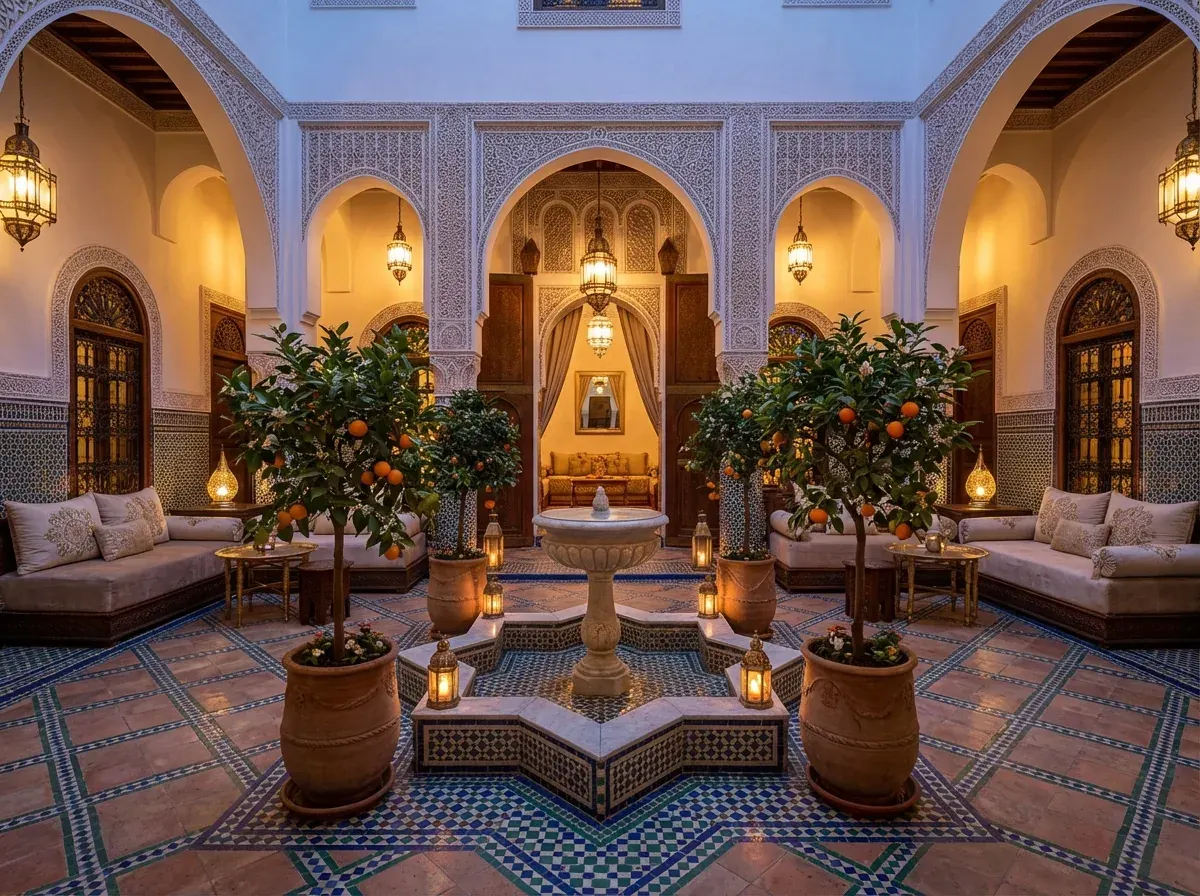
Yes — Morocco is a wonderful honeymoon, and for most couples the answer to the three questions is this: plan on seven to ten nights, and go to more than one of the three — ideally Marrakech to begin, the Sahara for the one unforgettable night, and the coast to wind down. Few countries let you wake in a rose-scented riad courtyard, sleep under the desert stars, and lunch over the Atlantic within a single week. The only real catch is distance: Morocco is large and its medinas are made to disorient, so a honeymoon here is far softer when someone else drives, navigates and opens the doors. Below, an honest, romantic guide to shaping yours.
Is Morocco actually good for honeymoons?
It is one of the most quietly romantic places within easy reach of Europe, and a rewarding long-haul trip from North America or further afield. The romance is not bolted on; it is in the architecture and the rhythm of the country. A riad — a traditional house turned inward around a private courtyard — is intimate by design: a handful of rooms, a still pool, a roof terrace for dinner just for two. The Sahara delivers a sense of awe that is hard to manufacture anywhere else. And the hospitality is genuine and discreet, so a couple is left to themselves when they want to be. The honest counterweight is that the same scale that makes Morocco thrilling — the drives, the labyrinthine cities — is also what can tire a honeymoon if it is left unmanaged.
How many days do you need? The 7–10 night shape
Seven to ten nights is the honeymoon sweet spot. Less than that and the driving starts to eat the days you came for; much more and you can slow right down or add Fès. Here is a sample seven-to-ten night shape that we return to again and again, because it rises to a peak in the desert and softens by the sea.
- Nights 1–3 — Marrakech. Settle into a palace riad. Gardens, the souks at your own pace, a couple's hammam, rooftop dinners, and a High Atlas day (Imlil or the Ourika valley, around an hour from the city) when you want mountain air.
- Night 4 — over the Atlas to the south. The drive from Marrakech across the Tizi n'Tichka pass to Aït Ben Haddou and the Dades or Skoura is roughly five to seven hours with stops — long, but spectacular, and the reason a chauffeur matters. An overnight in a Skoura or Dades kasbah breaks it beautifully.
- Nights 5–6 — the Sahara. Reach Erg Chebbi (Merzouga) and spend a night — two if you can — in a luxury camp. Camels at golden hour, dinner under the stars, sunrise over the dunes. This is the centrepiece most couples remember most.
- Nights 7–10 — the exhale. Return toward Marrakech and finish on the Atlantic at Essaouira (around two and a half to three hours from Marrakech) for sea air, fresh seafood and nothing to rush for — or simply add slow nights back in the city.
If you only have five nights, drop the southern overnight and the coast, and do Marrakech plus a tighter desert run, or Marrakech plus Essaouira. For the full route logic, our classic 7-day Morocco itinerary walks it day by day.
Where to go: Marrakech, the Sahara, or the coast?
Think of the three as movements in one piece of music rather than alternatives. Most honeymoons want two or three of them, in the order below.
| Region | The romance of it | Best for |
|---|---|---|
| Marrakech & the High Atlas | Palace riads, gardens, hammams, rooftop dinners; mountains an hour away | The opening — energy, beauty, ease of arrival |
| The Sahara (Erg Chebbi / Erg Chigaga) | Dunes at sunset, dinner and stars, silence, sunrise over the sand | The centrepiece — the one night you'll never forget |
| The Atlantic coast (Essaouira) | Sea air, ramparts, fresh seafood, an unhurried, salt-air calm | The exhale — winding down before home |
| Fès & the north (optional) | The deepest medieval medina, artisans, a more contemplative mood | Couples with 10+ nights who love history and craft |
If you must choose only two, the strongest honeymoon pairing is Marrakech and the Sahara; if you want softness over awe, swap the desert for Marrakech and Essaouira. Browse how we compose these as private journeys, or see the romantic moments themselves in our guide to a honeymoon in Morocco.
Riads vs desert camps — where should you sleep?
Not a choice — a sequence. Use riads for the cities and the coast, and a camp for the one or two desert nights. A riad gives you privacy, a courtyard and a roof terrace and the feeling of an exquisite private home; a luxury desert camp gives you a proper bed and an en-suite tent for a single night of dunes, fire and stars. Trying to camp for several nights tires most honeymooners; one perfect night is the romantic high, not the whole trip. For the detail, see the best riads in Marrakech and what staying in a desert camp is really like.
When should you go?
Spring (March to May) and autumn (September to November) are the most reliably lovely — warm days, cool desert nights, gardens at their best and the Sahara comfortable by day. Winter brings the clearest desert skies and a festive, mild coast, but genuinely cold high-altitude nights. High summer is intensely hot inland, which makes a coastal honeymoon around Essaouira far kinder than a desert one. If your wedding fixes the month, that is no obstacle — we simply shape where in Morocco you spend it around the season. Our seasonal packing list helps once the dates are set.
Is it safe and comfortable for couples?
Yes — Morocco is broadly safe and warmly welcoming, and discretion in the riads and camps is the norm. A little modesty with public affection is courteous to local custom, but within courtyard walls, in the dunes and along the coast couples are entirely at ease. The friction a honeymoon most wants to avoid — touts, a disorienting medina, long unmanaged transfers — is precisely what a private plan removes, leaving the trip as soft and unhurried as it should be. If you want the fuller picture, read our honest is Morocco safe guide.
What does a Morocco honeymoon cost?
It depends heavily on the standard of riad, the camp and the season, so we cost every honeymoon as a tailored quote rather than a fixed package. As a frame only: a comfortable independent honeymoon runs roughly US$120–200 per couple per day, while a fully private, chauffeur-guided honeymoon with luxury riads and a premium desert camp typically begins around US$500–800 per couple per day all-in, rising with palace riads and exclusive camps. For how the daily numbers are built up, see the real daily costs of Morocco, and whether a private trip earns its place in our piece on whether a luxury Morocco tour is worth it.
So — how do you decide?
Start from your nights and your appetite for driving. With five nights, hold to two places. With seven to ten, do the full city–desert–coast arc and let the desert night be the peak. Travel in spring or autumn if you can, and around the season if your date is fixed. Sleep in riads, with one or two nights under canvas. And on a honeymoon above all, choose fewer places held longer over a checklist — the slow mornings are the point.
If you would like it shaped around your dates, tell us when you marry and how long you have, and we will return a fully costed, private honeymoon proposal with real prices and no surprises — see our private journeys or simply tell us about your honeymoon.
Frequently asked
Is Morocco a good place for a honeymoon?
Yes — Morocco is one of the most romantic honeymoon destinations within easy reach of Europe, and a rewarding long-haul choice from further afield. In a single short trip a couple can have rose-petal turndown in a hushed riad courtyard, a private dinner under the Sahara stars, a couple's hammam, and a slow lunch over the Atlantic — landscapes and moods that most countries can only offer one of. It is warm, hospitable and unusually photogenic, and the privacy of a riad or a small desert camp makes intimacy easy. The one honest caveat is logistics: distances are long and medinas are deliberately disorienting, so a honeymoon here is far sweeter when someone else handles the driving and the doors.
How many days do you need for a Morocco honeymoon?
Seven to ten nights is the sweet spot. Five nights can work if you keep it to one city and one escape — Marrakech with two nights in the Sahara, or Marrakech with the coast — but it will feel brisk. Seven nights lets you pair a great city, a proper desert night and a coastal or mountain wind-down without the days dissolving into driving. Ten nights is the loveliest shape of all: it adds a second base, a day to do absolutely nothing, and the slow mornings a honeymoon is really for. Two weeks suits couples who also want Fès or the southern oases. The thing to avoid is trying to see everything in a week; on a honeymoon, fewer places held longer always beats a checklist.
Where should we go on a Morocco honeymoon — Marrakech, the Sahara, or the coast?
The honest answer is some of each, in that order of priority. Marrakech is the natural opening: a base of palace riads, gardens, hammams and rooftop dinners, with the High Atlas an hour away. The Sahara — Erg Chebbi near Merzouga or the wilder Erg Chigaga near Zagora — is the romantic centrepiece, a night of dunes, silence and stars under canvas. The Atlantic coast, usually Essaouira, is the exhale: sea air, fresh seafood and nothing to rush for. A classic honeymoon strings them together — city, desert, coast — so the trip rises to a peak in the dunes and softens by the sea. Which two or three you choose depends on your time and your taste for driving.
Should we stay in a riad or a desert camp?
Both, on different nights — they are different pleasures, not competing ones. A riad is a traditional house built around a private courtyard, often with a plunge pool, a roof terrace and only a handful of rooms; the best feel like staying in a friend's exquisite home, and they are wonderfully private and romantic for a city stay. A luxury desert camp is for one or two nights only — proper beds and rugs and an en-suite tent, dinner under the stars, sunrise over the dunes — and it is the moment most couples remember most. The ideal honeymoon uses riads for the cities and the coast, and a camp for the single magical desert night in between.
When is the best time of year for a Morocco honeymoon?
Spring (March to May) and autumn (September to November) are the most reliably beautiful — warm days, cool desert nights, gardens and valleys at their best, and the Sahara comfortable by day. Winter is romantic for the clearest desert skies and a festive coastal stay, though high-altitude nights are genuinely cold. High summer is intensely hot inland, which makes a coastal honeymoon around Essaouira far more comfortable than a desert one. If your wedding date fixes the month, that is fine — we simply shape where in Morocco you spend it around the season rather than fighting it.
Is Morocco safe and comfortable for couples, including honeymooners?
Yes. Morocco is broadly safe and warmly welcoming to couples, and discretion in the riads and camps is the norm. Public displays of affection are best kept modest out of courtesy to local custom, but couples are entirely at ease behind the courtyard walls, in the dunes and along the coast. The everyday friction a honeymoon wants to avoid — persistent touts, the disorientation of a vast medina, the long transfers — is exactly what a private plan removes, so the trip feels like the soft, unhurried thing it should be rather than a logistical exercise.
How much does a Morocco honeymoon cost?
It varies widely with the standard of riad, the desert camp and the season, so the honest answer is a tailored quote rather than a fixed figure. As a frame only: a comfortable independent honeymoon runs roughly US$120–200 per couple per day, while a fully private, chauffeur-guided honeymoon with luxury riads and a premium desert camp typically begins around US$500–800 per couple per day all-in, and rises from there with palace riads and exclusive camps. Against a comparable private trip in France or Italy, Morocco remains remarkable value at the top end — which is part of why it has become such a popular luxury honeymoon.
A honeymoon shaped around the two of you
Tell us your dates — we'll compose the city, the desert and the coast.
Share when you marry, how many nights you have and your sense of pace, and we'll return a fully costed private honeymoon proposal — riads, a desert night and the coast, held in the right order — with real prices and no surprises.
Plan our honeymoon